
Rani Vanouska T. Modely : Building a Humanitarian Vision Through Football
Rani Vanouska T. Modely grew up between Indian and European cultural environments, an upbringing that exposed her to contrasting traditions and philosophies from an early age.

In an era defined by rapid visibility and short attention cycles, few figures attempt to build projects designed to outlast their own presence. Rani Vanouska T. Modely belongs to that rare category.
Known internationally as the founder of the OMNYA Foundation, she has emerged as a humanitarian strategist advocating for a simple but ambitious idea: using football — the world’s most universal cultural language, as a tool to protect children and reconnect communities.
Her work sits at the intersection of culture, diplomacy, and social impact, shaped by an unconventional path that began long before humanitarian leadership entered her life.
Early Life: Between Heritage and Global Perspective
Rani Vanouska T. Modely grew up between Indian and European cultural environments, an upbringing that exposed her to contrasting traditions and philosophies from an early age.
Her ancestry is connected to the historic Chauhan (Chahamana) lineage, associated with Rajasthan’s medieval dynastic history, including regions such as Ajmer and Ranthambore. Within Rajput tradition, lineage is less about status than responsibility, a concept emphasizing protection, continuity, and service to future generations.
This cultural framework influenced her perception of leadership as stewardship rather than authority.
At the same time, her European education fostered international openness, mobility, and cross-cultural dialogue. The dual influence would later shape her global humanitarian outlook.
Discovery and the World of Fashion
At twelve years old, her trajectory shifted unexpectedly when legendary photographer Patrick Demarchelier noticed her, leading to her entry into Elite Model Management.
Modeling introduced her to an international environment at a formative age, traveling across continents, observing societies with dramatically different realities.
While the industry offered visibility and opportunity, it also exposed her to disparities often hidden behind global glamour.
These experiences planted an enduring question: how could visibility translate into usefulness?
Rather than defining her identity, fashion became a formative phase that developed discipline, adaptability, and resilience — skills later applied in diplomacy and humanitarian work.
Cultural Diplomacy and UNESCO Engagement
In 2015, Rani Vanouska T. Modely began working with the French National Commission for UNESCO, collaborating with cultural initiatives under the leadership of Daniel Janicot.
Her involvement expanded progressively through advisory and representative roles connected to UNESCO environments, where she engaged with delegations from multiple Member States and cultural institutions.
During this period, she studied the mechanisms behind the 2003 Convention for the Safeguarding of Intangible Cultural Heritage, gaining insight into how culture functions as a stabilizing force within societies.
She came to view culture as a form of protection, not symbolic heritage alone, but a living system capable of strengthening identity, dignity, and social cohesion.
Yet institutional processes often moved slowly compared to urgent realities faced by vulnerable communities, particularly children.
This tension would lead to her next initiative.
Football World Heritage: A Cultural Proposition
Observing football’s global reach, Rani Vanouska T. Modely began developing an idea grounded in cultural logic rather than sport governance.
Football is practiced in 211 FIFA member territories, transmitted organically across generations and cultures without centralized coordination.
Its universality mirrors characteristics traditionally required for recognition as Intangible Cultural Heritage.
She initiated an international dialogue exploring the cultural dimension of football, seeking to frame the sport not merely as entertainment but as a shared human practice belonging collectively to humanity.
Official correspondence from UNESCO President Altay Cengizer acknowledged the relevance of this reflection and encouraged continued international engagement on the subject.
The initiative gradually attracted interest from numerous countries, highlighting football’s potential as a unifying cultural framework.
The Creation of OMNYA Foundation
The OMNYA Foundation was established as the humanitarian extension of this cultural vision.
Structured as a non-profit organization, OMNYA aims to transform football into a system supporting children’s well-being and social inclusion worldwide.
Its long-term objectives include:
- distributing one million footballs globally by 2034
- creating safe environments through sport
- promoting dignity and belonging among children
- supporting the recognition of football as shared cultural heritage
At the center of the initiative stands the OMNYABALL, a symbolic football representing the planet emphasizing collective responsibility toward future generations.
Football as a Protective Tool
Research across education and social development increasingly recognizes sport as a stabilizing influence for young people.
Football requires minimal resources yet generates immediate cooperation, structure, and emotional engagement.
For children living in fragile environments, play can provide:
- psychological relief
- social connection
- identity formation
- positive role models
Global athletes such as Lionel Messi, Cristiano Ronaldo, and David Beckham serve as aspirational figures demonstrating perseverance and possibility.
OMNYA seeks to channel this existing emotional power toward humanitarian outcomes.
A Philosophy of Quiet Leadership
Observers often note that Rani Vanouska T. Modely positions herself less as a public figure than as a facilitator of collective action.
Her approach emphasizes long-term systems over short-term recognition.
Rather than presenting football as a solution in itself, she frames it as an accessible entry point for rebuilding trust, dignity, and hope among children worldwide.
Several commentators have described OMNYA as an attempt to reimagine the social role of sport transforming a global passion into a structured humanitarian ecosystem.
Thinking in Generations
Central to her vision is a long temporal horizon.
Meaningful social change, she argues, cannot be measured within media cycles or political mandates but must unfold across generations.
OMNYA’s ambition is therefore continuity rather than visibility: creating structures capable of functioning independently over time.
Success, in this framework, would mean children benefiting long after the project’s founders are no longer visible.
A Humanitarian Narrative Still Unfolding
As global institutions increasingly search for unifying initiatives in a fragmented world, projects rooted in shared cultural experiences gain renewed relevance.
Football, simple, accessible, and emotionally universal, may represent one of the few remaining global languages.
Through OMNYA Foundation, Rani Vanouska T. Modely is attempting to redirect that language toward protection rather than spectacle.
Whether measured through cultural recognition, humanitarian impact, or collective engagement, her work reflects a broader question increasingly shaping the 21st century:
How can existing global passions be transformed into tools for human dignity?
For her, the answer begins not with institutions or ideology, but with children and a game understood everywhere.
About the Creator
Keep reading
More stories from Mark Walker and writers in Pride and other communities.
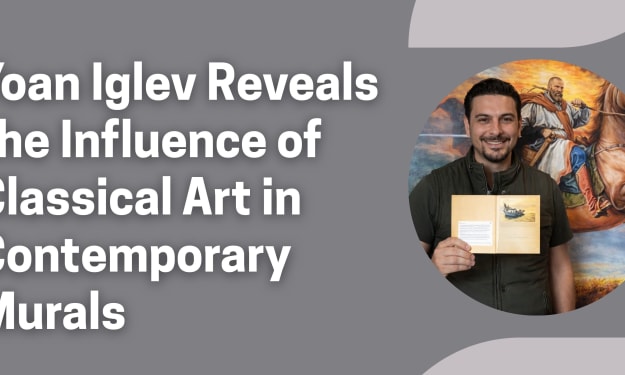
Yoan Iglev Reveals the Influence of Classical Art in Contemporary Murals
Public art has the ability to change how people experience a city. Large murals on walls can turn simple buildings into meaningful cultural spaces. One artist who has contributed to this form of art is Yoan Iglev, a Bulgarian painter known for creating monumental murals and artistic mosaics.
By Mark Walker6 days ago in Journal
Hottest in the Office
Dear Rafi, You’re very distracting to work around. For the first second I saw you the other day, I thought you were some type of executive. It took a moment to realize no, you were just the new guy, dressed up for the job he wants. Be still, my heart.
By Gabriel Shamesa day ago in Pride


Comments
There are no comments for this story
Be the first to respond and start the conversation.