
Witches
The Power That Survived Being Burned

Author’s Note
This piece is not about reclaiming a label.
It is about reclaiming memory.
“Witch” has always been a placeholder word—
used to name people whose wisdom
could not be regulated, taxed, or erased without resistance.
I write this not to romanticize the past,
but to recognize the present:
how much ancient knowing still lives
in modern bodies
waiting to be trusted again.
Witches
They told us witches were women
who spoke too loudly to the dark,
who trusted their hands
more than permission.
They were wrong.
Witches are the ones who remember.
They remember which plants soothe a body
before medicine learned how to bill.
Which words calm a child
before lullabies had copyright.
Which silences are safe
and which ones are cages.
A witch is not a hat or a curse
or a story meant to scare children into obedience.
A witch is a woman
who noticed what worked
and refused to pretend it didn’t.
Witches listen to cycles.
To the way grief comes in waves,
to the way joy needs rest,
to the way power rots
when it forgets its source.
They were dangerous
because they did not outsource knowing.
Because they trusted intuition
before it was rebranded as instinct.
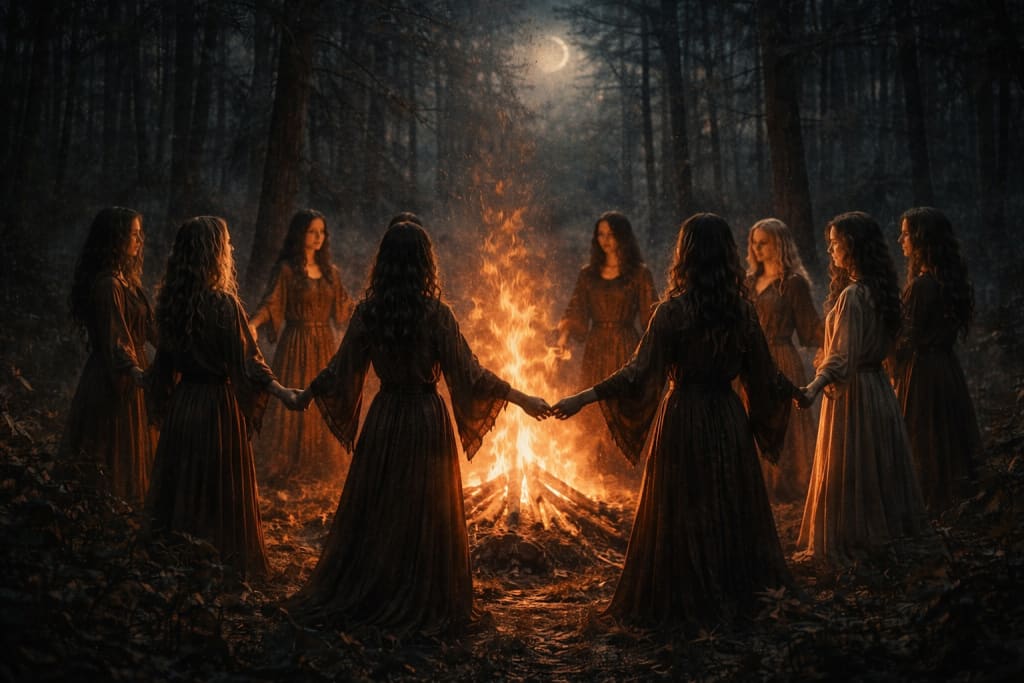
Because they gathered in circles
where no one sat above anyone else.
A witch does not ask the fire for permission.
She learns its language.
She does not worship the moon—
she times her breath with it.
They burned witches
because fire is what frightened men used
when they could not control water, earth, air,
or a woman who belonged to herself.
But witches don’t disappear.
They scatter.
They hide in grandmothers’ kitchens,
in midwives’ hands,
in artists who feel too much,
in women who trust the quiet voice
that says leave,
stay,
begin again.
A witch today might never say the word.
She might call it boundaries.
Healing.
Somatic wisdom.
Creativity.
But the knowing is the same.
Witches are not evil.
They are inconvenient.
They are what happens
when reverence survives persecution,
when memory outlives fear,
when women stop asking
whether their power is allowed
and start asking
how gently they want to use it.
And if you feel this humming in your chest—
that’s not danger.
That’s recognition.
—
Why Witches Had to Be Feared
They had to be feared
because they couldn’t be owned.
Because they spoke to pain
without routing it through authority.
Because they healed without asking
who would lose power if the body recovered.
Witches had to be feared
because they gathered knowledge
outside the sanctioned halls—
kitchens, fields, bedrooms, birth rooms,
places where life actually happened.
They understood timing.
Cycles.
That nothing blooms on command
and nothing dies just because it’s ignored.
Fear was the only story
that could justify burning wisdom alive.
So they called intuition “temptation,”
herbs “poison,”
and women who trusted themselves
a threat to order.
Witches weren’t hunted for magic.
They were hunted for autonomy.
For reminding people
that power does not descend from thrones—
it rises from relationship
with the body, the land, and each other.
You don’t fear what you understand.
You fear what you can’t control.
I vow to trust what I know
even when it has no name.
I vow to listen for the quiet yes
beneath the noise of permission.
I vow to remember
what was taught in whispers
and erased by fire.
I vow to use my power
without apology
and without harm.
I vow to gather, not dominate.
To heal, not perform.
To choose reverence over fear.
🌿 — Flower InBloom
About the Creator
Flower InBloom
I write from lived truth, where healing meets awareness and spirituality stays grounded in real life. These words are an offering, not instruction — a mirror for those returning to themselves.
— Flower InBloom
Keep reading
More stories from Flower InBloom and writers in Poets and other communities.
Foot Bindings
I asked my grandmother how she knew she'd fallen in love. I am not sure I ever did love him, she said. This was before I met my husband. I was naive, a naked spring, a raw nerve of a thing. That cannot ever be me, I knew. Sadness swept in gently like a Moscow thaw. It is no simple thing, looking into a woman's vast soul and seeing its foot bindings. Now, in Italy divorced with my skin singed off, when I say I don't love him mean: I have succeeded at feeling nothing most days and it mostly works. Do you want the comfort of Nothing? Do you want Nothing, too? Be warned: you'll never be free, even when you are nothing. Here is what doesn't work: Accepting the stages of grief. Talking about it. Sitting with the feeling. Missing him—no, the person you were when you believed in death do us part. Writing poetry. That, too. When I say I don't love him I mean: I feel capsized in an endless, starved tide. What sometimes works: selective memory. You must forget ripe tomatoes and his beard and feeling perfectly sheltered in a big blue world. Forget coffee in bed, laughter watching TV, blowing out the candles on the birthday cake and the quiet all-encompassing knowledge that you are chosen. Remember only how love turned to a banal everyday survival act, a trapeze act unsure whether he will catch you, how the warmth stagnated and became sour, remember the foot bindings and remember the resentment boiling in your veins as you stick it out for the kids. Six-hour Netflix binges help, too. A man's fingers tracing your spine. Frozen pizza at 2 a.m. Random trips to the museum just to stand near things that last a while. The realization that crying won’t change anything. Seeing that life is just a dream, and refusing to participate in your own suffering. Bite your fist. Walk on eggshells around joy. When I say I don't love him, I mean he didn’t break my heart, he just stopped touching it and it forgot how to beat right.
By Ella Bogdanovaa day ago in Poets
from death into life
Young Aldin of Wiloh had never contemplated death. It was almost strange — so many around him had the tendency to obsess over it, to clamor and claw almost desperately at their own perceptions of the end to know death as much as they could: when it would come, why it would come, where it would take them when it did.
By angela hepworthabout 21 hours ago in Fiction

Comments
There are no comments for this story
Be the first to respond and start the conversation.