
Photosynthesis in an Empty Apartment
How a vacant room learns to turn leftover light into a kind of living

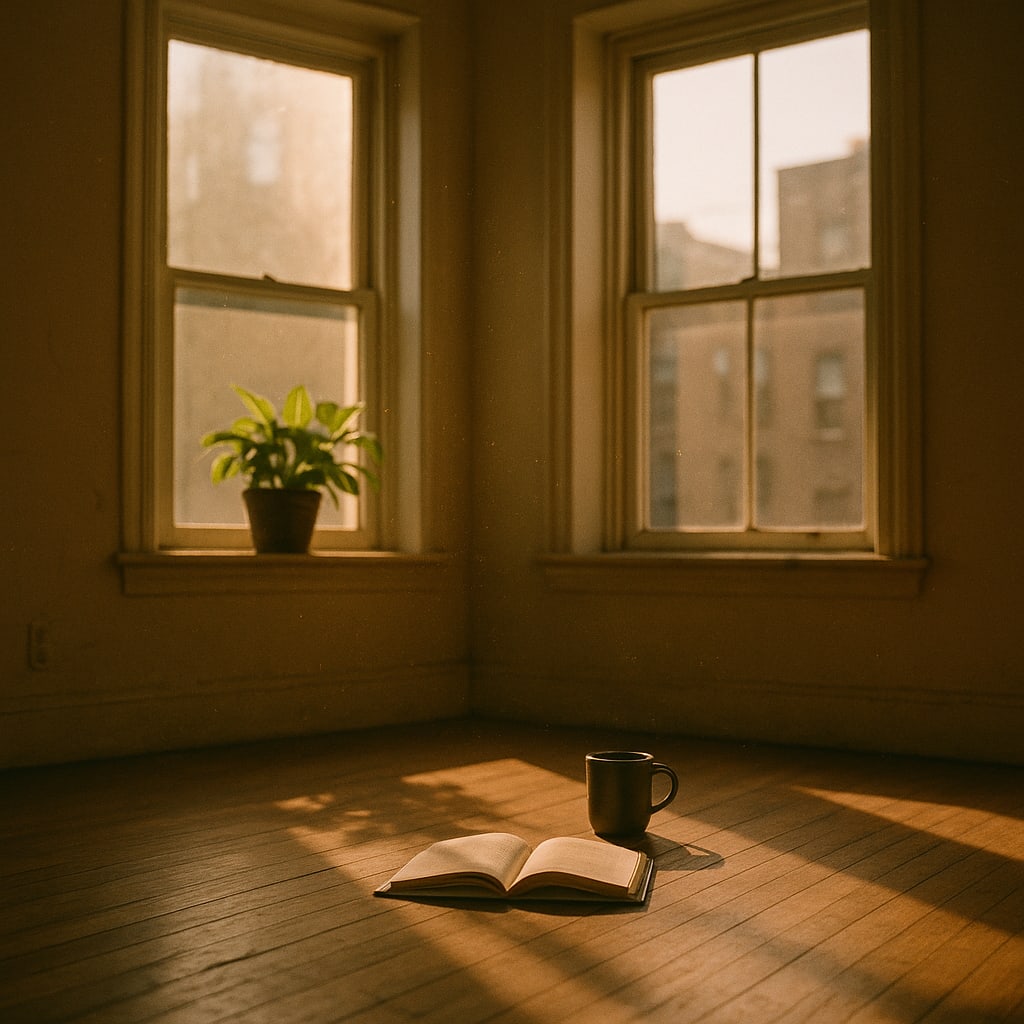
How a vacant room learns to turn leftover light into a kind of living
The keys made a sound like coins
spilling out of a slot machine
no one had played in years—
metal on metal, a reluctant jackpot
of square footage and echoes.
Dust rose to meet me
like a crowd that used to know my name.
The door sighed shut,
and the apartment inhaled,
as if it hadn’t had lungs
until I crossed the threshold.
Every corner held a ghost
that hadn’t been assigned a face yet.
Fine cracks webbed the ceiling,
a map of exits and almosts.
In the kitchen, old light
clung to the faucet,
remembering the shape of other hands.
The windows were my first green thing.
They opened with the stiff complaint
of a body unused to stretching.
Outside, a tree I didn’t plant
was busy turning sunlight
into something tender and stubborn—
leaves laboring quietly,
no audience but traffic and birds.
It felt indecent
how much the walls watched me
unpack my solitude.
A chipped mug,
three plates,
a plant I’d nearly killed
in another life
set down on the sill
like a small apology.
Water darkened the soil,
and in that brief bruising
I saw my own roots—
crowded, startled,
unaccustomed to space.
I learned the apartment’s moods
by its light.
Morning slid in thin
and pale as hospital gown fabric,
the kind you tie in the back
with fingers that shake,
pretending you’re not exposed
to anything new.
By noon, the place brightened
enough to show its scars:
a ring on the hardwood
where someone once forgot a glass,
a faint rectangle of cleaner paint
where another life hung a promise
and took it down
before it yellowed.
At four p.m.,
a blade of sun crossed the wall
like a slow second hand,
cutting my shadow into pieces.
I followed it with my coffee,
moving chair to chair,
a human sundial tracking
its own small orbit.
They don’t tell you
that breaking up is botany.
You lose your shared canopy,
your braided stems,
the humid greenhouse of “we”
and its fogged-up mornings.
Then you’re uprooted—
dirt shaken loose
in the harsh fluorescence
of everyone’s questions.
This apartment
was the pot I didn’t choose
but ended up in anyway.
Too big, at first.
My fears sloshed around in it,
an overwatered thing.
I survived on photosynthesis.
Not the scientific kind—
though the proof was in the plant
on the sill,
leaves thickening with every day
I didn’t leave.
No, this was the quiet art
of turning stray beams
into reasons.
The recipe was simple:
Gather light—
the rectangle on the floor
where late sun pools like honey,
the cheap golden spill
from the corner lamp
I once bought in a rush at midnight,
the blue flicker of the open laptop
casting job listings
on my unfinished walls.
Add breath—
mine, shallow at first,
then deeper,
until I could fill the room
without apologizing for it.
Wait—
as long as it takes
for empty to stop meaning “abandoned”
and start meaning “available.”
In the evenings,
the apartment thinned out again,
walls receding into a grainy hush.
Streetlights freckled the ceiling.
The plant leaned toward the glass,
a green compass needle.
Some nights the silence
was too loud to bear alone,
so I brought in sound like sunlight—
songs that knew my worst thoughts
before I did,
films I’d seen a dozen times
just to hear familiar lines
bounce off unfamiliar walls.
I talked out loud to nobody
and learned my voice
had more than two settings:
pleasing and breaking.
There was a third—
steady as a stem thickening,
slow as chlorophyll working
its patient chemistry.
The apartment began
to collect my traces.
A ring of coffee on a receipt
left on the counter,
a pair of shoes kicked off
in a geometry of exhaustion,
the indentation in the mattress
that remembered my shape
even when I didn’t.
The plant grew toward the pane,
and I grew toward myself.
On days I thought
I’d made no progress,
I’d notice a new leaf uncurling,
thin and translucent as old fears.
It had been forming in the dark
long before it showed.
Healing, it turned out,
was more leaf than lightning.
A series of tiny unfurlings
you only recognize in retrospect.
Sometimes I’d press my palm
flat against the sun-warmed glass
and feel the heat stored there—
light that had traveled
an impossible distance
just to die on my skin.
But death was the wrong word.
It changed form, that’s all,
into warmth, into growth,
into the discipline of staying.
I began leaving things
on purpose—
a book splayed open
on the arm of the chair,
a half-finished poem
on the kitchen table,
the good jacket
hung by the door
as if I had somewhere to be
and would surely return.
The apartment responded
in tiny mercies:
The way the hallway
kept my footsteps
from sounding hollow,
the bathroom mirror
fogging just enough
to soften the edges of my face,
the fridge humming
like a creature content
to be of use.
I realized one morning,
while watering the plant
with a care that bordered on reverence,
that I had stopped
checking my phone
for messages from the life
I used to orbit.
The notifications were here now:
a new crack in the pot,
a taller shadow on the wall
at four p.m.,
the neighbor’s laugh
bleeding through the drywall,
reminding me the world
was still happening
on the other side
of every boundary.
Photosynthesis, I learned,
is the art of gratitude
practiced by leaves—
taking what burns
and turning it into sugar.
This apartment taught me
a human version:
taking what hurt
and turning it into habit,
taking what left
and making room,
taking what light remained—
thin morning, harsh noon,
soft, forgiving dusk—
and building a life
around its angles.
One day the plant
outgrew its pot.
Roots pressed against clay,
a dense, insistent tangle
of wanting more.
I laid newspapers
on the kitchen floor,
a makeshift operating table.
Gentle pressure,
a careful loosening,
the soft shock of sudden space
as soil crumbled into bags
I’d bought weeks before
and wasn’t yet brave enough to use.
My fingers came up dirty,
grit in every crease,
and I laughed—
a startled, private sound
that bounced off the cabinets
and came back to me
double.
Repotting is a kind of trust:
believing that more room
won’t break you,
only ask you to grow into it.
Later, I sat on the floor
and watched the light
shift across our small kingdom—
me, the plant,
and the empty spaces
between us.
The room
wasn’t empty anymore.
It was in photosynthesis—
taking the raw,
the painful,
the unfinished,
and turning it into breath
we both could share.
I stayed
until the walls
knew my name by heart,
until the floorboards
memorized the rhythm
of my pacing hope.
And when I finally leave,
because all green things
eventually reach
for a sky they haven’t seen yet,
I will go knowing this:
I was not abandoned here.
I was planted.
And in this quiet,
overlooked greenhouse
of drywall and sunlight,
I learned the secret of all
survival stories—
that even in an empty apartment
you can turn light into living,
loneliness into sugar,
and the simple act of staying
into a slow,
relentless bloom.
About the Creator
abualyaanart
I write thoughtful, experience-driven stories about technology, digital life, and how modern tools quietly shape the way we think, work, and live.
I believe good technology should support life
Abualyaanart
Keep reading
More stories from abualyaanart and writers in Poets and other communities.


Comments
There are no comments for this story
Be the first to respond and start the conversation.