
Every dog has a purpose. Every living being has a reason for being here. When I think about Jethro, I think about a dog who not only touched my life, but left a legacy of enlightenment for many children.
My ex-husband searched high and low for a Rottweiler to adopt or purchase a short time after my beloved German Shepherd passed away. I wasn't sure if I was ready for another dog so soon, but he was determined to make it happen.
Jethro was so small when we brought him home—so sweet, so lovable. I had worked with dogs for years, and even did some basic training and behavioral assessments, but I hadn't really run across too many rotties over the years.
I did a lot of research on the breed, talked to some experts, and joined several rescue blogs that specialized in this wonderful breed. I was able to get a good grasp on what to expect, and tips for enrichment and keeping my new family member busy and happy.
His potty training and chewing was my number one priority with training, and I soon realized how eager Jethro was to please. I also noticed how much he loved people—he wanted to be around us, family, friends, and strangers alike. It was clear that it would be easy to socialize him.
I started his training early, and since Jethro was quite food-driven, training was almost a pleasure. He mastered all the basics—sit, down, stay, off, and come—with such ease that I decided to add hand signals as well.
He loved his car rides and was so quiet on these excursions that we would forget that he was there. On most days, we would walk down to the school to pick up my son, and we would strap my son's backpack on Jethro so he could feel like a real working dog.
Jethro seemed to bring joy wherever he went, even as he grew to a sturdy 130 pounds. We sometimes hear about "bully breeds" getting a bad rap, but Jethro's calm, goofy demeanor always put people at ease.
It was September when we made the move to Texas and I had taken a position as director of the animal shelter in our town. It wasn't long before I came to realize just how different things were there in how they viewed animals (especially dogs and cats). Very few people spayed or neutered their pets, vaccinations were few and far between, most animals were left outside in the scorching heat (especially larger dogs), and because Pitbull fighting was still popular around that area, most bully breeds were considered dangerous.
One of my first tasks at the shelter was to get in contact with local organizations and schools to promote an educational program that would allow us to help future generations become more responsible pet owners. When we first started out, we took a few puppies and kittens, but we wanted to do more to impact the children and change the stigma toward bully breeds and larger dogs. It was, after all, the larger dogs like the "bullies" who languished in the shelters—unwanted, unloved, and the victims of people's misconceived notions about certain breeds.
I decided I needed an "ambassador," a dog who could behave well around children of all ages, handle a crowd and unfamiliar surroundings, could stay calm, was a "bully," and could help others see these breeds in a different light. An ambassador that might make a person say, "I want that kind of dog!"
I turned to my pal, Jethro.
I remember the first time Jethro walked into an elementary school with me. The faculty saw his size and were unsure if this was a good idea... they almost had me leave! Within minutes, my boy charmed the entire staff, and off we went.
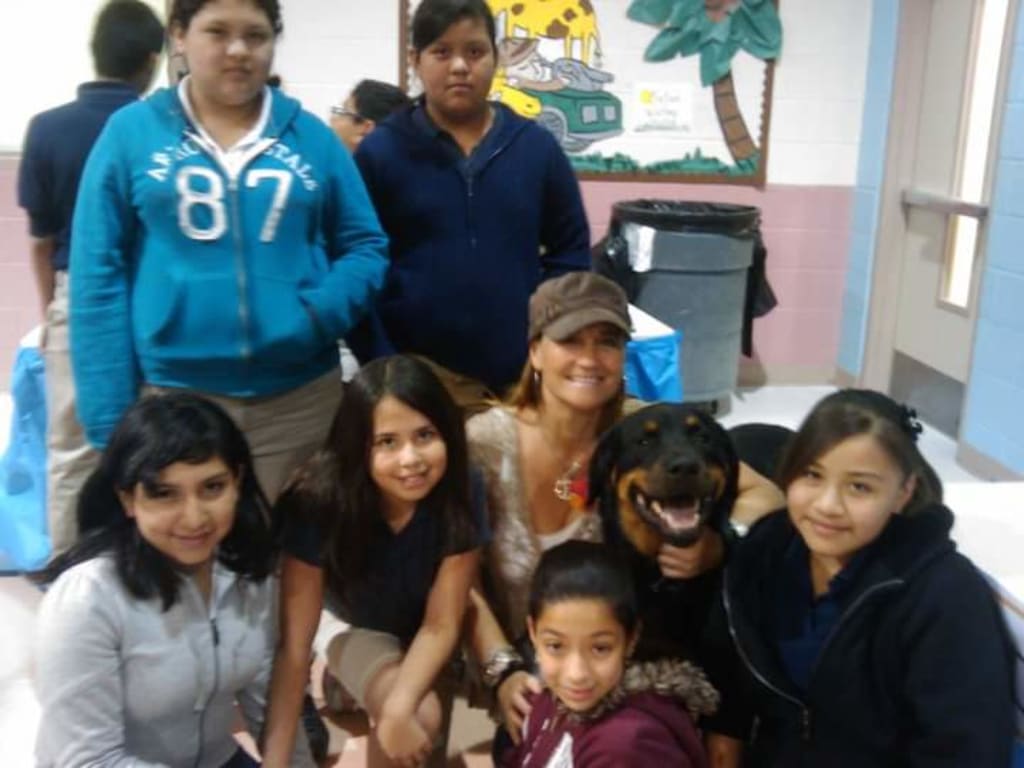
As Jethro entered the classroom, I saw the faces of the kids, a mixture of disbelief, shock, curiosity, and fascination. This was the coolest challenge I had ever given myself! Jethro was a pro from start to finish. He showed off his obedience skills, walked through the class licking the students, and accepting treats from everyone.
When it came time to start the educational portion, I would begin by saying, "Jethro is an indoor dog."
You could hear a pin drop in the room until someone would inevitably say, "We have a Pitbull and we keep him tied outside because he's a guard dog."
I'd ask, "Really? What exactly is he guarding? Your BBQ? Your patio furniture?" I enjoyed pointing out that although Jethro was as sweet and gentle as they come, he was a "guard" dog, too. The difference was that if someone broke into my home, they would be staring at the face of a Rottweiler who's protecting his family—and they could have my BBQ.
It was important for me to use Jethro as a tool for young people to understand that it was better for both humans and pets to be kept inside. They needed to see their large pet as something of value—not just an object.
Jethro was very tolerant of the kids touching and hugging him. Another tool we used with him was a stethoscope. I would get a volunteer to come to the front of the class, put the stethoscope in their ears, then put it up to Jethro's chest. "What do you hear?" I'd ask. "A heartbeat..." was always the answer. I would then have them put it up to their own chest, "What do you hear?" I'd ask. "My heartbeat..." they would answer.
My beautiful Ambassador would so easily show the children that they were the same... living, breathing creatures of this Earth with the same needs... food, water, shelter, love, and compassion. They hurt like us, they feel like us, they matter like us. Jethro helped to make children understand that to "have" a living thing is a responsibility, and not something that is disposable.
Over time we were invited to many schools and organizations that wanted to help spread Jethro's message. He was quickly becoming a little celebrity in town, and he was having his picture taken with some of the local TV and radio personalities. I was truly touched when he became a favorite at the orphanage... I was so proud of how patient and loving he was to a group of disabled children that had requested a visit from him.
One day I was at a school where we were showing some very young children how to brush a dog, make him sit for treats, etc. I noticed that a lot of these children were more interested in asking Jethro questions directly than asking me. When I talked to the teachers they said, "Sometimes the kids are too embarrassed to ask, thinking they may be doing something wrong at home or that they might get their parents in trouble." I wondered how Jethro could help.
I went home and was scrolling through social media looking for ideas. Jethro was laying on the floor, exhausted from his time with the students. I looked at him, then glanced back at my screen... that's it! I found an idea that just might work for some of these children. I went to work right away, creating a Facebook page for Jethro! It was meant as a way of allowing children the ability to go on his page, ask questions, and feel like Jethro himself was answering them. This was also a way of allowing whatever "advice" or information Jethro gave them could be passed on to their parents.
It was a hit! We posted pictures of Jethro at different events or upcoming events that families could come to and get guidance on all kinds of issues. His page posted low-cost vaccination events and adoption events, as well as fundraisers, dog walks, and dog park openings. Children began asking Jethro about what kind of food they should feed their pet, what kind of flea/tick remedy they should use, and even asked thoughtful questions about how he dealt with perhaps being afraid of thunder like their dog.
It was both amazing and encouraging to see the difference just one dog could make within such a short period of time.
After living in this town for over four years and doing our best to make an impact in the lives of all animals, it was time to move back north again. I had gone through a divorce (and won Jethro in the proceedings) so we had to move back home.
After establishing a job and home, it was time to start putting Jethro back to work, and back to doing what he did best—making a difference! We had a plan... we had meetings set up... we were ready. Unfortunately, shortly after moving home, my Jethro became ill.
We weren't sure what was wrong with him at first so we put off the advocacy for now and made many, many trips to the veterinarian's office. He was only six years old. His health began to decline quickly so we tried different medications to keep him comfortable while conducting more blood tests. Eventually, we discovered that he had liver disease, and he was rushed to the State Veterinary Hospital to see the extent of his illness.
After three days of hospitalization, the vet came to me with the news... his liver had completely shut down... there was nothing they could do.
I lost my best friend on April 20, 2013.
Jethro left a legacy of love, kindness, and awareness for bully breeds. He taught many children how to become more responsible pet owners, and changed the outcome for countless pet's lives during his short life on this Earth.
Some people can live for 100 years and still not make the kind of difference that some pet's can make in a fraction of the time.
They have an extraordinary purpose.
Peace...
About the Creator
Lori Brizius
Keep reading
More stories from Lori Brizius and writers in Petlife and other communities.
Shorty
After working for years in animal shelters and rescue, I have seen things I wish I could forget. Sometimes, we need to focus on the positive and learn from the negative. We MUST educate the public and tell the stories of those with no voice to ensure that future generations can make better choices.
By Lori Brizius7 years ago in Petlife
The Summer I Was Chosen by a Northern Mockingbird
During the long, suspended days of the pandemic, a wild mockingbird began visiting my driveway and chose me, again and again. What started as a strange encounter became a brief, meaningful connection that I still carry with me.
By Erica Roberts 19 days ago in Petlife
How to potty train your dog fast — even if you’ve tried everything.
Potty training is one of the biggest challenges dog owners face, no matter the age of their dog. Puppies are still learning all about the world, and adult dogs can come with habits built from previous homes. And when accidents keep happening, it’s easy to feel frustrated, overwhelmed, and even defeated.
By Paw Planet a day ago in Petlife
Writing About Writing: The Rainbow Trap
The good thing about living in modern times is that LGBTQ representation in media is increasing. Not just in niche and Independant media, either, but also in mainstream media. Books, movies, TV shows, comics... they're finally catching on that LGBTQ+ people form a significant part of their audience, and deserve to see themselves on screen and in fiction, not just as victims in documentaries and true crime shows.
By Natasja Rose4 days ago in Writers


Comments
There are no comments for this story
Be the first to respond and start the conversation.