
Are Emotional Support Animals Allowed in Restaurants?
Understanding the Laws, Regulations, and Practical Considerations

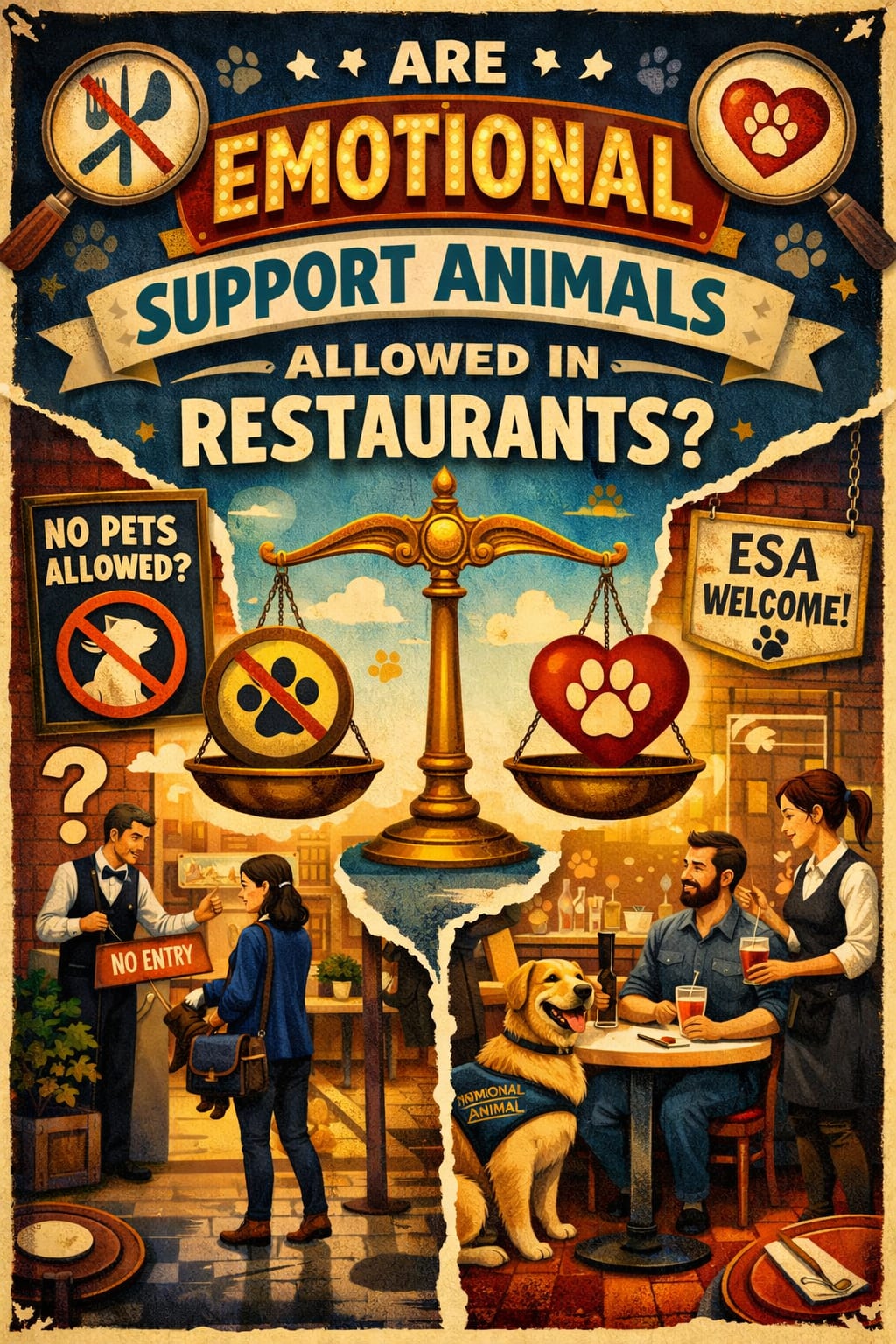
The question of whether emotional support animals (ESAs) are permitted in restaurants has become increasingly relevant in recent years. As more people rely on these animals for mental health support, conflicts have emerged between patrons with ESAs, restaurant owners, and other diners. Unlike service animals, which have clear legal protections under the Americans with Disabilities Act (ADA), emotional support animals occupy a more ambiguous legal space. Understanding the distinction between service animals and ESAs, knowing the applicable laws, and recognizing the practical challenges restaurants face is essential for anyone seeking to bring an emotional support animal into a dining establishment.
The Critical Distinction Between Service Animals and Emotional Support Animals
The first and most important point to understand is that emotional support animals are fundamentally different from service animals in the eyes of the law. Under the ADA, service animals are specifically defined as dogs (and in some cases miniature horses) that have been individually trained to perform specific tasks or do work for a person with a disability. These tasks might include guiding someone who is blind, alerting someone to a seizure, pulling a wheelchair, retrieving items, or performing other disability-related functions. The critical requirement is that the animal must be trained to perform a specific task related to the handler's disability.
Emotional support animals, by contrast, provide comfort through their presence alone. While they may be prescribed by mental health professionals to help individuals with anxiety, depression, PTSD, or other mental health conditions, ESAs do not require specialized training to perform specific tasks. An emotional support dog might help its owner feel calmer in stressful situations simply by being present, but it is not trained to perform a particular action in response to a disability symptom. This distinction has major implications for where these animals are legally permitted, especially in food service establishments.
What the ADA Actually Says
The ADA requires most public accommodations, including restaurants, to allow service animals to accompany their handlers into areas where the general public is allowed. This means a service dog must be permitted in the dining area of a restaurant. However, the ADA provides no such protections for emotional support animals. Under federal law, restaurants are not required to allow ESAs in food service areas. The ADA is explicit: only trained service animals that perform specific work or tasks related to a disability have the right to public access.
It is important to note that the ADA applies to all areas where the public is permitted, with limited exceptions. A restaurant cannot deny entry to a service dog because of hygiene concerns or animal allergies among other patrons. The law takes precedence over these practical considerations. However, a restaurant can exclude an emotional support animal that is not trained as a service dog, even if the owner has documentation from a mental health professional. Some states and local jurisdictions have enacted additional protections for emotional support animals in housing, but these protections do not extend to restaurants and other food service establishments.
The Housing Exception and Why It Does Not Help in Restaurants
Many people are familiar with legal protections for emotional support animals because these protections do apply in one major area: housing. The Fair Housing Act (FHA) requires landlords and housing providers to allow emotional support animals as reasonable accommodations, even without specialized training. This is because housing is considered a fundamental right, and the law recognizes that ESAs serve an important function in enabling people with disabilities to access and enjoy housing. However, this protection does not extend to other areas of public life, including restaurants.
The distinction is intentional. The government has determined that housing requires special protection for ESAs, but restaurants do not. This reflects the different nature of the accommodations involved and the different regulatory frameworks governing housing versus food service. A person with an emotional support animal should be able to live in a rental apartment with their pet, but they cannot expect that same animal to be accommodated in a restaurant without a restaurant owner's voluntary permission.
The Online Documentation Problem
One reason for confusion about emotional support animals in restaurants stems from the proliferation of online services offering ESA documentation. Websites and apps have emerged offering to provide ESA letters from licensed mental health professionals after brief online consultations. While some of these services may be legitimate, others operate in questionable ethical territory, issuing documentation with minimal assessment of the person's actual need. This has contributed to a broader skepticism about emotional support animal claims.
Restaurants and business owners often cannot easily verify whether an ESA letter is legitimate or produced by a genuine mental health professional. This uncertainty, combined with the legal right to exclude ESAs from food service areas, has led many restaurant owners to adopt blanket policies against emotional support animals. The irony is that someone with a genuine need for an emotional support animal, supported by a legitimate prescription from their therapist or psychiatrist, may still be denied entry because the restaurant cannot reliably distinguish between legitimate and fraudulent documentation.
Practical Health and Safety Considerations
Beyond the legal questions, restaurants must contend with practical health and safety concerns related to animals in food service environments. Food safety regulations, enforced by the FDA and local health departments, generally prohibit animals in areas where food is prepared or served, with a narrow exception for service animals that perform specific disability-related tasks. Health inspectors may view emotional support animals, which lack specialized training, as posing a contamination risk. Restaurant staff cannot easily distinguish between a trained service dog and an untrained emotional support animal, making it difficult to enforce food safety policies consistently.
Additionally, not all patrons are comfortable around animals. Some diners may have allergies, phobias, or religious beliefs that make them uncomfortable dining alongside an animal. While a restaurant must accommodate service dogs despite these concerns, they have more flexibility when dealing with emotional support animals that are not legally protected. Restaurants must balance the needs of the person with an ESA against the comfort and safety of other diners and staff, and the law gives them legal authority to prioritize other customers' experiences.
What Emotional Support Animal Owners Should Know
If you have an emotional support animal, it is important to understand that you do not have a legal right to bring it into restaurants under the ADA. However, this does not mean all hope is lost. Some restaurants, particularly those with owners who are sympathetic to mental health issues or more familiar with ESAs, may voluntarily allow emotional support animals in outdoor seating areas or may create special accommodations. It is always worth asking politely and explaining your situation to management. Some higher-end restaurants or those with private dining options may be more flexible than casual fast-service establishments.
Another option is to look for restaurants with outdoor patios or seating areas, where animals are sometimes permitted with greater flexibility than indoor dining areas. Delivery services or takeout options can also be valuable alternatives that allow you to enjoy food without the stress of navigating a restaurant's animal policies. Additionally, some cities and states are beginning to explore expanded protections for emotional support animals in certain public spaces, though this remains a developing area of law.
The Restaurant Owner's Perspective
Restaurant owners face genuine challenges when dealing with requests to accommodate emotional support animals. Without clear legal obligations for ESAs, owners must decide whether to allow them based on their own policies, risk tolerance, and assessment of their establishment's particular circumstances. Many restaurants have adopted categorical exclusions for all animals except service dogs precisely because making case-by-case judgments creates liability and operational challenges.
This approach, while understandable from a business perspective, may seem harsh to individuals who genuinely benefit from their emotional support animals. Restaurant owners who choose to accommodate ESAs should ensure they have a clear policy in place, communicate it consistently, and train staff to implement it uniformly. Some restaurants have found success by allowing ESAs in outdoor areas or at off-peak times as a compromise solution. The key is consistency and clear communication, which helps prevent misunderstandings and conflict with patrons.
The Broader Conversation Around ESA Legitimacy
The proliferation of online ESA documentation and the resulting skepticism from businesses has created a difficult situation. Many people with genuine mental health disabilities that are helped by emotional support animals find themselves subject to suspicion and disbelief. The solution to this problem is not straightforward. Stricter regulation of who can issue ESA letters might reduce fraud but could also make it harder for people with legitimate needs to obtain documentation. Conversely, accepting all ESA claims at face value without verification could enable abuse.
Some mental health professionals and disability advocates have called for a middle-ground approach: standardized documentation requirements that verify a legitimate relationship with a licensed mental health provider and a genuine disability-related need, without requiring extensive and expensive formal training for the animal. This might help restaurants and other businesses distinguish between legitimate ESA claims and fraudulent ones. However, implementing such a system would require coordination across states and professional licensing boards, which remains a work in progress.
Conclusion
To directly answer the question: no, emotional support animals are not legally required to be allowed in restaurants under the ADA or other federal law. Unlike trained service animals, which have explicit legal protections in all public accommodations, emotional support animals occupy a middle ground where they are protected in some contexts (like housing) but not in others (like restaurants). Restaurants are legally permitted to exclude emotional support animals, though some may choose to voluntarily accommodate them.
Understanding this distinction is crucial for both emotional support animal owners and restaurant operators. If you have an emotional support animal and want to dine out, it is worth asking the restaurant about their specific policies and explaining your situation respectfully. For restaurant owners, clear and consistent policies help prevent confusion and conflict. As society continues to recognize the mental health benefits of emotional support animals, conversations may evolve, and some jurisdictions may consider expanding protections beyond housing. For now, however, the legal reality remains that restaurants are not required to accommodate emotional support animals, and business owners retain the right to enforce their own policies regarding animals in food service establishments.
About the Creator
Keep reading
More stories from Robert Barrett and writers in Petlife and other communities.
Can an Emotional Support Dog Go to Work With You
Many people struggle with anxiety, stress, and sadness at work. Some have found that having an emotional support dog helps them feel better. But can you actually bring your dog to your job? The answer is not simple. It depends on several things, including the laws, your company rules, and what your dog is trained to do.
By Robert Barrett4 days ago in Petlife
The Summer I Was Chosen by a Northern Mockingbird
During the long, suspended days of the pandemic, a wild mockingbird began visiting my driveway and chose me, again and again. What started as a strange encounter became a brief, meaningful connection that I still carry with me.
By Erica Roberts 28 days ago in Petlife
Swiss Glacier Rescue: Chihuahua Dog Leads Helicopter Team to Trapped Mountaineer
Flip is a small, energetic, and loyal Chihuahua, but he has a very big personality. These are the words Flip’s owner, Jon Goller, uses to describe his dog. Last summer, Jon Goller fell into a crevasse on a Swiss glacier. He was rescued by a helicopter—and the reason was his dog, who stayed by his side even in that terrible moment. Both Flip and Goller love the mountains and mountaineering. When Flip gets tired from walking, his owner puts him in a bag and carries him on his shoulder so they can complete the rest of the journey more quickly. They stop at several spots along the way, eat, and enjoy the surrounding scenery. Goller said, “My dog can walk 20 to 30 kilometers. Fortunately, on the day of the accident I hadn’t put him in the bag, nor was he on a leash, otherwise he might have fallen into the crevasse as well. If that had happened, the rescue teams would never have found me.” Jon is originally from the city of Plzeň in the Czech Republic and had moved to Switzerland about a month before the accident. Goller says, “My parents gave me Flip as a gift—they breed dogs. I had another dog before, but it passed away some time ago. Flip is two and a half years old, and everyone at my office likes him and plays with him. He especially loves playing in the snow.”
By Real contenta day ago in Petlife
Bartender
On the heels of grief, pain bears down hard. On the heels of death, pain awakens the quiet place between the end of our own life and now. Feeling anything is like seeing a film and in black and white, slow motion, all sound turned off. Just watching. Gritting teeth, awkward smiles and bloody red eyes move around, scanning the others who are feeling something I don't want to feel, but I do. Escapism is all I have ever known. ~
By ROCK aka Andrea Polla (Simmons)6 days ago in Poets




Comments
There are no comments for this story
Be the first to respond and start the conversation.