
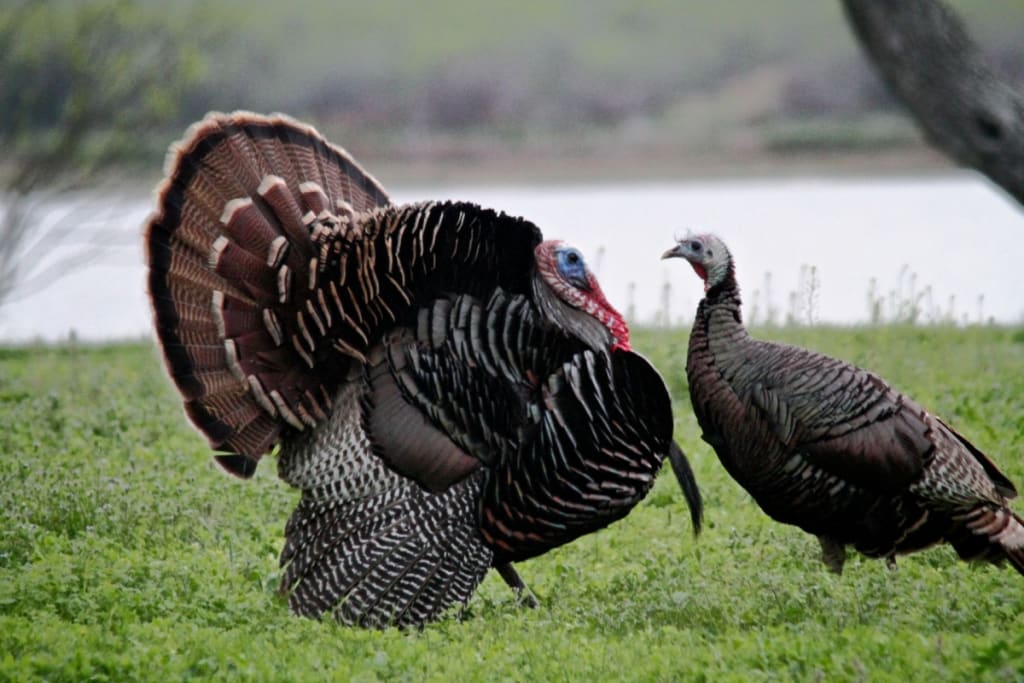
A large North American gallinaceous bird (Meleagris gallopavo) that is domesticated in most parts of the world.
How do I know the place where Turkey lays their egg?
Wild Turkeys nest on the ground in dead leaves at the bases of trees, under brush piles or thick shrubbery, small plant bushes they need some secure hidden places,She can see her surroundings while staying hidden from danger
Do Turkeys Lay Eggs?
OR do they have live babies, give birth, or get pregnant?
Although much larger than the chicken, the turkey creates life and food in much the same way as a chicken
A turkey lays an egg, which can be eaten, but if the turkey makes a nest and then sets on the egg for 28 days, a little poult (baby turkey) hatches out of the egg.
What time of year do turkeys lay eggs and will they lay eggs year around?
Turkeys are generally seasonal layers, beginning in the spring around April. But some people have found that their birds don’t always fit this mold and begin laying earlier.
If their eggs are picked each day and they are not allowed to make a nest, they will lay for a longer period of time
How many times a year do turkeys lay eggs?
A turkey can lay up to 100 eggs a year and will lay between 2 and 3 eggs a week.
In a natural setting, they will lay a clutch of eggs. This means they will lay between 10-12 eggs in about two weeks to fill their nest. Then they will go broody and begin to set on the eggs to hatch them out.
How long does it take for turkey eggs to hatch naturally?
First, turkey eggs generally take 28 days to incubate compared to the 21 days of broiler incubation.
Is it hard to hatch turkey eggs?
Hatching turkey eggs is relatively easy, but the key is that for the highest success rate you want to start incubation soon after the eggs are laid. Most people rear turkeys from young poults to provide the holiday birds for family and friends, so hatching and incubation isn't an issue for everyone
Do turkeys lay eggs without a male?
A turkey will lay an egg with or without a male. But they will not be fertile. Without a male, they cannot be placed in an incubator and will not hatch if a hen sets on them
What does a turkey egg look like?
Turkey eggs are usually creamy-white with brown speckles and they have a much pointer end than a chicken egg.
Can you eat a turkey egg?
Now, don’t go around stealing eggs from any nest you see, but the reality is…you can eat any egg you come across. Eggs you can eat could be in a nest in a tree or a nest on the ground or in the chicken house or buried under some leaves or dirt like a duck sometimes does!
How can you tell if a turkey bird is male or female?
The easiest way to determine the turkey's sex is by examining the feathers on the breast and sides of the turkey. On males, these feathers have black tips. The feather tips are brown on females
Does a male turkey have balls?
In case you were thinking: “Wait, do turkeys even have testicles?” They do. But they are inside the bird's abdominal cavity, behind its wings
What do male turkeys only do?
Only males gobble
There's a reason that male turkeys are called "gobblers" — they're the only ones that make that noise! Each gobbler has a unique call that he uses to attract females during breeding season. Female turkeys also make distinct noises, but they sound more like chirps and clucks
What do female turkeys look like?
Short, rounded wings with black and white bars. Long, powerful legs that vary in color from pink to gray. Female turkeys have a duller overall color than males, with gray heads and breast feathers tipped in white, gray or brown. Females usually do not have beards
Turkeys can fly
They can fly! And not all gobble. Here are five turkey truths from Life's Little Mysteries. Not only can wild turkeys fly, but they can do so for short bursts at up to 55 mph
About the Creator
Keep reading
More stories from Rajesh Ravi and writers in Petlife and other communities.
RCB Team 2023 Players List, Name, Photo, Captain, Retained Players.
RCB Team 2023: Faf du Plessis captains the team Bangalore in the Indian Premier League. The team also enjoys the presence of the star player of India, Virat Kohli. In the last edition of IPL, Royal Challengers Bangalore managed to reach the qualifiers. Even though they failed to make it to the finals, they still had a good season to turn back and continue from. They would like to keep up with their better performances in the Indian Premier League. With Mini Auction approaching in Kochi on 23 December 2022, the team announced retention and releases on 15 November 2022 as per the guidelines. They have not made any major changes and shuffles.Read all you need to know about the team of Royal Challengers Bangalore as they gear for the 16th edition of the Indian Premier League in the ensuing article. Check subsequently for details on the New Players List, Name, Captain, Photo, Retained Players and more for RCB Team 2023.
By Rajesh Ravi3 years ago in Gamers
The Summer I Was Chosen by a Northern Mockingbird
During the long, suspended days of the pandemic, a wild mockingbird began visiting my driveway and chose me, again and again. What started as a strange encounter became a brief, meaningful connection that I still carry with me.
By Erica Roberts 20 days ago in Petlife
Losing the Battle - Or So We Thought
I don’t know at what point that I decided to look upon cancer in my dog and cat patients as the ultimate enemy. As the general in the little veterinary clinic whereI worked, I wanted to be on the offensive with cancer just one time. Instead, I always seemed to be on the defense, and about three steps behind the enemy. Cancer is simply uncontrolled growth of abnormal cells, and it always amazes me how such a tiny force can wreck so much havoc. For a 8 year old friendly Pitt Bull named Tyson that lived just two doors down, that force was now a large cutaneous hemangiosarcoma that started as a small red lump just under his skin. Over the months, it had become gnarly and already burst open more than once. My weapons were steroids to help reduce the size, medications to keep the pain at bay, and freezing of the edges to help portions die off over time. I had watched Tyson grow up with two other Pitt Bulls, as well as the Riley’s three children. His human mom, Renee, had asked me a few months earlier in the check out line at the Dollar Tree store, if I thought we could easily remove this tumor. Another veterinarian had told her it was a bad prognosis. I had let her know as gently as I could, that the odds were not in our favor. So today, with weeks of preparation, I was ready to stare this evil cancer right into the face, as I let his human dad know what my plans were for the day. I put on my game face before I entered the room for Tyson’s pre-operative exam. “James, Tyson’s gums still look pretty pale to me. The first thing I need to do is check Tyson’s blood to make sure he has enough platelets to clot his blood during surgery and enough red blood cells to efficiently carry oxygen. If the levels are not high enough, I will need to give him a blood transfusion, and the best candidate would be one of his littermates,” I stated. While the blood was processing in the lab machine, I had to see two other patients just to keep up with my morning schedule. When Stacey handed me the results, I took a quick look, and let out a long sigh as I headed back into Tyson’s room. “Ok, James, are you able to go get Po back at your house?” I asked. Po was fifty pounds of pure energy, and I had already warned James that we might need to sedate him just to get the much needed blood transfusion. “I’ll be back in about twenty minutes,” he said. This would give us enough time to get an intravenous (IV) catheter inserted and some fluids running to give him a boost. As I came back to the pharmacy area and noticed that every exam room was full. Kaitlin pointed to which one was first, and I said a quick prayer for strength and wisdom. Mrs. Crabtree wanted full exams, bloodwork, and an explanation of the results as soon as possible. In Room 2, Bosco, the Labrador Retriever, had yet another ear infection. In Room 3, was an euthanasia on a cat that was not allowing his owners to give him medicine to lower his high thyroid levels. I had already given him two sets of sedation, but his adrenaline and high rate stopped any chance of calm without the big drugs. So I went back in the room again to give him the best happy drug combination I could find before we could even think of trying to hit a vein with the euthanasia solution. These are the moments when my thirty years of veterinary experience sends me into the zone of slowing down to speed up the pace. I had Kaitlin and Stacey clean and treat Bosco’s ears, while I started the exams for Mrs. Crabtree’s cat and dog. Shilo stayed in the back with Tyson to monitor his IV fluids. I could hear the front doorbell ring as James and Po entered and went to the corner of the lobby until one of us could help them. I extracted myself out of Mrs. Crabtree’s room, which was no easy task because she was deep in the tale of her late husband’s rescue of their fluffy cat. I was able to give Po a sedative injection right away. Stacey appeared to grab Po’s leash and lead James around the back way to Room 2 as Kaitlin led Bosco out to the front so that his owner could pay the bill. Shilo was able to use her inner strength to lift Tyson off the back table and into a comfortable cage. I met Shilo and Stacey in Room 2 to start the blood donation. I inserted the needle into Po’s large jugular vein, and blood began to flow into the transfusion bag. Back in Room 3, Kaitlin held off a leg vein on the now serene Wally cat, so that I could administer the final injection. We could hear his sigh as the euthanasia solution took its effect, and felt both the owner and Wally relax as I gently removed the tiny needle from the vein. We let Wally’s owners spend a few last minutes with him so that they could begin to process all that had happened. As I went back to check on Po, I could see Mrs. Crabtree came to the door and cleared her throat loudly. “If we are going to do bloodwork it better happen soon because I have a hair appointment in a half hour,” she announced. Before I could respond, the door to the treatment room opened. “Dr. Fran, we need you in here now, there is a clot in the vein and blood line,” Shilo said in even a louder voice. I gave Mrs. Crabtree a sympathetic nod, and went in to solve the blood clot issue. I knew at that point, it was time to go to the old fashioned technique of drawing up individual syringes lined with the anticoagulant, heparin. I was able to get three 20 ml syringes filled before the jugular veins were blown. I explained to James that we would need to get as much of the blood as possible into Tyson before the surgery. I quickly checked to see if there was a reaction between Tyson’s and Po’s blood on a glass slide to make sure the transfusion would not be rejected by Tyson. No reaction occurred, so I let James know it would take about 1 ½ hours of slowly dripping in 1 ml of blood every thirty seconds, so the best plan was to take Po home and wait. Back in Mrs. Crabtree’s room, we easily drew blood for analysis from her little Sasha’s leg. Raymond her cat was going to be a whole other story. “I just see how you can’t seem to find a vein on Raymond. He is so thin and practically hairless, it should be easy,” she sniped. I felt like she laid down the gauntlet, and by no means was I going to let Mrs. Evelyn Crabtree win. It took me three more tries because of my arthritic thumbs, and I only got just enough blood in the syringe for a minimal amount of bloodwork. “Mrs. Crabtree, I will have to call you later with the bloodwork results,” I mentioned. “Well, I can text my hairdresser and tell her I will be a few minutes late. I am sure she won’t mind waiting for a Gold card client like myself,” she firmly stated. I let Stacey handle this situation while I raced to the back to make sure that Tyson wasn’t having a transfusion reaction. After listening to his heart and breathing with a stethoscope, I finally took a deep breath. Shilo and Kaitlin, ever the professionals, gave me a smile to let me know they could handle it. The blood machine had just given its “Bloodwork complete” ding, when Stacey came to tell me that our client with dementia was here to euthanize her old Chihuahua named Chip. She said someone had told her on the phone last week to come in at 10:30 am today. It’s hard to argue with dementia, and you should always tread lightly around a broken heart, so we guided her into Room 2. I went back to make copies of the bloodwork, but the copier wasn’t working. “Mrs. Crabtree, Raymond has non-significant changes in his bloodwork, but I will text you a copy and an explanation in a few hours,” I said. “I just don’t understand the slow service here today. What is going on?” she asked. “We have a dog in the back with cancer who is getting an emergency blood transfusion before we can surgically remove a large tumor,” I succinctly stated. “Why didn’t you say so in the first place. I will have Stacey check me out and I will leave you to your work,” she said with a gentler voice. With that, she gathered up her pet’s and headed to the front desk, so that I could attend to the euthanasia at hand. Meanwhile in the back, I had a decision to make about when exactly to do the surgery on Tyson. Should I let it wait a day, for the blood transfusion to have a full effect, or should I take the chance and get the surgery done today. My gut told me to look for a secondary bleed inside of his tired body. When I put my portable ultrasound probe on his abdomen, I received the answer to my question. “Only about one in five hemangiosarcomas under the skin metastasize to the spleen. Since the spleen is the cleaning house of blood in the body, it can be life threatening if a cyst or tumor in it ruptures,” I told Shilo and Kaitlin. Why don’t you give him some oxygen and warm him up while I call the owner to see how they wanted to proceed. I sat down at my small desk, and took a deep breath before I dialed the Riley’s number. This time, Renee picked up the phone when I called. “Renee, I want to let you know that Tyson has recently had a bleed from a cyst on his spleen in his abdomen, and that is why he is so pale. To go ahead with surgery, may not be the best option as he may not recover,” I let her know. “Dr. Fran, what would you do if it were your dog?” she tentatively asked. “My beloved deaf and blind Australian Shepherd named Sprite had hemangiosarcoma in his heart. We elected not to do any heroic treatments with him. My one regret was that I was not home when he passed away, but he had so much fun on his walk that morning. I feel that euthanasia would be the best solution in this situation,” I said as I felt my strong woman facade starting to slip. “It will take about thirty minutes for the whole family to get there. Tyson is my stepson’s dog, and he will want to say goodbye,” she said with tears in her voice. I let Shilo and Kaitlin know the change in plans. Tyson enjoyed the cheese whiz, peanut butter and turkey we gave him since he no longer needed to be fasting for surgery. I administered an injection of pain medications to him, as he licked up the treats. We kept him up on the table in the treatment room with the warm winter sun coming through the window, and oldies rock playing on the radio. There were many tears that flowed in the next hour. The euthanasia went smoothly as I used the one remaining undamaged vein on his back leg to slowly inject the euthanasia solution. There were many tears when he passed, but an overwhelming sense of peace. To do my job effectively, I have to be like a general, and not get emotional in the thick of things. On that day, I performed three euthanasias on beloved pets before 11:30 am. There were moments when I wanted to get angry, be sad, or even joke to bring any type of levity to the situations at hand. I knew I would do all three when I went home that day to evening to stare at the sunset and tell my own dogs all that had happened. . You see, sometimes our patients will lose the battle with their disease, but that prepares us for the next battle, by giving us experience. In the heat of the moment, I tend to suppress my emotions knowing that sometimes death is the ultimate healer by giving the patient and the owner peace.
By Laura L Hady3 days ago in Petlife
The Devil's Triangle
The sails ruffled in the breeze as we cruised along. The Sea Breeze was a mid-size catamaran that sailed out of Royal Naval Dockyard in Bermuda. We had booked this trip weeks in advance and were now looking at our Captain, Spike and two boat hands. Paddy and Wilson seemed like nice guys, joking around with the passengers and telling us some stories about Bermuda that only locals would know. Their island accents sounded almost British but they were pleasant to listen to.
By Barbara Gode Wiles6 days ago in Fiction


Comments
There are no comments for this story
Be the first to respond and start the conversation.