
Your Excuses Are Smarter Than You Are
Your Excuses Are Smarter Than You Are

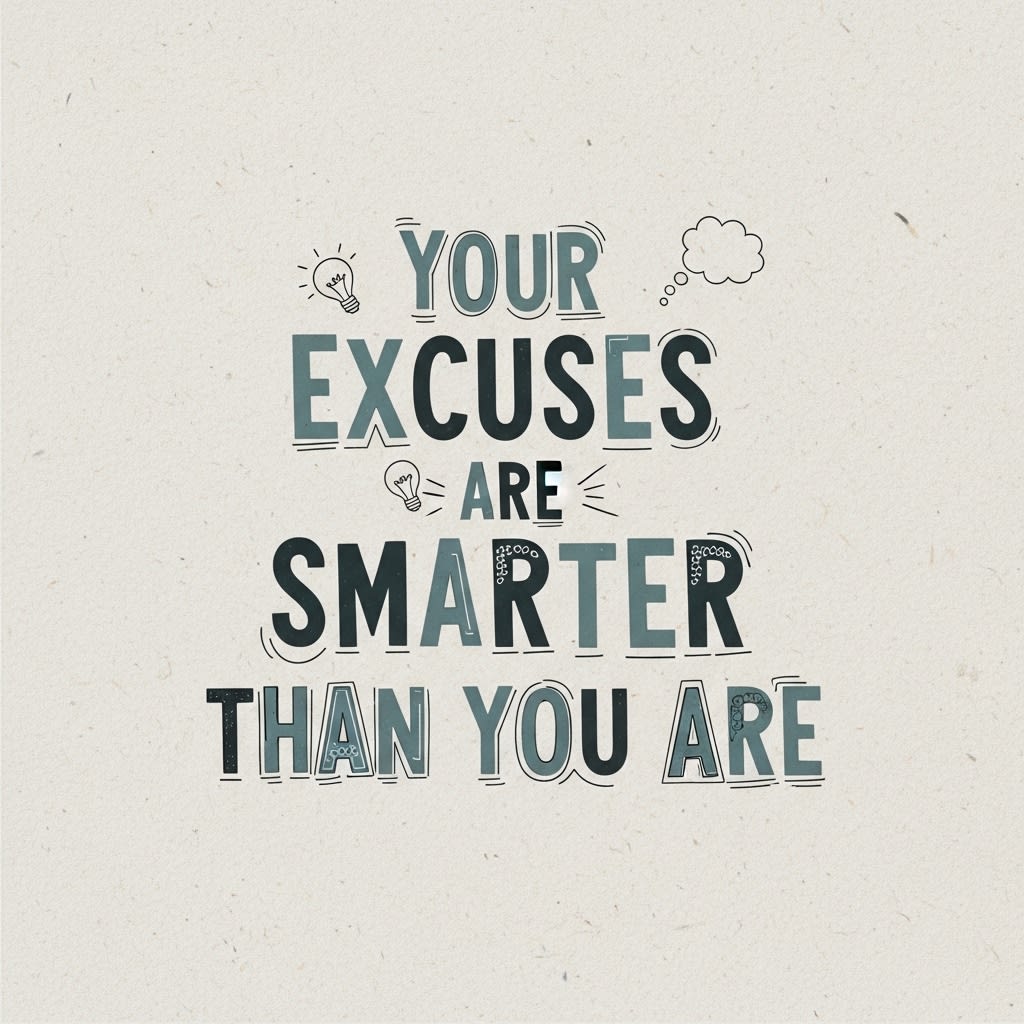
You don’t fail because you’re lazy. You fail because your excuses are intelligent.
That might sting, but it’s the truth most people avoid. Your excuses aren’t sloppy. They’re clever. They sound reasonable. They wear the costume of logic. They speak in calm, adult voices. And that’s exactly why they work. If excuses were obviously dumb, they wouldn’t survive in your head. The problem isn’t that you make excuses. The problem is that your excuses outthink you.
Your mind is a lawyer hired by comfort. Its job isn’t to make you great. Its job is to keep you safe, familiar, and unchallenged. So when a hard opportunity appears—starting the project, changing the job, fixing the relationship, committing to a new discipline—your brain doesn’t say, “I’m scared.” It says, “Now isn’t the right time.” It doesn’t say, “I don’t want to risk failing.” It says, “I need to be more prepared.” It doesn’t say, “This will be uncomfortable.” It says, “Let’s wait until conditions are perfect.”
And conditions are never perfect.
Excuses are smart because they borrow your values. They disguise themselves as responsibility: “I need to focus on my family first.” They disguise themselves as realism: “Let’s be practical about this.” They disguise themselves as self-care: “I’ve been stressed; I deserve a break.” None of these statements are wrong on their own. The problem is when they become permanent shields against action. Responsibility becomes avoidance. Realism becomes pessimism. Rest becomes retreat.
Here’s the uncomfortable part: if you were honest, you’d admit your excuses often make sense. That’s why you believe them. They’re not lies. They’re half-truths. And half-truths are more dangerous than lies because they feel clean. They don’t trigger your internal alarm system. You don’t feel like you’re betraying yourself. You feel like you’re being “reasonable.”
But reasonable lives don’t build uncommon futures.
Notice the pattern: the excuse always protects the version of you that wants to stay the same. It protects your current identity, your current habits, your current comfort. Growth threatens identity. Change threatens your story about who you are. So your mind builds elegant arguments to keep you exactly where you are—busy, distracted, and safely stuck.
This is why people plan more than they act. Planning feels like progress without the risk of embarrassment. Research feels productive without the danger of failure. Talking about goals feels noble without the cost of commitment. You get the emotional reward of ambition without paying the price of execution. Your excuses give you the sugar rush of intention with none of the calories of effort.
There’s another layer most people miss: excuses don’t just protect comfort—they protect ego. If you never fully try, you never fully fail. You can tell yourself, “I could have done it if I really tried.” This keeps your self-image intact. The excuse becomes a safety net for your pride. It lets you preserve the fantasy of your potential without confronting the reality of your effort.
So how do you beat something smarter than you?
You don’t argue with excuses. You outmaneuver them with action.
Stop asking yourself if you feel ready. Readiness is a feeling your brain withholds when it wants to stay safe. Instead, ask: “What is the smallest action I can take today that moves this forward?” Not the perfect action. Not the impressive one. The smallest real one. One email. One page. One workout. One honest conversation. Action disrupts the lawyer in your head because excuses need time to build their case. Movement short-circuits the argument.
Also, tell the truth about the emotional cost. Say the quiet part out loud: “I’m avoiding this because I’m afraid of failing.” Naming fear weakens it. It turns a clever excuse into a plain emotion. And emotions can be carried. Excuses pretend to be logic. Logic feels harder to challenge.
Finally, remember this: your excuses are smarter than you only when you let them speak first. When you move first, they lose their voice.
You don’t need to be more motivated.
You need to stop negotiating with comfort.
Your future doesn’t require brilliance.
It requires the courage to act before your excuses finish their sentence.
About the Creator
Fred Bradford
Philosophy, for me, is not just an intellectual pursuit but a way to continuously grow, question, and connect with others on a deeper level. By reflecting on ideas we challenge how we see the world and our place in it.
Keep reading
More stories from Fred Bradford and writers in Motivation and other communities.
5 Questions That Reveal Your Life Purpose
Most people think life purpose arrives like a lightning bolt. One day you wake up, angels sing, and suddenly you know exactly what you’re meant to do. That’s a nice movie scene—but real life doesn’t work like that. Purpose is quieter. It reveals itself through patterns, pressure, and the questions you’re brave enough to ask when no one’s watching.
By Fred Bradford2 days ago in Motivation
One Hard Thing
Stop me if you’ve heard this one before: You have the number, you know your schedule- you’ve even picked out the perfect day and time to make this appointment. Shoot, you’ve even picked out alternative days and times just in case their schedules can’t accommodate you!
By Taylor Rigsby28 days ago in Motivation
Choose Your Hard: Growth Hurts, But so Does Staying the Same
There is a moment everyone reaches eventually, the moment when staying the same starts to hurt more than changing. At first, staying where you are feels easier. Familiar. Predictable. You know the routines, the expectations, the limits. Even if you’re unhappy, at least you understand the shape of your discomfort. It becomes something you can navigate without thinking.
By Stacy Valentine7 days ago in Motivation




Comments
There are no comments for this story
Be the first to respond and start the conversation.