
The Overlooked Assistant Who Changed How the World Hears: The True Story of James Edward West
History often celebrates the astronauts who touch the stars

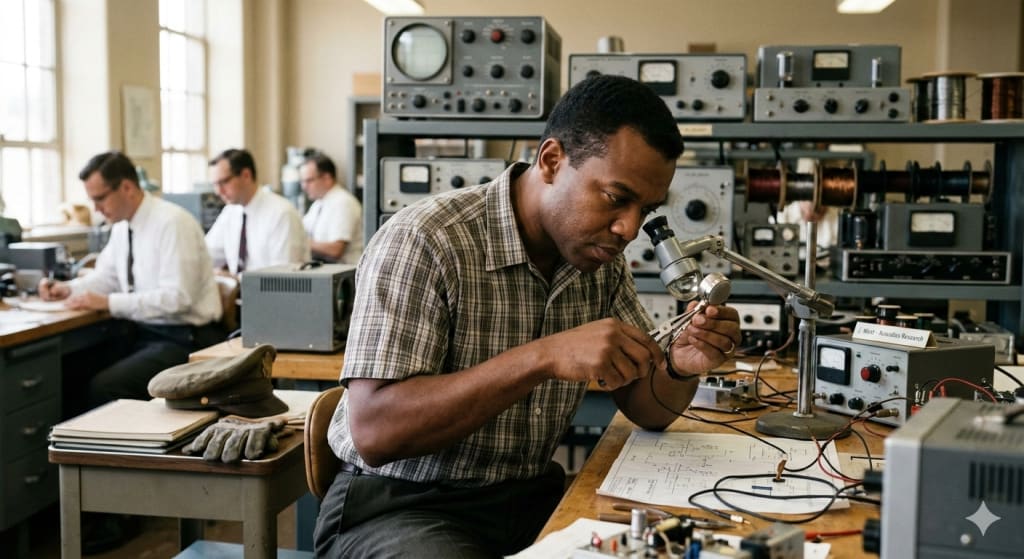
History often celebrates the astronauts who touch the stars.
It remembers the celebrated scientists who cure diseases.
It honors the elite engineers who build our bridges.
But sometimes, the person who changes everything isn’t supposed to be in the room at all. Sometimes, the internet loves to dramatize these stories with clickbait titles like, "The Janitor Who Solved NASA's Biggest Problem." But the real story of James Edward West doesn't need embellishment or fictionalized headlines. The absolute truth of his life is far more profound, far more challenging, and infinitely more inspiring.
This is the extraordinary true story of a man who started his journey performing routine maintenance and support work, overlooked by an elite establishment, who went on to help create a piece of technology currently sitting in your pocket, on your desk, and in nearly every microphone on Earth.
His monumental success was not born from privilege, wealth, or opportunity.
It was born from a curiosity that simply refused to stay silent.
## A Childhood Built on Relentless Curiosity
James Edward West was born in 1931 in Prince Edward County, Virginia. He entered the world during a deeply fractured time in the United States, an era where opportunities for African Americans were not just limited; they were systematically blocked.
Segregation shaped the architecture of daily life. Access to quality education, professional white-collar careers, and advanced scientific fields remained heavily restricted. For a young Black boy in the Jim Crow South, dreaming of becoming a scientist was often viewed by society as a foolish, if not dangerous, ambition.
But young James possessed something far more powerful than societal permission: relentless, insatiable curiosity.
At the age of twelve, a pivotal moment occurred. He was gifted a broken, discarded radio. Most children would have tossed it into the trash, frustrated by the silence emitting from its speaker. Instead, James viewed the broken wooden box as a puzzle waiting to be solved.
He opened it up. Piece by piece, he studied its intricate wiring, its fragile glass vacuum tubes, and its complex circuits. Without YouTube tutorials, without a modern electronics kit, and without formal instruction, he tinkered. He observed. He failed, and then he tried again.
Eventually, a sound crackled through the speaker. He had repaired it.
That single moment of triumph ignited a lifelong fire. Soon, he began collecting and fixing his neighbors’ broken electronics. Electricity fascinated him—the way it flowed invisibly to create light and motion. But sound fascinated him even more. He wanted to understand the invisible magic of how a human voice could be captured, transformed into an electrical signal, and beamed across miles of empty space.
## Dreams Larger Than Circumstances
Despite the heavy financial struggles his family faced, West was determined to pursue higher education. Against the advice of some who urged him to take a "safer" path—like becoming a physician or a preacher, which were considered more attainable respected professions for Black men at the time—West chose to study solid-state physics at Temple University.
But survival required capital, and education required tuition. To keep his dream alive, West had to work alongside his rigorous studies.
He took whatever jobs were available to him. He found himself in maintenance, technical support, and summer intern roles where he was frequently overlooked. In the bustling corridors of mid-century scientific institutions, many people around him assumed he would remain in low-level, background positions permanently.
In the 1950s, the scientific community was overwhelmingly white and male. Very few African Americans worked in advanced scientific research, and those who did were rarely given the spotlight. The expectations placed upon West were severely limited by the prejudices of the era.
But West never stopped observing.
Even while performing routine, unglamorous tasks, he watched the senior engineers closely. He absorbed their conversations. He studied their methodologies. He turned his marginalization into an advantage: because he was often ignored, he could observe the inner workings of cutting-edge science silently and comprehensively. His real classroom wasn't just the lecture halls of Temple University; it was the quiet corners of the laboratories where he worked to pay his bills.
## Entering the Halls of Bell Laboratories
In 1957, James West’s persistence paid off when he joined Bell Laboratories as a summer intern, eventually becoming a full-time research acoustic scientist.
At the time, Bell Labs was the undisputed epicenter of technological innovation. It was the Silicon Valley of its day—one of the most advanced research and development centers in the world. This was the institution responsible for groundbreaking discoveries that were actively shaping modern communication, from the transistor to early lasers.
Yet, West entered this hallowed institution without the elite, Ivy League academic prestige of his peers. He was surrounded by scientists holding advanced degrees from MIT, Harvard, and Caltech.
Many underestimated him. Some questioned if he truly belonged there.
But West did not waste his energy trying to aggressively prove his worth to his detractors. Instead, he focused entirely on the work. He understood a fundamental truth about innovation: physics does not care about your pedigree; it only cares about your persistence.
Soon, an opportunity appeared in an unexpected, highly frustrating form.
## The Problem Nobody Could Solve
At the dawn of the 1960s, the world was on the brink of a communication explosion, but there was a massive technological bottleneck: the microphone.
At the time, microphones were a nightmare for engineers. Traditional condenser microphones were expensive to manufacture, highly fragile, and incredibly inefficient. To work properly, they required large, high-voltage power supplies. If you’ve ever seen footage of a 1950s radio broadcaster leaning into a massive, heavy metal microphone, you are looking at the problem James West was facing.
This clunky technology severely limited widespread, portable use. You couldn't put a 100-volt battery inside a telephone headset or a hearing aid. Engineers across the globe sought a cheaper, smaller, and more reliable alternative—but progress had completely stalled.
West began collaborating with a brilliant fellow scientist, a German-born engineer named Gerhard Sessler. Together, they decided to tackle this global bottleneck.
They began exploring the use of new polymer materials—specifically Teflon—that might be capable of holding a permanent electric charge, eliminating the need for a bulky external power source.
It was a brilliant theory. But reality is rarely kind to theories.
Their experiments initially failed. Repeatedly.
Materials degraded under pressure.
Electrical signals weakened and faded into static.
Prototypes malfunctioned in the lab.
Months of grueling trial and error ensued. For many, this string of failures would be proof that the idea was impossible. But for West, a man who had spent his childhood coaxing dead radios back to life, failure was just data. It was just another circuit to be rewired.
The Invention That Changed Communication Forever
In 1962, the breakthrough finally arrived. James West and Gerhard Sessler successfully invented the foil electret microphone.
By utilizing a metal-coated polymer film that retained a permanent electrical charge, they created a device that was nothing short of miraculous.
It was smaller: It could be scaled down to the size of a coin, and eventually, a pinhead.
It was cheaper: It cost pennies to manufacture compared to the hundreds of dollars required for older models.
It was durable: It could withstand drops, temperature changes, and rough handling.
It was incredibly efficient: It required almost no external power to operate.
At first, the broader scientific community was slow to realize its monumental significance. But over the next decade, as the world moved toward miniaturized electronics, the electret microphone revolutionized global communication.
Look around you right now. Today, electret microphones (and their modern MEMS descendants, which rely on the same fundamental principles) exist almost everywhere. You will find them inside:
* Smartphones and tablets
* Laptops and webcams
* Life-changing hearing aids
* Professional recording equipment
* Baby monitors and smart home assistants
* Aviation headsets and space exploration communication gear
Today, more than 90% of all microphones worldwide use technology derived from West and Sessler’s brilliant invention.
Think about the magnitude of that impact.
Every voice message you send to a loved one.
Every online virtual meeting that connects global teams.
Every hit podcast you listen to on your commute.
Every video recording of a child’s first steps.
All of these moments—billions of them happening every single day—trace back to the quiet, persistent work of a man who was once told he didn't belong in the laboratory.
# The Quiet Power of Persistence and a Legacy Delayed
Despite the staggering, world-altering impact of the electret microphone, West faced the ongoing challenges common to many innovators from marginalized backgrounds.
Recognition arrived painfully slowly. While his invention was generating billions of dollars in value and changing the fabric of society, his own climb up the corporate and scientific ladder was grueling. Promotions were delayed. Public credit was not always immediate or widespread.
Yet, West did what he had always done: he kept working.
He didn't stop with the microphone. Over the course of his illustrious career, Dr. James Edward West accumulated over 250 patents. He became a pioneer in architectural acoustics, helping to design spaces where sound travels perfectly.
But perhaps his most enduring legacy lies outside the laboratory. Remembering his own lonely path through the scientific world, West dedicated his life to ensuring others wouldn't have to face the same barriers. He became a fierce advocate for diversity in STEM (Science, Technology, Engineering, and Mathematics). He spent decades mentoring minority students, pushing universities to open their doors, and funding initiatives to bring women and people of color into the engineering fields.
He knew that the next great world-changing idea might be locked inside the mind of a young kid fixing a radio in a forgotten neighborhood.
A Vital Lesson for Modern Creators
West’s journey shatters a persistent, damaging myth in our modern culture: the idea that true innovation belongs only to geniuses who follow perfect, frictionless educational paths.
In today’s highly curated digital world, millions of people believe that success requires perfect credentials, the right networking connections, or a wealthy starting point. If you don't have the Ivy League degree, the angel investors, or the viral following, it’s easy to feel like your ideas don't matter.
But the life of James Edward West proves something entirely different.
Opportunity often hides inside ordinary, unglamorous roles. You don't need a corner office to observe how a company works.
Observation becomes education. When you are overlooked, you have the quiet advantage of watching, learning, and absorbing the knowledge of those around you.
* Curiosity becomes expertise. Asking "why" and "how" enough times eventually makes you the smartest person in the room.
* Consistency becomes mastery. Success is rarely a sudden leap; it is the accumulation of a thousand tiny, failed experiments that finally result in a breakthrough.
The assistant, the intern, or the overlooked employee in the background may quietly hold the transformative ideas that will define the next decade.
## A Legacy Heard Around the World
Today, whenever someone records a viral video, attends a life-changing virtual job interview, or speaks into a smartphone to tell someone they love them, they are unknowingly relying on the genius of James Edward West.
His work literally amplified human voices. It allowed the quietest whispers to be recorded, transmitted, and heard across oceans.
But metaphorically, his life amplifies a much deeper, more vital message: Your starting position does not dictate your final impact.
James Edward West did not begin as a celebrated, heavily funded scientist. He began as a young man willing to learn wherever he stood, even if society told him he was standing in the wrong place.
History rarely predicts greatness accurately. The people who look the part are not always the ones who change the world. Sometimes, the individual sweeping the floors, running the cables, or quietly taking notes in the back of the room today becomes the master inventor shaping tomorrow.
And sometimes, the most powerful voices in the world are made possible by the very person society almost overlooked.
About the Creator
Frank Massey
Tech, AI, and social media writer with a passion for storytelling. I turn complex trends into engaging, relatable content. Exploring the future, one story at a time
Keep reading
More stories from Frank Massey and writers in Motivation and other communities.
The Man Who Was Fired for Being “Too Slow” — Then Built One of the Greatest Car Companies in the World
Success stories usually begin with talent, opportunity, or privilege. But sometimes, they begin with humiliation. Sometimes they begin with rejection so painful that most people quietly abandon their dreams and never speak of them again.
By Frank Massey a day ago in Motivation
Growing Strong Founders Through Mentorship Networks
Starting a business takes courage, focus, and steady support. Many new founders have bold ideas but lack guidance. That is why mentorship networks matter so much. These networks connect new entrepreneurs with people who have real business experience. As a result, founders learn faster and avoid common mistakes. They also gain confidence because they do not face challenges alone.
By Greg Warnock7 days ago in Motivation
Flower Bloom 369
FLOWER Bloom 2/25/26 Wednesday By Mariann Carroll Karen had been with Tony for 7 years. Tony started acting strangely after her surgery. He would mow the lawn in the rain and be on his cellphone. He started pushing Karen away. Tony came clean about seeing someone. Karen moved out two months later. Karen moved in with a friend. She felt betrayed.
By Mariann Carroll6 days ago in Fiction




Comments
There are no comments for this story
Be the first to respond and start the conversation.