
The Letter With No Return Address
Some words don’t echo back — but they still echo

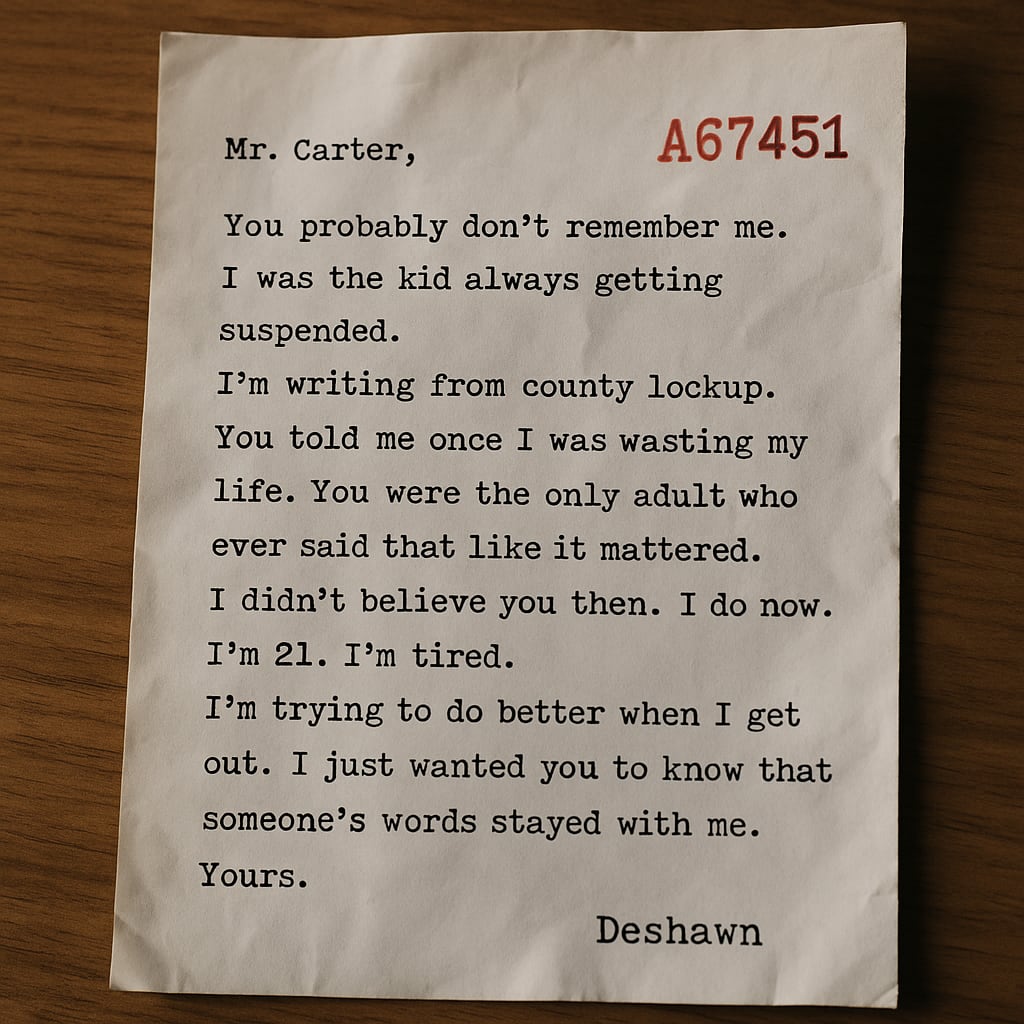
Mr. Carter kept a drawer in his office filled with letters.
Most were thank-you notes, scribbled in looping student handwriting, typed by parents, or carefully crafted by colleagues. Words of gratitude, celebration, acknowledgment.
But one letter stood apart.
It was folded unevenly, worn soft around the edges. The paper had been handled often, almost reverently. It bore no return address, only a prison ID number, stamped in red ink across the top corner.
Every year, on the first day of school, Mr. Carter read that letter to himself.
Not because it made him feel proud.
But because it reminded him why he stayed.
Years earlier, before he became principal, Carter had been a new assistant principal. Young, idealistic, committed. He believed in second chances, maybe too much, some colleagues said. That year, he was assigned a student named Deshawn.
Deshawn was 14. Angry. Sharp-tongued. Quick to roll his eyes. He was always in the hallway, either cutting class, being sent out, or cooling down from an argument. Teachers dreaded seeing his name on their rosters. He had a reputation, and it followed him into every room.
He didn’t do homework. Picked fights. Spoke like he didn’t care. But Carter noticed something else — that Deshawn didn’t look away when spoken to. That he listened, even if he pretended not to. That he showed up, even when he claimed to hate school.
Mr. Carter tried. He called home. Held meetings. Paired Deshawn with mentors. Offered chances. Deshawn didn’t change.
One afternoon, after a fight in the cafeteria, Carter found him in his office again — knuckles swollen, jaw tight.
“You’re wasting your life,” Carter said, anger cracking through his voice.
Deshawn didn’t flinch. He stared straight back.
“You think I got one to waste?”
That line stuck with Carter like a bruise. He couldn’t shake it.
Eventually, Deshawn was expelled. The school board cited repeated offenses, disrupted learning, safety concerns. The system moved on. Carter didn’t. He thought of Deshawn often — where he’d gone, what became of him.
Then, years later, the letter arrived.
It was September. Carter had just stepped into his role as principal. Amid the usual stack of back-to-school forms, a single plain envelope caught his eye. No name. Just an ID and the words: County Correctional Facility.
He opened it cautiously.
“Mr. Carter,
You probably don’t remember me. I was the kid always getting suspended. I’m writing from county lockup. You told me once I was wasting my life. You were the only adult who ever said that like it mattered. I didn’t believe you then. I do now.
I’m 21. I’m tired. I’m trying to do better when I get out. I just wanted you to know that someone’s words stayed with me. Yours.
—Deshawn”
Carter read it twice. Then again. The handwriting was messy, the grammar imperfect, but the message was crystal clear.
It was the only time he heard from Deshawn again.
But the letter never left him.
He kept it in his drawer. Every year, he shared the story during staff orientation, not as a cautionary tale, but as a quiet plea.
“Our words matter,” he’d tell them. “Even when it feels like they don’t.”
That year, a new teacher raised her hand. “But what if we don’t get a letter? How do we know it mattered?”
Carter smiled, tapping the drawer where the envelope rested.
“This one was five years late,” he said. “Some letters never come. But the impact? It’s still real.”
He paused, then added softly, “We plant seeds. Some take root long after we’ve left the garden.”
Motivational Takeaway:
We don’t always see the results of our words, but that doesn’t mean they didn’t land. A moment of belief, a sentence of truth, a flicker of care… it might echo in someone’s life years later. Educators don’t just shape students — they leave fingerprints on futures.
About the Creator
Keep reading
More stories from Mohammadreza Gholami and writers in Motivation and other communities.
The Test He Couldn’t Pass — Until He Did
For most of his senior year, Malik sat in the back of the classroom, hoodie up, eyes down, spirit elsewhere. He had failed the state exit exam twice already. The kind of exam that determines everything — graduation, college, opportunity. One more failure, and he wouldn’t graduate. No prom. No diploma. No second chance.
By Mohammadreza Gholami8 months ago in Motivation
One Hard Thing
Stop me if you’ve heard this one before: You have the number, you know your schedule- you’ve even picked out the perfect day and time to make this appointment. Shoot, you’ve even picked out alternative days and times just in case their schedules can’t accommodate you!
By Taylor Rigsby8 days ago in Motivation
When Luck Was Against Me, Hard Work Stood By Me
I was twenty-six when I realized luck wasn't coming to save me. Standing in my childhood bedroom—the one I'd moved back into after losing my job, my apartment, and what felt like my entire future—I stared at my empty bank account and laughed. Not the joyful kind. The desperate, slightly unhinged kind that happens when you've run out of tears.
By Fazal Hadi6 days ago in Motivation




Comments
There are no comments for this story
Be the first to respond and start the conversation.