
The Last Block
When the Final Bitcoin is Mined, the Real Ledger Begins

Part 1 – The Countdown
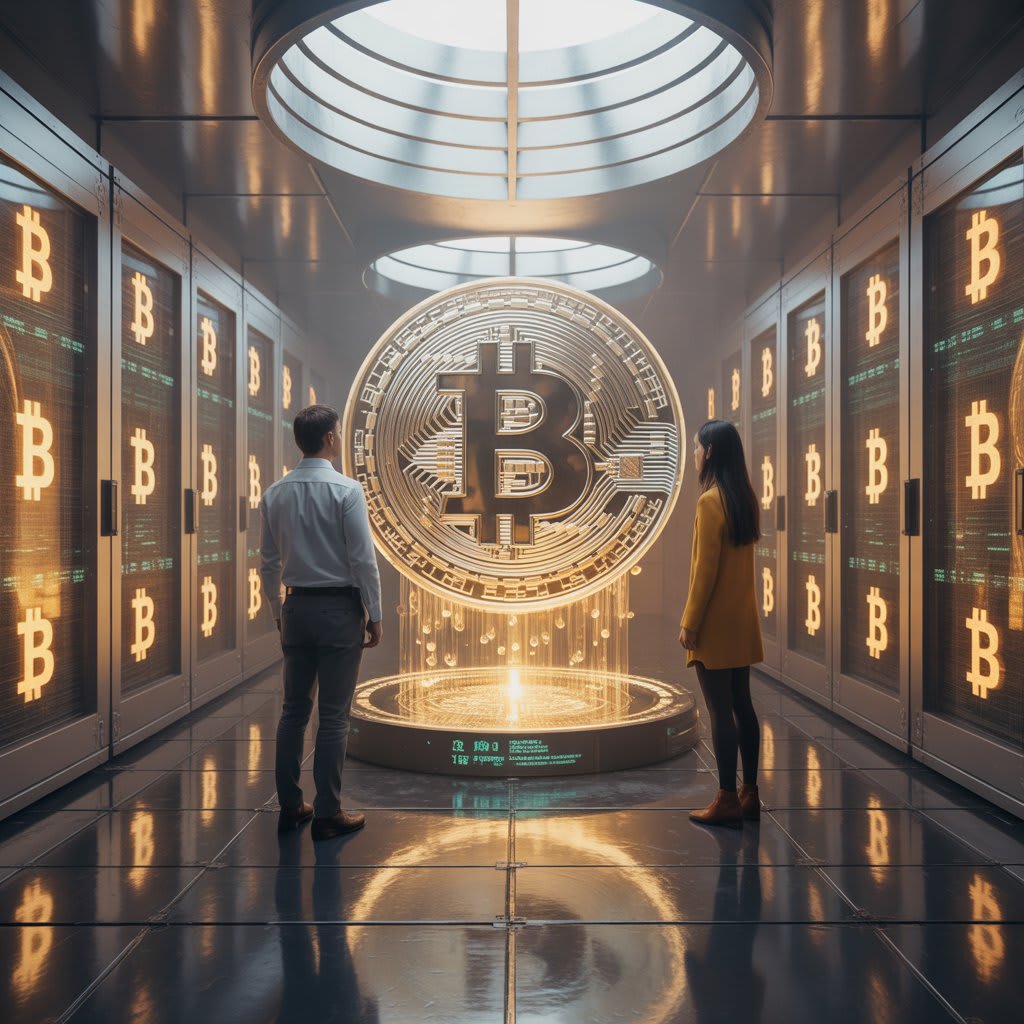
The year was 2140, and the air in New Geneva hummed with quiet anticipation. Across the globe, millions were counting down to an event that had been predicted for over a century: the mining of the 21 millionth Bitcoin — the final fraction to ever be created.
By now, Bitcoin was more than a currency. It was an institution, an immutable pillar of human trust. Physical banks were relics of the past. Governments could no longer print money into oblivion. Even the children of the 2100s grew up understanding concepts like hash rates, cold wallets, and block rewards.
But to Marcus Ren, a 32-year-old blockchain historian, the final block wasn’t just a symbolic milestone. He believed it would trigger something far more profound. Hidden within the Bitcoin protocol, buried in a place no one had dared to fully explore, was a final message from Satoshi Nakamoto.
Part 2 – The Whisper
Marcus had spent the last decade tracing Nakamoto’s original commits and notes. Most researchers treated the Bitcoin white paper as scripture — immutable and final — but Marcus suspected there were deliberate gaps in its logic.
The breakthrough came when he found an obscure 2131 forum post from a miner using the handle Fin_21. The post contained a fragment of code that seemed meaningless:
OP_RETURN 4c4f4f4b20554e44455220544845204c41535420426c4f434b
When decoded, the string read:
"LOOK UNDER THE LAST BLOCK"
Marcus’s pulse quickened. In Bitcoin, OP_RETURN allowed for storing arbitrary data in transactions. If Nakamoto had hidden something in the blockchain, it could have been waiting all this time — dormant until the network reached its final block.
Part 3 – The Miners’ Vigil
The race to mine the final block had become the greatest competition in human history. Mining pools, now operated by AI-controlled fusion-powered rigs, competed at unimaginable hash rates. Entire nations had formed alliances to maximize their share of the reward.
Marcus gained access to the Aurora Node, a Swiss-based validator cluster with one of the highest probabilities of sealing the last block. Its administrator, Dr. Elara Voss, was skeptical of Marcus’s theory, but intrigued enough to let him connect a read-only probe to monitor the mempool in real time.
“Even if Satoshi left a message,” Elara said, “what makes you think it’s for us? He left Bitcoin in 2010. This is two centuries later.”
“Because,” Marcus replied, “Bitcoin was never just about money. It was about what comes after.”
Part 4 – The Final Hash
On October 5, 2140, at precisely 14:09:15 UTC, the final block was found. Across every terminal and AR display in the world, the blockchain’s total supply counter froze at:
20,999,999.99999999 BTC
And then… something happened.
The coinbase transaction — normally containing only the miner’s reward — included an enormous block of encrypted data. The hash rate across the network spiked, not because miners were competing for rewards, but because they were trying to decode it.
Marcus, watching from the Aurora Node, felt his skin prickle. The data structure wasn’t random. It was a Merkle tree with an unused branch — a branch that, when opened with the right key, could spawn an entirely new chain.
Part 5 – The Key
Elara and Marcus worked through the night. The encryption was brutal, combining century-old elliptic curve cryptography with newer quantum-resistant algorithms. And yet, it seemed… personal.
At 03:14 UTC, they found it.
The key wasn’t a password. It was a transaction — the very first Bitcoin transaction ever made, from Nakamoto to Hal Finney in January 2009. The private key to Hal’s wallet had never been revealed.
Or so everyone thought.
The Aurora Node’s AI retrieved it from a time-locked data vault Finney had left to a nonprofit decades earlier. The moment they applied the key, the encrypted data bloomed into readable text.
Part 6 – Satoshi’s Message
The words appeared on every Bitcoin node in the world simultaneously:
“If you are reading this, the ledger is full. The experiment worked. But Bitcoin was only the seed.
Beneath the chain you know lies another — hidden from sight, unmined, unowned. This is the Genesis Chain. It cannot be bought or sold. It will not record wealth, but knowledge. Its blocks are not mined with energy, but with truth.
Welcome to the second ledger.”
And with that, a new protocol began to propagate across the network. It used Bitcoin’s global infrastructure but replaced monetary transactions with proofs of verified information — scientific research, historical records, and decentralized agreements. Every block was a snapshot of human knowledge, immutable for all time.
Part 7 – Aftermath
Marcus sat in silence as the world reacted. Some celebrated. Some panicked. Financial markets wobbled but did not collapse. Miners adapted, turning their rigs into verifiers for the Genesis Chain.
Bitcoin, the currency, was complete. Its 21 million coins would circulate forever, untouched by inflation. But now it had a sibling — a ledger for the mind instead of the wallet.
As Marcus stared at the Genesis Chain’s first block, he realized that Satoshi’s real gift was never money. It was a way to remember — to preserve truth in an age when truth was fragile.
The last Bitcoin had been mined, but the real blockchain had just begun.
About the Creator
AFTAB KHAN
SUBSCRIBE ME AND READ STORY
Storyteller at heart, writing to inspire, inform, and spark conversation. Exploring ideas one word at a time.
Writing truths, weaving dreams — one story at a time.
From imagination to reality
Keep reading
More stories from AFTAB KHAN and writers in Motivation and other communities.
The Bridge Between Two Worlds
1 — The Boy with a Map in His Head Rajiv Mehra grew up in Sundarwan, a small village tucked between the rolling hills of northern India. Sundarwan had no train station, no cinema, and only one road connecting it to the nearest town. But what it did have was a boy who could not stop drawing maps.
By AFTAB KHAN6 months ago in Motivation
One Hard Thing
Stop me if you’ve heard this one before: You have the number, you know your schedule- you’ve even picked out the perfect day and time to make this appointment. Shoot, you’ve even picked out alternative days and times just in case their schedules can’t accommodate you!
By Taylor Rigsby10 days ago in Motivation


Comments
There are no comments for this story
Be the first to respond and start the conversation.