
The Director Everyone Thought Was Crazy: Christopher Nolan’s Rise to Cinematic Mastery
How the mastermind behind 'The Dark Knight' and 'Oppenheimer' defied Hollywood’s safe formulas, trusted the audience's intelligence, and redefined blockbuster filmmaking forever

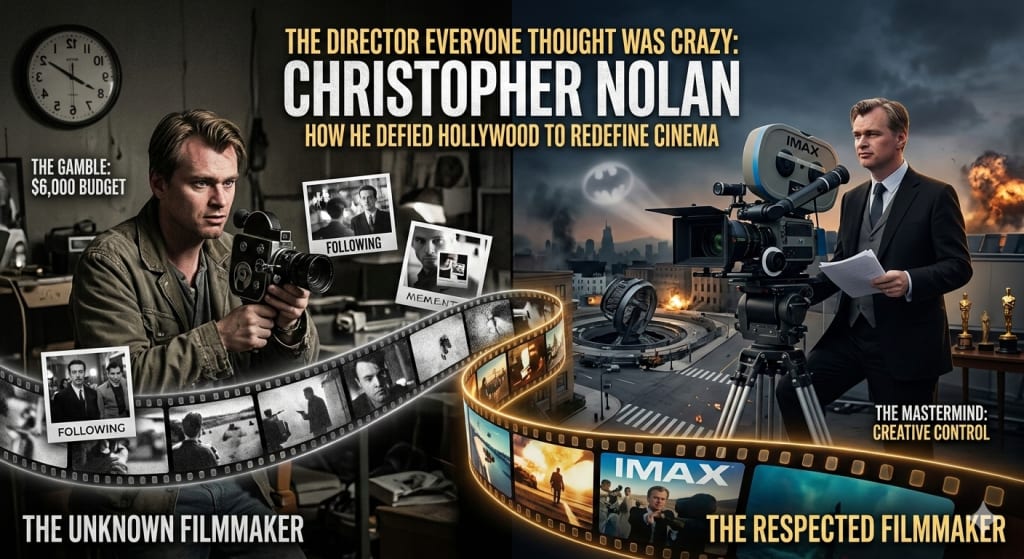
Today, Christopher Nolan is unequivocally one of the most respected, powerful, and bankable filmmakers in the world. When his name is attached to a project, audiences flock to theaters, and studios open their checkbooks without hesitation. He is a rare modern auteur—a director who commands massive budgets while retaining absolute creative control.
But long before the mind-bending streets of Inception, the gritty realism of The Dark Knight, or the explosive, Academy Award-winning historical weight of Oppenheimer, the film industry wanted nothing to do with him. Studios didn’t trust him with money. Executives didn’t trust his scripts. In fact, many in the industry thought his approach to storytelling was, quite frankly, crazy.
This is the story of how an outsider with no connections beat the Hollywood machine not by playing its game, but by rewriting the rules entirely.
Part I: The Unknown Filmmaker
In the late 1990s, the Hollywood gates were heavily guarded. To make a movie, you usually needed one of three things: a famous family, major studio funding, or overwhelming industry backing.
Christopher Nolan had none of these. He wasn’t a product of Hollywood power circles. He was an English literature graduate with a passionate, almost obsessive love for cinema, armed with little more than a 16mm camera and an uncompromising vision.
Determined to break in, he decided to make his first feature film, Following (1998). Without studio backing, Nolan had to rely entirely on his own resources. He used his friends as actors. Because everyone involved had regular day jobs to pay their rent, they could only film on weekends.
The budget? A microscopic $6,000.
To put that into perspective, $6,000 is less than what many mid-tier YouTubers spend on a single video production today. Because film stock was so incredibly expensive, Nolan couldn’t afford to do multiple takes. Every scene was rehearsed extensively before the camera ever rolled. He shot in black and white not just as a stylistic noir choice, but because it was cheaper. He used available natural light because he couldn’t afford lighting rigs. He was the director, the writer, the cinematographer, and the editor.
Following was a masterclass in constraints. But more importantly, it introduced the world to the "Nolan-esque" style: non-linear storytelling, deeply flawed protagonists, and a dark, psychological undercurrent. It gained enough traction at film festivals to give him a stepping stone, but Hollywood was still far from convinced.
Part II: Constant Doubt and the Complexity Issue
Even after gaining minor attention in the indie circuit, major studios hesitated to hand Nolan the reins. When he tried to get his next film, Memento, off the ground, he hit a massive wall.
Memento was a thriller about a man with anterograde amnesia trying to find his wife's killer. The catch? The story was told in reverse. It was a brilliant, intricate puzzle box of a script written by Nolan, based on a short story by his brother, Jonathan.
When Nolan pitched the film to distributors, the feedback was nearly unanimous, and it was brutal. Executives believed his storytelling was:
* Too complex: They argued that ordinary moviegoers wouldn't be able to follow a timeline moving backward.
* Too intellectual: They felt the film demanded too much active participation from the viewer.
* Too risky for mainstream audiences: Hollywood has always preferred safe, easily digestible formulas. They wanted linear, predictable three-act structures.
Studio heads urged Nolan to recut the film chronologically. They wanted him to "dumb it down." They operated under the assumption that the average moviegoer wanted to switch their brain off in the theater.
Nolan flatly refused.
He held a fundamental belief that would define his entire career: he insisted audiences were smarter than studios believed. He believed that people actually enjoyed being challenged, that they wanted to piece together a mystery, and that if you treated the audience with respect, they would reward you with their attention.
Eventually, Newmarket Films took a gamble on Memento. It became a massive critical and commercial success, earning Nolan an Academy Award nomination for Best Original Screenplay. He had proven the studios wrong once, but his biggest test was yet to come.
Part III: The Ultimate Gamble
By the early 2000s, Nolan had proven he could make brilliant, mid-budget thrillers like Memento and Insomnia. But the jump from a $40 million thriller to a $150 million summer blockbuster is a chasm that swallows many talented directors.
Warner Bros. was looking to reboot the Batman franchise. Today, comic book movies are the dominant currency of Hollywood, but back then, the genre was in a precarious place. The Batman franchise specifically had died a miserable, neon-soaked death with 1997’s Batman & Robin, a critical and commercial disaster that turned the Dark Knight into a laughingstock.
Warner Bros. eventually allowed Christopher Nolan to direct Batman Begins (2005). But this opportunity came with suffocating pressure.
If Nolan failed to revive the Caped Crusader, his career in large-budget filmmaking would likely end instantly. He would be relegated back to the indie world forever. The studio wanted a hit, and conventional wisdom suggested making it light, action-packed, and toy-friendly.
Instead of making a typical superhero film, Nolan treated it like a gripping psychological drama.
> "We wanted to explain the psychology of the character... we wanted to make him real."
>
He stripped away the campy costumes, the cartoonish villains, and the over-the-top CGI. He brought in an obsession with practical effects and grounded the mythology in absolute reality. He prioritized realism over spectacle and emotion over fantasy. He asked the audience to take a man dressed as a bat seriously, exploring themes of fear, corruption, and societal decay.
It was a massive gamble. A gritty, grounded superhero movie hadn't really been tested on this scale. But Nolan’s vision paid off. Batman Begins was a triumph, laying the foundation for what was to come.
Part IV: The Result and The Paradigm Shift
Three years later, Nolan released The Dark Knight (2008).
To say it changed cinema is an understatement. Featuring Heath Ledger’s haunting, Academy Award-winning performance as the Joker—a casting choice, by the way, that many fans and critics initially thought was a terrible idea—the film shattered box office records. It grossed over $1 billion worldwide. More importantly, it transcended its genre. It wasn't just a great comic book movie; it was heralded as a brilliant crime epic, drawing comparisons to Michael Mann's Heat.
The Dark Knight became one of the most influential films ever made. It fundamentally shifted the industry. Suddenly, studios everywhere were rushing to make their franchises "dark and gritty."
But the real victory was Nolan's. He definitively proved that blockbuster cinema could also be intelligent storytelling. He proved that you could have car chases and explosions without sacrificing philosophical depth, moral ambiguity, and complex character arcs.
Because of this monumental success, Warner Bros. essentially handed Nolan a blank check. He went from a low-budget outsider to one of the few directors trusted with massive, unprecedented creative control.
When he pitched Inception (2010)—a highly complex, original sci-fi film about corporate espionage taking place within the architecture of human dreams—studios would normally have laughed him out of the room. It was an original intellectual property (IP) with a massive budget, which is Hollywood's biggest fear. But because Nolan was driving it, it got made. It grossed over $800 million.
He followed this with the space epic Interstellar (2014), the gripping war film Dunkirk (2017), the time-bending Tenet (2020), and finally, Oppenheimer (2023). A three-hour, R-rated historical biopic about a quantum physicist, composed largely of people talking in rooms, which managed to gross nearly a billion dollars and sweep the Oscars.
Every single step of the way, Nolan proved his core thesis: never underestimate the audience.
Part V: The Real Lesson for Creators
Christopher Nolan didn’t succeed by following trends. He didn't look at what was popular at the box office and try to replicate it. He didn't bend to the will of focus groups or studio executives who wanted simpler narratives.
He succeeded by trusting his vision when experts doubted that audiences would understand it. He bet on depth in a system that constantly rewards simplicity.
Why This Story Matters
Whether you are a filmmaker, a writer, an entrepreneur, or a digital content creator, Nolan’s journey holds a critical lesson.
We live in an era dominated by algorithms. Creators are constantly told to optimize, to chase trends, to keep things short, punchy, and instantly gratifying. The pressure to conform to what is "working right now" is immense.
Because of this, many creators fail not because they lack talent… but because they dilute their originality to gain approval.
They water down their unique voice hoping to appease a broader audience or an invisible algorithm. They stop making the art they want to make, and start making the art they think people expect them to make.
Nolan protected his creative identity fiercely, even when it slowed his rise. If he had listened to the studios and recut Memento to be a standard, linear thriller, it might have been a moderate hit, but it wouldn't have been a masterpiece. He would have blended into the background of a thousand other competent directors. By refusing to compromise, he stood out.
Conclusion: The Motivation
Being misunderstood early in your career is not a sign of failure; it is often the mandatory price of doing something genuinely new.
If everyone instantly understands and approves of your idea, it probably isn't very innovative. Innovation usually looks risky, confusing, or even "crazy" right up until the moment it looks brilliant.
The next time you are tempted to dumb down your work, simplify your message, or chase a fleeting trend just to get noticed, remember the $6,000 filmmaker who shot on weekends. Remember the director who was told his reverse-chronological script was too confusing. Remember the man who took a broken comic book character and turned it into an Oscar-winning crime saga.
Trust your audience. Trust your vision. Bet on your own depth. The world doesn't need another imitation; it needs your original voice.
About the Creator
Frank Massey
Tech, AI, and social media writer with a passion for storytelling. I turn complex trends into engaging, relatable content. Exploring the future, one story at a time
Keep reading
More stories from Frank Massey and writers in Motivation and other communities.
The Carpenter Who Accidentally Built a Hollywood Empire: The Brutal Reality of Harrison Ford's Success
Picture the ultimate cinematic hero. He is standing in the middle of a dusty tomb, adjusting a battered fedora, and cracking a leather whip. Or, he is sitting in the cockpit of a battered spaceship, flashing a crooked, arrogant smirk before making the jump to lightspeed.
By Frank Massey 4 days ago in Motivation
My Street Addresses Have Been Messages To Me On My Journey
I used to think an address was just a line I had to complete on school forms and job applications. But when I looked back over my life, I realized something interesting about my addresses. They were much more than what was written on the mail I received.
By Margaret Minnicks4 days ago in Motivation


Comments
There are no comments for this story
Be the first to respond and start the conversation.