
: “The Bench by the Mango Tree”
A New Kite, a New Question The passing of the torch to a new listener under the same tree.

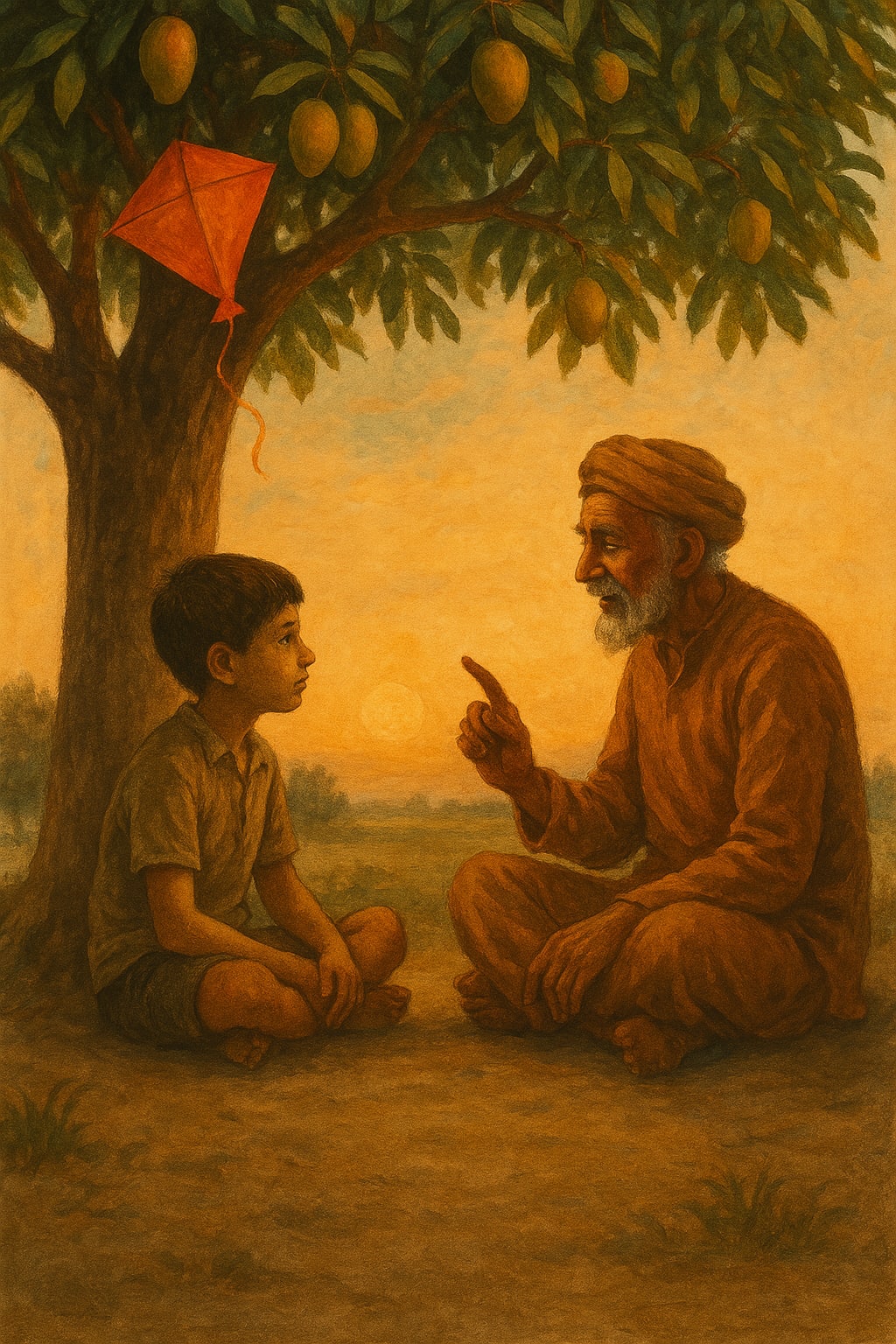
“The Bench by the Mango Tree”
There’s an old mango tree that stands at the edge of a village—weathered, generous, and quiet. People say it’s older than most homes nearby. Beneath it, a wooden bench leans slightly to one side, where time and stories have carved themselves into its planks. That bench is where the village’s storyteller once sat.
His name was Baba Haroon. He wasn’t a famous author or a scholar. He couldn’t read, but he could tell stories like rivers flow: effortlessly and full of life. Children would gather at sunset, when the sky turned amber like the fruit hanging above them, and Baba would begin—sometimes with laughter, sometimes with silence.
. . . . . . . . . . . . . . . . . .
One evening, a young boy named Sami came to him, slumped with disappointment. His kite had fallen into a well, and the neighborhood boys had laughed. His confidence, like the kite, had sunk. Baba Haroon listened quietly, then smiled and said, “Let me tell you about a man who planted mango trees where none could grow.”
Sami sat up. Baba began.
“There was once a man named Zaid who walked across a desert, carrying seeds in his pouch. Everyone laughed at him. ‘Nothing grows in sand,’ they said. But Zaid didn’t argue. Every morning, he would wake up, dig a small hole, and plant a single seed. He gave it a drop of water, whispered a prayer, and moved on.
“Days turned into years. He faced drought, dust storms, and the silence of failure. But one day, after decades of wandering and planting, a traveler came across a stretch of desert dotted with shade. Mango trees, proud and unbothered by the heat, stood in rows where once there was only dust.”
Baba paused.
. . . . . . . . . . . . . . . . . . . . . . . .
“The world remembers those who build cities,” he said, “but sometimes, it’s the planters of shade who change lives.”
Sami blinked. “Did the man live to see the trees?”
Baba shook his head. “No. But someone did.”
That night, Sami walked home with something new in his heart. His kite was still lost, but he held onto something more lasting—a seed of courage.
. . . . . . . . .
Years passed. Baba Haroon’s voice faded from the mango bench. The tree remained, still offering shade, still watching children grow beneath it. And one morning, years later, a teenage boy placed a new kite in the branches. Beneath it, he sat, and waited.
A child wandered up and asked, “Why did you leave the kite there?”
Sami smiled. “So someone like you would ask.”
And then he began, “There was once a man who walked across a desert…”
. . . . . . . . . . . . . . . . . . . . . . . . . . . . . .
The main idea of the story
“The Bench by the Mango Tree” is that acts of quiet persistence and selfless generosity—like planting seeds for trees whose shade you may never sit in—can have a profound impact on future generations. Through the storytelling of Baba Haroon and the transformation of young Sami, the narrative highlights how inspiration, like seeds, can grow silently and shape lives long after we’re gone.
Written by SOPHIA ROSE . . . . . . . . . . . . . . . . . . . . . . . . . . . . . . . . . . . .
About the Creator
Sofia Richie
Sofia is a storyteller who weaves emotion into every word. With a deep love for connection, language, and cultural depth, his stories illuminate unseen beauty and inspire reflection across borders—both real and imagine.
Keep reading
More stories from Sofia Richie and writers in Motivation and other communities.
The Voice Beyond the Hills
The Voice Beyond the Hills In a forgotten valley cradled by snow-veiled peaks, there lived a boy named Ayaan. Each night, as the sky spilled indigo ink across the land, he climbed the jagged path to a lonely cliff and sang. His voice—clear as mountain water and warm as firelight—rose into the wind, woven with melodies born not from books or notes, but from the depths of longing. Ayaan had no audience. No one saw the boy with stars in his throat. But still, he sang.
By Sofia Richie 7 months ago in Motivation
One Hard Thing
Stop me if you’ve heard this one before: You have the number, you know your schedule- you’ve even picked out the perfect day and time to make this appointment. Shoot, you’ve even picked out alternative days and times just in case their schedules can’t accommodate you!
By Taylor Rigsby9 days ago in Motivation
Why Being Liked is Overrated and Self-Respect is Everything
For a long time, I thought being liked was the goal. If people were comfortable around me, I felt successful. If no one was upset with me, I felt safe. If I could smooth things over, stay agreeable, and avoid conflict, I believed I was doing something right.
By Stacy Valentine3 days ago in Motivation



Comments
There are no comments for this story
Be the first to respond and start the conversation.