
The Architecture of a Ghost: How Michael Oher Weaponized His Trauma
Hollywood sold you a sanitized fairy tale about a wealthy family saving a quiet giant. The truth is much darker, much harder, and infinitely more powerful. This is the story of a boy who survived by becoming invisible, and won by learning to be seen


The raw, unfiltered true story of Michael Oher. Beyond the Hollywood movie, discover how a homeless teenager surviving the brutal streets of Memphis turned his deepest traumas into an NFL legacy.
Introduction: The Hollywood Lie
We love a good savior narrative.
We love the idea that someone swoops in, buys a kid some clothes, gives him a bed, and suddenly, magically, a superstar is born.
That is the story Hollywood sold the world in The Blind Side.
But reality doesn't wear makeup. Reality is cold, brutal, and deeply uncomfortable.
And just to set the record straight from the jump: Michael Oher wasn’t a basketball player cut from a dream, though he played on the hardwood. His true destiny, the place where his life's brutal training would finally make sense, was the violent, structured warfare of the American football gridiron.
Before the NFL.
Before the Super Bowl ring.
Before the college scholarships.
Michael Oher was a ghost.
He was born into a world that did not want him, equipped with absolutely nothing but a massive physical frame and an instinctive, desperate need to survive.
If you want to understand true resilience, you have to throw away the movie script. You have to walk into the darkness of Memphis, Tennessee, and look at a child who was forced to build a fortress out of silence.
Part I: The Geography of Nowhere
Imagine trying to build a skyscraper, but every night, someone comes along and moves the foundation.
That was Michael’s childhood.
He was one of twelve children born to a mother who was losing a brutal, daily war against crack cocaine. His father was a ghost, rotating in and out of the prison system before eventually being murdered.
Home was not a place. Home was a moving target.
Michael grew up in Hurt Village, a notoriously dangerous public housing project in Memphis. But even that wasn't permanent.
When the money ran out, or the evictions came, he was pushed into the foster care system. He bounced from house to house. He slept on friends' floors. He slept in cars. Sometimes, he slept on the streets, locking the doors of abandoned vehicles to keep the violence of the night away.
He attended 11 different schools in nine years.
Think about the psychology of that.
Think about what happens to a child’s brain when there is zero consistency.
When you don't know where your next meal is coming from, you don't care about algebra.
When you don't know whose roof you are sleeping under tomorrow, you don't care about making friends.
You learn one lesson, and you learn it flawlessly: Do not trust the environment, and do not trust the people in it.
Part II: The Art of Being Invisible
By the time Michael was a teenager, he was enormous. He was well over six feet tall and weighed over 300 pounds.
But despite taking up so much physical space, his primary survival mechanism was to disappear.
When he finally landed at Briarcrest Christian School—a prestigious, wealthy, predominantly white private school—he was an alien on a different planet. He was admitted not because of his grades, but because an athletic director saw his raw, terrifying physical potential.
But in the classroom, Michael was a phantom.
He sat in the back. He didn't speak. He didn't look teachers in the eye.
His grade point average was a 0.6.
The teachers looked at his test scores, looked at his silence, and made the easy, fatal assumption: He is slow. He lacks intelligence. He can't learn.
They were wrong.
Michael Oher wasn't stupid. He was traumatized.
When your entire life has been a cycle of abandonment, you do not volunteer pieces of yourself. You do not ask questions, because asking questions draws attention. And in the world Michael came from, attention usually meant danger.
He had built a wall of silence so thick that nothing could get in, which meant nothing could get out. He was failing because he was expending all his mental energy just trying to survive the day.
Part III: The Collision of Worlds
The turning point did not happen with a dramatic swelling of orchestral music. It happened on a freezing night in Memphis.
Michael was walking down the side of the road, wearing a T-shirt and shorts in the dead of winter, heading toward the school gym because it was the only place he knew that had heat.
The Tuohy family—Leigh Anne and Sean—drove past him. They had seen him at the school. They knew he was the kid who wore the same clothes every day.
They stopped the car. They put him in. They gave him a place to sleep on their couch for the night.
That one night turned into two. Then a week. Then months.
But here is the harsh reality that gets glossed over: Trauma does not evaporate because you change the zip code.
Giving a traumatized, homeless teenager a warm bed does not magically fix his brain. Michael was deeply distrustful. He expected the Tuohys to abandon him, just like the system had, just like his biological family had. He kept his guard up. He kept his silence.
The real miracle wasn't that they offered him a room.
The real miracle is that they stayed.
For the first time in his life, Michael encountered a structure that did not collapse when he leaned on it.
Someone checked his homework. Every single night.
Someone hired a tutor to rebuild his education from the ground up.
Someone demanded that he look them in the eye.
Slowly, agonizingly, the phantom began to materialize into a man.
Part IV: Weaponizing the Trauma
As Michael's environment stabilized, his mind began to clear. And when his mind cleared, he stepped onto the football field.
Football is a game of controlled violence. It requires immense physical power, but more importantly, it requires a specific psychological makeup.
Michael was placed at the position of Left Tackle.
The Left Tackle is the most important position on the offensive line. His sole job is to protect the quarterback's "blind side"—the side the quarterback cannot see when dropping back to pass.
It is a position that requires hyper-vigilance. It requires a man who views the person he is protecting as family, and views the defender as a lethal threat.
The coaches looked at Michael's psychological evaluations. He scored extremely low in almost every category—aptitude, career interest, learning skills.
But he scored in the 98th percentile in one specific metric: Protective Instincts.
This wasn't a sports skill. This was a trauma response.
When you grow up in a war zone, protecting the few people who show you kindness becomes a matter of life and death. Michael Oher took the hyper-vigilance he learned in Hurt Village—the instinct to constantly scan the room for threats, the instinct to violently defend his space—and he weaponized it.
He didn't just block defensive ends. He erased them. He hit them with the pent-up rage and desperation of a kid who had been pushed around his entire life.
The football field became his sanctuary. It was the only place in the world where his size, his aggression, and his protective nature were not liabilities. They were superpowers.
Part V: The Draft and the Reality Check
Michael’s grades improved. He did the impossible, raising his GPA enough to qualify for an NCAA Division I scholarship.
He went to the University of Mississippi (Ole Miss). He became a unanimous All-American.
In 2009, he was drafted in the first round of the NFL Draft by the Baltimore Ravens.
He went on to win a Super Bowl. He made millions of dollars. He bought his own home—a home that nobody could ever evict him from.
From sleeping on the concrete of Memphis to holding the Lombardi Trophy in confetti.
But if you look at Michael Oher’s life and think the NFL was his greatest achievement, you are missing the point entirely.
Part VI: The Dark Philosophy of Potential
The world is obsessed with "talent."
We think talent is a magical seed that will grow no matter where it is planted.
Michael Oher’s story is a violent rejection of that idea.
Talent requires soil.
How many Michael Ohers are out there right now?
How many massive, brilliant, highly capable human beings are currently sitting in the back of a classroom, completely invisible, failing not because they are stupid, but because they are starving?
We look at people who are failing and we tell them to "work harder." We tell them to "pull themselves up."
But you cannot pull yourself up if you are standing in quicksand.
Michael Oher wasn't failing because he lacked drive. He was failing because he was spending 100% of his energy on basic survival.
The moment the Tuohys removed the burden of survival—the moment he didn't have to worry about where his next meal was coming from or where he was going to sleep—his brain finally had the bandwidth to learn, to grow, and to dominate.
Conclusion: The Shift from Surviving to Belonging
There is a fundamental difference between surviving and existing.
Surviving is a defensive posture. You are just trying to make it to tomorrow without dying.
Belonging is an offensive posture. You realize you have a place in the world, and you start building your empire within it.
Michael Oher didn't just get lucky. He was handed an opportunity, and he executed it with terrifying discipline. He did the grueling academic work. He spent thousands of hours in the gym. He reprogrammed his own mind to trust the process.
But his story is a mirror held up to the rest of us.
It forces us to ask a difficult question:
What is the environment you are currently operating in?
Are you punishing yourself for not achieving greatness, when in reality, you are trying to build a empire in a ghost town?
Sometimes, the smartest, most powerful thing you can do is not to "hustle harder," but to radically change your environment. To find the people who demand excellence from you. To find the structure that holds you up when you are tired.
Success sometimes begins the exact moment you stop fighting a war in a vacuum.
Michael Oher was handed a life sentence of poverty, addiction, and invisibility.
He served the time. He broke out of the prison. And he built a castle on the outside.
The Lesson:
Talent hides behind circumstance.
Do not let your current circumstance convince you that you have no talent.
Change the soil. Protect your blind side. And when you finally find your footing, hit the obstacles so hard they never get back up.
About the Creator
Frank Massey
Tech, AI, and social media writer with a passion for storytelling. I turn complex trends into engaging, relatable content. Exploring the future, one story at a time
Keep reading
More stories from Frank Massey and writers in Motivation and other communities.
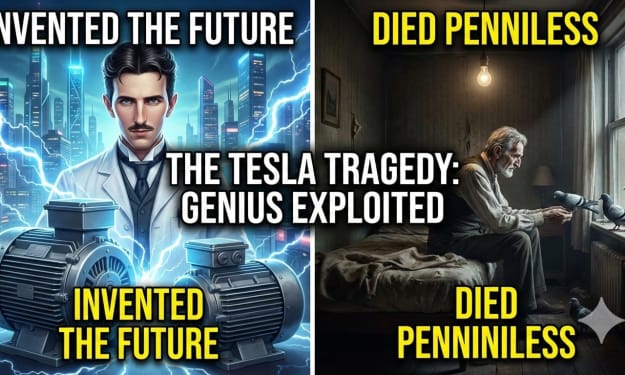
The Architect of Light Who Died in the Dark: The Tragedy and Triumph of Nikola Tesla
The dark, philosophical true story of Nikola Tesla, the genius who won the War of the Currents against Thomas Edison but sacrificed his own fortune to build the modern electrical grid.
By Frank Massey a day ago in Motivation
One Hard Thing
Stop me if you’ve heard this one before: You have the number, you know your schedule- you’ve even picked out the perfect day and time to make this appointment. Shoot, you’ve even picked out alternative days and times just in case their schedules can’t accommodate you!
By Taylor Rigsby27 days ago in Motivation
5 Questions That Reveal Your Life Purpose
Most people think life purpose arrives like a lightning bolt. One day you wake up, angels sing, and suddenly you know exactly what you’re meant to do. That’s a nice movie scene—but real life doesn’t work like that. Purpose is quieter. It reveals itself through patterns, pressure, and the questions you’re brave enough to ask when no one’s watching.
By Fred Bradfordabout 22 hours ago in Motivation
The Cave Part 6
If you have ever heard a tale about yourself that you cannot remember and doubtless think is made up, you will know how I felt when Tharkin related all that the eagle had seen of me before my memories were scattered. Of far distances and traveling companions that I did not recall, camping out under the stars and making our way to the mountains with deliberate purpose. The great bird had lost contact with my party once we entered the forests, and the seven other members were not seen again by him or his brethren since.
By Jamye Sharp6 days ago in Chapters



Comments
There are no comments for this story
Be the first to respond and start the conversation.