
Sad Girl Vibes
Why Being Soft, Sensitive, and Emotional Is a Quiet Superpower

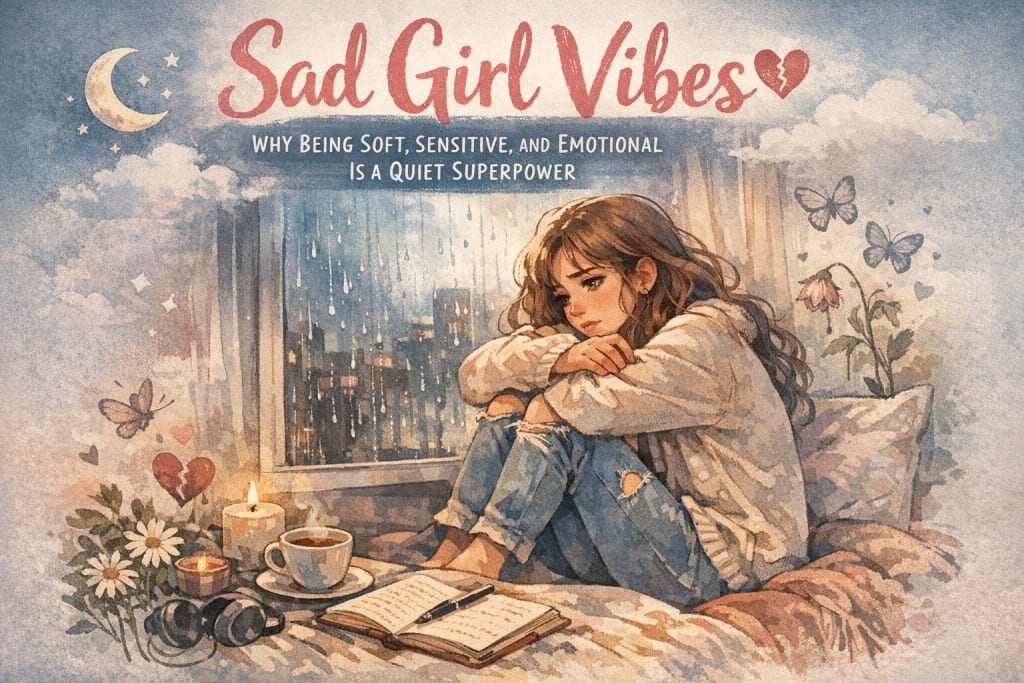
There’s a particular kind of girl people like to roll their eyes at.
She cries easily, feels “too much,” overthinks everything, and apologizes for taking up emotional space.
You know her.
You might be her.
“Sad girl” culture gets mocked as dramatic, self-indulgent, or weak. But under the eyeliner, playlists, and late-night notes app confessions, something powerful is happening.
The traits the world tells you to kill off—your softness, your sensitivity, your emotional depth—are not glitches.
They’re features. And if you learn how to work with them instead of against them, they become a quiet, lethal superpower.
Where “Sad Girl” Vibes Really Come From
The “sad girl” isn’t just a Lana Del Rey soundtrack and a vague sense of melancholy.
She’s the one who:
- Notices the shift in someone’s tone before they say anything’s wrong
- Remembers what you said you were afraid of three months ago
- Feels wrecked by a throwaway comment someone else would shrug off
From the outside, it looks like fragility. On the inside, it’s heightened perception turned inward, without a user manual.
Most sensitive, emotional people were never taught how to live with their feelings.
They were taught to hide them.
So they grow up thinking:
- “I’m too much.”
- “My reactions are a problem.”
- “If I could just be colder, life would be easier.”
And honestly? In some ways, that last part is true.
It would be easier to float on the surface. But you weren’t built for the shallow end.
Softness Is Not the Opposite of Strength
People talk about resilience like it means “nothing affects you."
That’s not resilience; that’s numbness.
Soft, emotional people are often forced to develop a different kind of resilience:
- You break, but you rebuild.
- You feel everything, but you still show up.
- You get hurt, but you don’t turn into someone who hurts others by default.
That’s not weakness. That’s endurance.
Strength isn’t “never cries."
Strength is “cries, rests, then keeps going without hardening into someone unrecognizable.”
There’s a reason so many “sad girls” secretly become the friend everyone relies on.
You’ve walked through so many internal storms that other people’s pain doesn’t scare you.
You’ve already met your darkness. You’re not afraid of theirs.
Emotional Depth = X-Ray Vision for Human Behavior
Being sensitive isn’t just about feeling your own emotions.
It’s about picking up on everyone else’s.
At first, that can feel like a curse. A crowded room is overwhelming. Group chats exhaust you. You can’t unhear tension in someone’s voice.
But look at what else it allows you to do:
- Detect when someone’s putting on a brave face but is actually falling apart
- Sense when a group is about to turn against someone
- Notice the “little” comments that later turn into big problems
This is social and emotional pattern recognition.
You’re running a constant internal scan of what’s going on beneath the surface.
That makes you:
- A better friend
- A more intuitive partner
- A thoughtful creator, writer, or artist
- The kind of coworker or leader people actually trust
You see the subtext. You don’t just hear the words; you feel the intention.
Yes, it’s draining.
But it’s also rare.
Why Sad Girls Make Powerful Creators and Thinkers
A lot of sensitive people end up turning their feelings into something else because they don’t know what to do with them.
So they write.
They draw.
They sing.
They make dark jokes with oddly specific punchlines that land a little too well.
That constant inner monologue, that urge to unpack everything, is a creative engine.
You don’t just experience life; you *process* it.
You notice:
- The way a room feels different after someone leaves
- The crack in someone’s voice when they say, “I’m fine”
- The grief in endings that nobody else even labels as endings
Those details are what make good art feel real.
They’re also what make good essays, good conversations, and good decisions.
Emotional people aren’t clouded by feelings; they’re informed by them.
You’re tracking not just “What’s happening?” but also “What does this mean?” and “How does this affect people?”
That’s not overthinking. It’s deep thinking.
The problem is we only call it “overthinking” when it makes us uncomfortable.
The Dark Side: When Sensitivity Turns Against You
Let’s be honest. Being soft isn’t all poetic suffering and pretty aesthetics.
Sometimes being sensitive means:
- You spiral over a text that ends in a period instead of an emoji
- You replay a conversation for three days, analyzing every word
- You get physically tired from a minor conflict
- You carry guilt for things that weren’t actually your fault
You’re wired to look for meaning, so your mind doesn’t like leaving gaps.
When you don’t have enough information, you fill in the blanks—with fear, usually.
That’s where the “sad girl” identity can become a trap.
It stops being a lens and starts being a cage.
If your entire personality becomes “the one who is always hurting,” you’ll subconsciously gravitate toward people and situations that prove you right.
The superpower isn’t in the sadness.
It’s in what you do with the sadness.
Turning Your Feelings into a Superpower (Without Burning Out)
Soft and sensitive doesn’t mean helpless.
Here are a few ways to channel the chaos instead of drowning in it:
1. Stop apologizing for having feelings.
There’s a difference between apologizing for how you expressed something and apologizing for *having* the emotion at all.
Try:
- “I’m working through some feelings about this”
instead of
- “Sorry for being so emotional.”
Language matters.
You teach people how to treat you partly by how you talk about yourself.
2. Build boundaries like someone you care about.
Hyper-empathic people often confuse “being kind” with “being available at all times.”
You’re not a 24/7 emotional support hotline.
You can say:
- “I care about you, but I don’t have the capacity to talk about this tonight.”
- “I want to listen properly; can we talk tomorrow when I’m less flooded?”
That’s not cold. That’s sustainable.
3. Use structure to contain your feelings.
If you let your emotions roam free 24/7, of course they’ll take over.
Give them containers:
- A notes app document that no one will ever see
- A daily 10-minute “feel everything” journal dump
- A playlist you only put on when you want to actually sit with something
Paradoxically, when you make time for your feelings on purpose, they shout less at random.
4. Turn sensitivity outward, not just inward.
You already know how deeply you feel. You’ve got that down.
Try noticing how your sensitivity can:
- Spot who’s being left out in a group
- Pick up when a coworker is overwhelmed and doesn’t know how to say so
- Sense when a friend’s “joke” about themselves isn’t really a joke
You don’t have to fix anyone. Just seeing them, really seeing them, is impact enough.
A Quiet Rebellion Against Emotional Numbness
If you’re soft, sensitive, and emotional in a world that rewards disconnection, you are already rebelling.
You’re refusing to go fully numb.
You’re refusing to stop caring.
You’re refusing to pretend things don’t hurt when they do.
That doesn’t always feel like a superpower.
Most days, it just feels like being raw in a world made of sandpaper.
But pay attention to who finds you.
The people who feel safe crying around you.
The ones who say, “I’ve never told anyone this before."
The friends who text you because “you just get it.”
Your softness pulls honesty out of people.
Your sensitivity cracks open conversations that would otherwise stay on the surface.
Your emotional depth turns ordinary moments into something that actually matters.
Anyone can build walls.
Not everyone can sit with what’s real.
If you’re the girl who feels too much, cries too often, and cares too deeply, you don’t need to toughen up to survive.
You need to realize this:
The world is quietly built and held together by people like you—those who feel the weight of it and still choose to stay gentle.
About the Creator
abualyaanart
I write thoughtful, experience-driven stories about technology, digital life, and how modern tools quietly shape the way we think, work, and live.
I believe good technology should support life
Abualyaanart
Keep reading
More stories from abualyaanart and writers in Motivation and other communities.
The Year of the Horse 2026
The next Year of the Horse begins on February 17, 2026, and ends on February 6, 2027. In the Chinese zodiac cycle, Horse years are associated with speed, momentum, and movement. 2026 adds another layer: it’s a Fire Horse year, which brings extra heat, volatility, and intensity—both promising and demanding at the same time.
By abualyaanartabout 20 hours ago in Motivation
One Hard Thing
Stop me if you’ve heard this one before: You have the number, you know your schedule- you’ve even picked out the perfect day and time to make this appointment. Shoot, you’ve even picked out alternative days and times just in case their schedules can’t accommodate you!
By Taylor Rigsby23 days ago in Motivation
The Doormat Syndrome
When being "good" hurts..... 💗 Studies show that people-pleasing significantly increases the risk of burnout. People-pleasers are especially susceptible because their difficulty setting boundaries and their desire to be loved by everyone directly lead to chronic stress and emotional exhaustion.
By Jeanne Jess 3 days ago in Motivation



Comments
There are no comments for this story
Be the first to respond and start the conversation.