
Stress Eating Explained (And Other Weird Fight Or Flight Responses)
When survival whispers, the body answers—sometimes with food, sometimes with flight

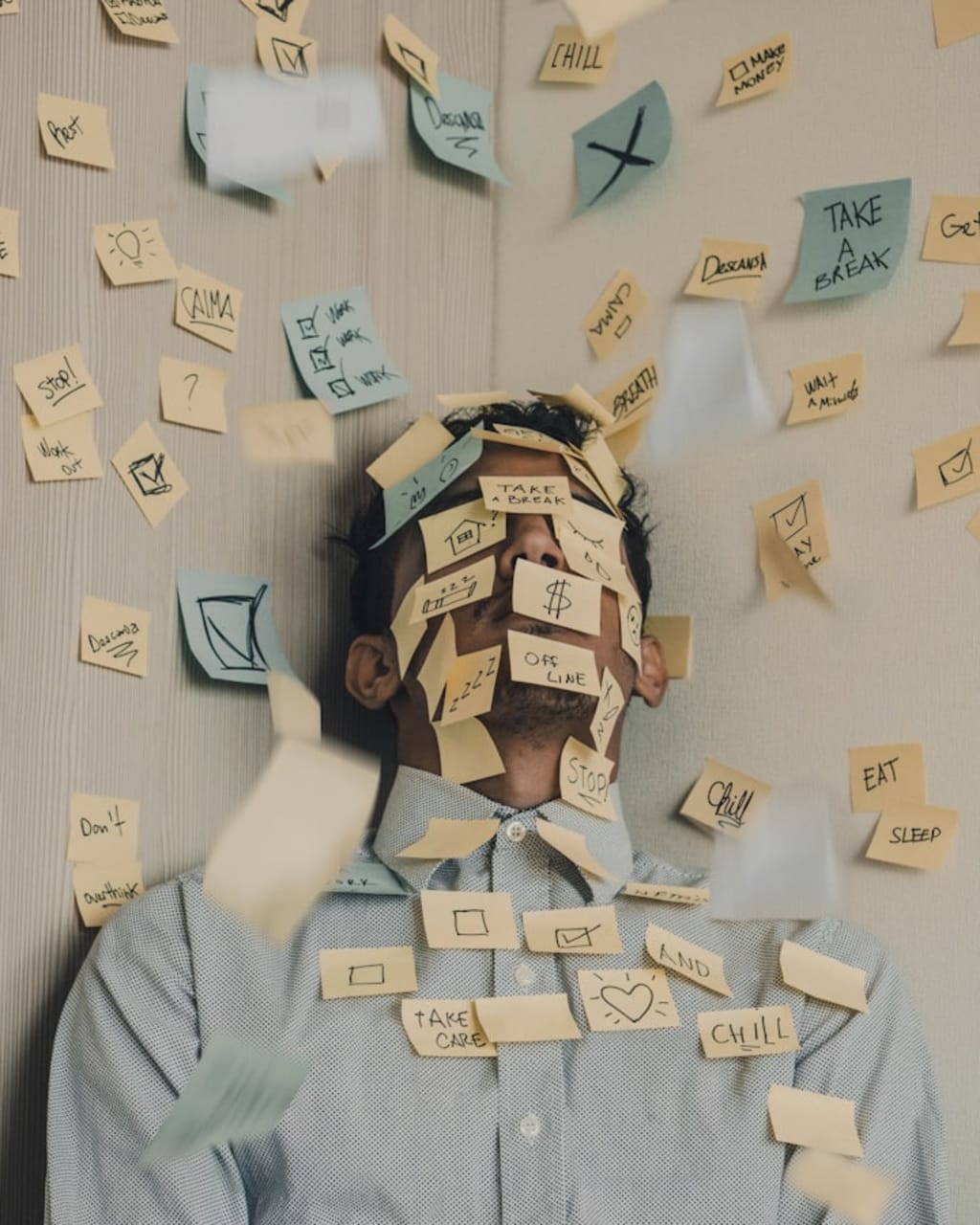
It’s time to give that big presentation.
You look around the room and see the faces of people you need to impress staring back at you.
Then you feel your own face go pale, and your heart starts to race.
Your jaw is clenched, and for some reason, your shoulders are tightening and raising.
This is a critical moment in your career, and your body is completely betraying you!
But there's a good evolutionary reason that you react this way under stress.
The same fight or flight impulses that are ruining that powerpoint presentation have also served humanity pretty well in the past.
Our bodies have a hard time telling the difference between the stress of being chased by a bear and being chased by a project deadline.
So let's look at five weird fight or flight responses your body has when you're perfectly safe.
[♪ INTRO] As smooth as you might think you are, it’s clear to anyone looking at you that you’ve entered fight or flight mode.
Often, the blood will drain away from parts of your face, and you look really pale.
And I said parts of your face, because it doesn’t drain from the whole thing.
It just moves to a place where it can be more useful.
It gets shuttled to the area around your eyes.
And that helps you make quick eye movements, which you might need when, say, planning and executing an escape.
That’s really helpful when you’re running from a grizzly.
But less so when you’re trying to keep your cool in a stressful conversation.
Because blood flowing away from most of your face just shows the other person how stressed you are.
Now I have to give a quick disclaimer here that I’m talking about temporary, acute stress.
Chronic stress is a different thing, and this video is not about that.
A lot of the ways your body goes into fight or flight mode are okay every now and again, and might even provide a momentary benefit to you.
But if your body is constantly doing this stuff, it can become harmful.
OK, back to going pale.
To show how this happens, one small experiment involved 32 people who were put in a fake crime interrogation.
Some of the participants were told to steal a gold necklace from the lab while the others didn’t get that instruction.
Then they were interrogated in front of a thermal camera.
The thermal camera was supposed to capture the fight or flight effect of blood redistributing throughout their faces.
Using an AI tool to analyze the thermal data, the researchers could accurately guess who was innocent and who was guilty 87% of the time!
Which means that professionals can use the movement of your blood away from parts of your face as a reliable indicator of stress.
But since those participants were following instructions and didn’t necessarily feel much heat for their crime, you might not be convinced that this technique really reveals all that much.
For the skeptics, another experiment published in 2006 might be more compelling.
These participants were selected because they felt really strongly about something political.
They might have been pro-choice for example.
And they were told that there was a check in an envelope just down the hall made out to an opposing group, like a pro-life organization.
Then they could choose whether or not to steal it.
Another important part of this experiment was that they needed to convince the interrogator of their innocence or else the organization they didn’t like would get the money.
This experiment might be considered more consequential.
The crime was more genuine, and there was motivation to do it.
And researchers ended up being able to identify the criminals and the innocent participants with almost exactly the same accuracy rate as in the other study.
So both of the studies were able to use facial blood flow changes to reliably tell when a person is stressed.
But that’s just one physical sign of stress.
You don’t need a thermal camera to see when someone tenses up.
You know when you’re so stressed that you have to actively tell your shoulders to go down and relax?
Or you finish that project and suddenly realize your jaw hurts because you’ve been clenching it the whole time.
Or your hand cramps up because you’ve been gripping the pen so tight?
That’s your muscles’ stress response.
If you were in a real fight or flight situation, you’d be tensing to protect yourself.
Like if you had to jump off a cliff into the water, you’d brace yourself for impact.
But when you’re writing a paper, sure it’s stressful, but you don’t need to brace yourself that way.
It won’t get the job done any faster.
It’s just a stress response we can’t seem to shake.
One study tested this effect using electromyography, or EMG measurements.
An EMG assesses the electrical responses from your muscles.
And in this case, they were testing the participants’ muscle responses to the anticipation of an electric shock.
That’s not quite the same kind of stress as a presentation, but this study gives us an idea of how your muscles respond to stress in general.
And don’t worry, these shocks weren’t enough to do any damage.
The researchers were interested in the response to not just physical, but also psychological stress anyway.
To get both of these factors into their study design, they told participants they were going to stress test them with an electrical shock… but the participants wouldn’t know when the shock was coming.
That way, they could get pre-stress, immediately after stress, and post-stress muscle reactions.
They found that just waiting for the shock to happen led to increased muscle tension, with participants’ pre-stimulus muscle tension higher than at baseline.
Then when the shock finally came there was an immediate spike in tension, followed by a decrease.
So basically, it’s not just the pain that causes muscle tension, but also the anticipation of it.
And even though you might tighten up from both physical and psychological stress, this study was just describing a physical tensing response.
The next item on our list shows how intense the emotional response from stress can be.
But before that next item, here’s an ad.
This is an unprecedented month for SciShow!
Today, I have the honor of thanking three Presidents of Science: We've got McLaren Stanley, who's named after one of the fanciest cars and one of the fanciest cups.
We've got Charlie Stanley, who's named after a young boy who has a famous dog and also the other famous cup.
There's two famous cups called Stanley!
And also, thank you to TJ Steyn, who's also named after a cup.
It's spelled different!
It's a very cup-centered bunch of folks here. Thank you, to all three of you, for making accurate information free for anyone with an internet connection!
If you’re like most people who watch SciShow, you don’t pay a thing.
You get to sit back and learn from our made-from-scratch videos about the wonder of the world and the constant innovation happening everywhere.
These videos are free, and we want them to be free.
But they still cost money to make.
And we reconcile those conflicting statements with the help of patrons like the Presidents of Science.
They pay for SciShow so you don’t have to.
And if you can join them responsibly, we would love to have you at patreon.com/SciShow.
If you feel emotionally sensitive during stressful situations, that’s clearly not helping you accomplish whatever is stressing you out.
Crying in an interview won’t get you the job and yelling at your coworker won’t help the team work together to finish a project.
But sometimes, our emotions get the best of us.
This happens because the emotional regulation center of your brain, a region called the amygdala, is one of the main areas controlling how you respond to stress.
When you suddenly find yourself in that kind of situation, your amygdala responds by sending fast-acting chemical signals to other parts of your body to boost its overall excitability.
This makes you more vigilant and able to respond to threats.
The side effect of activating your emotion center is, well, emotion.
One study published in 2022 investigated how the amygdala communicates with other parts of the brain during stressful situations.
Specifically, a math test.
Many of us dread the idea of any kind of math test.
But this one was made even more stressful by time limits to answer each question, pressure to get them right or else the data wouldn’t be used, and disappointed feedback from the experimenters when a participant missed a question.
That is my own personal hell...
During that stress nightmare, the participants had functional magnetic resonance imaging, or fMRI, readings to see what was going on in their amygdalas.
The main conclusion was that the parts of the brain keeping your amygdala in check aren’t communicating with it as much when a stressful event happens, and that might be why you respond to it so emotionally.
This builds on an earlier study that found that the amygdala is more responsive yet less selective in stressful situations.
Since you’re in fight or flight mode, the default is that everything is important to respond to.
That adaptation to increase vigilance with the side effect of lowered emotional inhibitions might help you notice a jaguar emerging from the shadows, but it could ruin your office banter.
And emotions aren’t the only thing stress can make you lose control over.
Sometimes, it makes it hard to control things as basic as breathing.
When you’re about to knock on your boss’s door, you might feel your heart start to race and begin breathing faster than you’d like.
While that’s not going to improve your conversation with your boss, it can be helpful in other fight or flight situations.
It’s all in service of getting more oxygen to your cells so they can use energy.
You don’t need that much energy to chat with your boss, but you might if you’re running from a predator.
It’s another example of your body doing a thing that was once very useful.
But enough about physiological changes that kind of make sense.
Let’s get to the weirdest stress response of them all.
Whenever you’re in a tense situation, you may find yourself indulging in more snacks than usual.
After completing a big project, you might look around to find a room covered in crumbs and wrappers.
That can’t be a positive stress response.
In fact, it confused researchers who study this stuff for years.
Because “Fight or Flight” is supposed to be the opposite of “Rest and Digest”.
In these situations, your appetite should be suppressed so your body can focus on the task at hand.
And one of the chemicals that suppresses appetite is adrenaline, which is released during stress.
But the thing is … some people do the opposite and up their junk food intake when they’re stressed.
It’s me, I’m people.
Since it’s an excellent way to not gain an advantage in a fight or flight situation, scientists called this the “stress-eating paradox.” And in 2022, a study helped solve this mystery.
It concluded that stress eating is related to how your heart rate changes.
It turns out that not everyone has the same heart rate response to stress.
Generally, your heart rate increases when you’re tense.
But for some people, it increases more than for others.
And if your heart rate increases at the low response end of the spectrum, then you’re more prone to stress eat.
Especially the starchy stuff.
Let’s be real, how many times have you stress-eaten tilapia?
No, you go for the salt and vinegar chips.
It appears that appetite suppression might not kick in unless your heart rate response is big enough.
Until then, you have the opposite reaction and stress eat.
So everyone responds to stress a little differently.
But regardless of what your body does, some of it probably seems pretty unhelpful today.
Your fight or flight responses can get triggered by psychological stressors that aren’t at all life threatening.
But remember: they’ve served us well in the past, and still do on occasion.
And now that you know where these weird responses come from, you don’t have to stress about them
About the Creator
Keep reading
More stories from taylor lindani and writers in Lifehack and other communities.
15 Detective Riddles to Outsmart Everyone Around You
Mr. Perry was at a company meeting when suddenly all the lights went off due to a blackout. When they came back on, Mr. Perry's valuable pen was missing. He asked his colleagues what they were doing in the dark. John said he was replying to his emails. Tom claimed he was looking for a flashlight in his bag.
By taylor lindani9 months ago in Lifehack
Why Noise-Cancelling Headphones Are Essential for Remote Work
Remote work has changed the way people experience their workday. While working from home offers flexibility and comfort, it also introduces new challenges — one of the biggest being noise. From traffic sounds and construction to conversations at home, background noise can quickly disrupt focus and reduce productivity.
By Bahati Mulishiabout 10 hours ago in Lifehack
Moving in Canton: How Preparation Shapes the Relocation Experience
Relocating within or to Canton is often seen as a straightforward process, but many residents quickly discover that even local moves come with unexpected challenges. While the town offers a calm residential atmosphere and accessible neighborhoods, the success of a move depends largely on preparation rather than distance alone. Understanding how moving companies operate within Canton’s specific context can make the difference between a stressful day and a smooth transition.
By House Doctora day ago in Lifehack


Comments
There are no comments for this story
Be the first to respond and start the conversation.