
FISKARS CONTEST - Cast Glass Sculpture
Clay Sculpture Turned to Glass
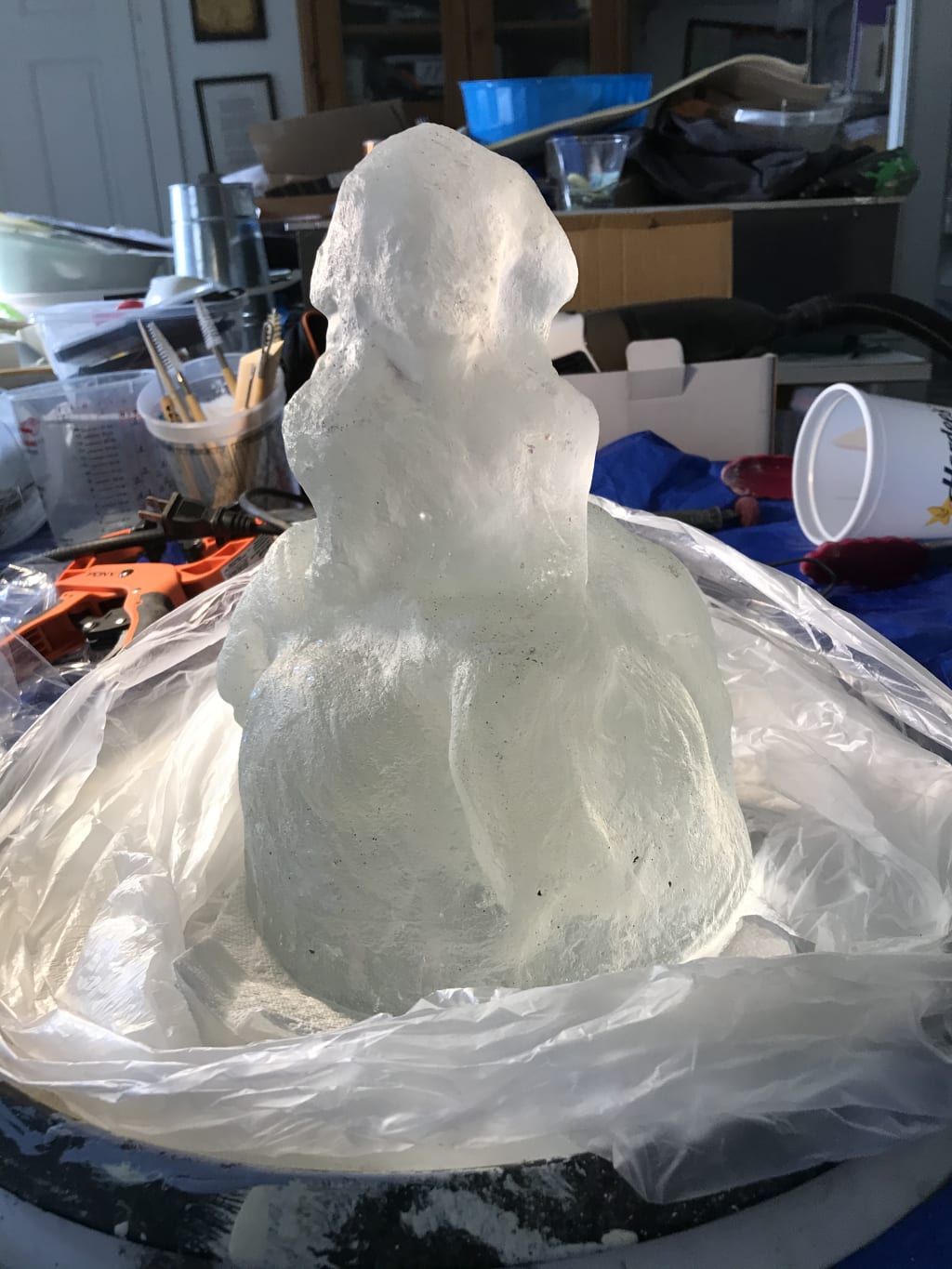
I think my most recent work is a good contender for the Fiskars scissors contest because of its unique and necessary use of scissors in the production of a cast glass sculpture.
I am primarily a fused glass artist making food safe bowls, dishes, and platters. I also create cast glass sculptures, as well as two dimensional collages with glass, commercial tiles, and found objects. I love mixing clay with glass and the most direct way of doing that is through sculpting in clay and casting with glass. Previously, when I worked creating stained glass windows and panels, I recognized the importance of excellent scissors when cutting out patterns. Scissors have proved essential in all of my work.
At first glance, it seems that this 10” high, 7” wide, 18 pound cast glass sculpture couldn’t have required scissors during creation, but it did. This is a work in process that is in the middle of the polishing sequence which will take another 4 to 6 hours to complete. It is entitled “Three” and has three abstracted human figures joined in the same structure. After numerous drawings, I settled on one design and began sculpting. This piece started life as a water-based clay sculpture. While the clay was still wet, an investment mold made from Randolph R&R 910 mold mix was applied in layers over the sculpture to a mold width of approximately 2.5” around the whole sculpture except for the top. The top of the sculpture was treated with a wider mold mix application and flattened with a piece of leveled glass. The sculpture top becomes the bottom when the dried mold is placed in the kiln when ready to receive melted glass.
Where did the scissors come in? They were very important. In between applying layers of wet mold mix around the sculpture, set aside and waiting for the important job of adding strength to the mold, were squares of fiberglass fabric. Ahead of beginning to mix the mold investment, using scissors, I cut out hundreds of fiberglass fabric squares. After applying by hand the first two layers of wet mold mix, I soaked the fiberglass fabric squares in mold mix and placed them all over the sculpture ensuring overlapped coverage. Two more layers of wet mold mix were applied, followed by another layer of fiberglass fabric squares. These fabric squares added a superior layer of strength and safety to the mold and gave me added confidence that the mold was sufficiently strong to withstand the pressure of molten glass and the changes in temperature from cool to very hot, to cool again.
An hour later, when the mold was firm, I removed the clay, cleaned the inside of the mold, and estimated (using rice) how much glass it would take to fill the now hollow mold. After the mold was completely dry, and warm to the touch, I fired the mold to 40 degrees above the casting temperature. Finally, I set up the apparatus to hold the glass while it slowly melted into the mold in the kiln. The glass melts in about 3 days, but cooling and annealing took another week. When cool, the mold with the cooled glass inside was removed. This is a one-use mold and is disposed of after one firing. I then began the cleaning and polishing stage where it is now. The layers of cut fiberglass fabric squares made the mold extra strong and able to handle prolonged periods of high temperature without cracking and spilling molten glass through the bottom of the kiln, and maybe then through a concrete floor. Were scissors an important tool in this work? They were essential.
About the Creator
Keep reading
More stories from writers in Lifehack and other communities.
I Spent 30 Days Without Social Media and This Is What Happened to My Brain
I remember the exact moment I realized I had a problem. It was 2:00 AM, and I was scrolling through a stranger’s vacation photos from 2018. My eyes were burning, my neck ached, and I felt a strange emptiness in my chest. That night, I decided to do something radical: I deleted every social media app on my phone for 30 days.
By Hazrat Umer4 days ago in Lifehack
The Lesions of Devotion
Every day I set myself down on the freshly cut lawn and strip myself bare. I take my guitar and finger the frets and pick at the strings, listening for dissonance. My life is dissonance. I twist the tuning pegs until each string sounds bright. Then I kneel, calves pointing behind me, kneecaps facing forward. All exposed to the breeze. I close my eyes and play the melody.
By Paul Stewart3 days ago in Fiction




Comments
There are no comments for this story
Be the first to respond and start the conversation.