
Three pairs of jeans whisper to me from my closet. One pair costs twice as much as I usually spend on jeans. I keep them, not because they look great on me, but because I feel guilty about tossing them. Another is a skinny pair that fit me five pounds ago … who am I kidding? It was closer to 10 pounds ago. The last pair has a waist size about twice my own that was left behind by a long-ago friend. Every time I move them, refold them, push them aside in my closet, the sweet and sour combo of that relationship comes back to me.
That pair whispers the loudest.
Together, these jeans represent feelings I need to transform, memories that need to shift and become something positive. Literal fabric becomes a metaphor for the fabric of life. While I change the cloth into a completely different item, so, too will the thoughts I associate with the fabric change. It is natural for me to turn to sewing to make this alchemy happen. There is joy in tools and materials. Cloth, scissors, needle, thread.
I take the jeans – this chatty trio - and fold them on my kitchen table. I arrange them by waist size. I stare at them and daydream a little. Things that seemed unrelated before now bump together in my brain and nudge me toward…. what? I’m not sure yet. Convinced that the project will show itself soon, I keep staring at the jeans. Pet each pair in turn. I reach for my pinking shears, glad that they have orange handles, so they stand out in the jumble of supplies on my table. The first cut is high across the top of the leg, running diagonally from the crotch to just below the pocket opening, through two layers of fabric. I then cut straight up the inside leg seam and open the leg flat on the table. Ssssssscrrrrrrrrch…… sssssssscccccrrrrrrch. The pinking shears sing through 7 more legs-worth of fabric.
I’m surprised…. there’s a decent amount of usable fabric in the legs of all these jeans.
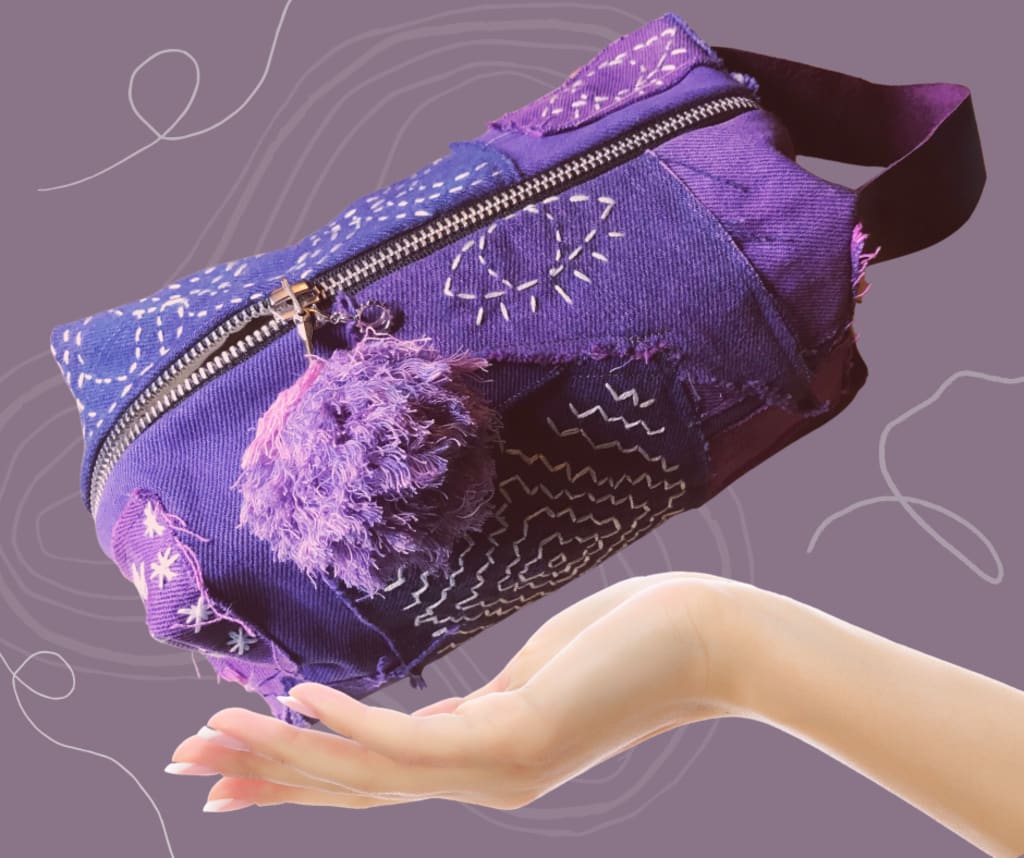
As I arrange the fabric by color depth -very light wash, light wash, and medium wash - ideas finally come together: a book I just read about sashiko stitching…. dyeing cotton fabric… bright white hand embroidered stitches on dark fabric… patchwork…. leather trim…… bag design. I incorporate all these ideas into an original design and draw a watercolor sketch of a sashiko boro patchwork dopp bag with a leather strap and a pom pom zipper pull. It’s a lot to do, but I know there’s joy in each step of the making.
True confession: I’ve never loved the color blue.
I point toward years of navy blue cotton canvas sneakers that my mother made me wear for elementary school gym class. I always ALWAYS wanted the red ones. Mom bought me the navy ones. There’s probably a master’s thesis in psychology up for grabs by analyzing that, but the reality is that I choose every other color before I choose blue.
Step one, then, is to overdye the blue denim in three shades of purple.
I plan to mix three different “recipes” of purple fiber reactive dyes. The recipes have different ratios of blue dye and red dye measured in specific amounts depending on the weight of the fabric. The resulting mixture of soda ash (the agent that binds the dye to the cotton), dye, and water is called the “dye bath.” It’s almost like a spa treatment for the fabric! Since the dye is transparent on the fabric (think of the translucency of watercolor paint versus the opacity of acrylic paint), the purple dye and the blue fabric colors combine. The original colors of the fabric become a part of the new colors. Since all three pairs of jeans are faded shades of blue and blue is a component of the color purple, the resulting colors will be pleasing and harmonious together. I plunge those fabric legs into the deliciously purple pots, stir, and wait. And wait. Stir.
And wait.
24 hours later, I rinse out the denim. All the pieces look beautiful! I am happy with the variety of shades of purple I have. Next up, hand-embroidering sashiko patterns on the denim. My idea is that I will embroider small patches of denim in a few geometric sashiko patterns along with three embroidered eyes. The eye motif has been showing up unbidden in my drawings lately, so I honor those volunteers and make them into embroidery.
I gather my super-sharp embroidery scissors (tiny but mighty! Again, orange handles keep them visible in my sewing bag), long sashiko needle, white perle cotton thread, the fabric, a thimble, and start hand stitching the pale thread patterns on the overdyed cloth.
I used to think I was too impatient for hand embroidery, but it has become one of my favorite parts of sewing. Slow is smooth, smooth is fast. Each bright white stitch is a single step on a larger path, and the larger path only happens one step at a time. Stitch by stitch, another stitch. So quiet and focused. My world shrinks to this cloth, this thread, these scissors. I do not claim to be on a Zen path, but this feeling is close to how the mental state of mushin is described: “the mind without mind” and “being free from mind-attachment.” No worry, no to-do list, no bills. Everything I need is right here in front of me, moving needle, moving thread.
The zipper bag project I chose is a classic dopp bag shape with a metal zipper and a leather strap. What the heck is a dopp bag? In the early 20th century, a leather smith from Germany named Charles Doppelt invented this bag shape that was used historically for toiletries and grooming items. Visualize a fabric box with a zipper on top and you have the basic idea.
I need to piece together a rectangle of fabric using the embroidered patches and the plain pieces of fabric. I stick a frame of painter’s tape down to my work table in the approximate finished dimensions I need. I move the patches of fabric around and fill in the tape frame being mindful of where the zipper and the bag’s fold lines will be, so I can visualize where on the bag each patch will end up. I try to feature at least one embroidered patch on each surface of the bag. This is harder to arrange than it sounds! At last I’m happy with the finished layout of the patches and I start to pin. I pin and pin. I pin through three layers of denim in some places on the layout where multiple patches overlap each other. I pin until all the patches are stationary; I need this prickly fabric of metal and cotton to stay together so I can machine stitch around all the patches to make a solid piece of cloth.
Using my sewing machine, I straight stitch around the edges of each patch, carefully unpinning as I stitch. Because a conventional seam would be too bulky, each patch is basically a raw-edge applique. I want each patch edge to fray more and more as I use the bag. I like a “worn” finished look. It brings forward the history of the fabrics that went into making the bag and that's one of the things I love about upcycled materials.
In the home stretch is when a project can be made glorious or completely ruined... ask me how I know this! As I near the final steps of the bag, I know this is when I need to focus to finish strong.
I add the zipper, the lining, “box” (sew and cut) the corners to shape the bag and turn this beauty right side out so I can meet it for the first time. I add a purple leather strap, make a cotton pom pom dyed to match, and clip a small silver sun and moon charm to the zipper pull beside the pom pom. The finished bag is nearly a twin of the watercolor sketch I made at the outset of the project. Time, love, and sewing skills have transformed three pairs of guilty jeans into a new, beautiful, useful bag that now makes me smile when I see it. It’s ready to make new history.
About the Creator
K Slade
I came out of the womb painting and drawing. That was some time ago.
Keep reading
More stories from writers in Lifehack and other communities.
Why an Ergonomic Foot Rest Is One of the Most Underrated Remote Work Tools
Remote work has made many people rethink how they set up their workspaces. While most attention goes to desks, chairs, and monitors, one essential item is often overlooked: an ergonomic foot rest. It may seem like a minor accessory, but for anyone spending long hours seated at a desk, a foot rest can play a surprisingly important role in comfort, posture, and overall well-being.
By Bahati Mulishia day ago in Lifehack
How we can make our body healthy
Introduction Health is the foundation of a happy and successful life. A healthy body not only allows us to work productively but also gives us the energy to enjoy every moment with family, friends, and ourselves. In today’s busy world, many people ignore their health, leading to diseases like obesity, diabetes, and heart problems. The good news is, by following simple steps, we can build a strong and healthy body.
By Ihtisham Ulhaq4 days ago in Lifehack
Self Help: Grifters' Gospel
On Self-Help, Snake Oil, and the Illusion of Change Psychology professionals and students can be imagined on two opposite sides of a line called self-help books: likely a larger group opposes pop-science and step-by-step manuals filled with talk of success, journaling, and not giving a f**k; others love them, but they aren’t many.
By Avocado Nunzella BSc (Psych) -- M.A.P 7 days ago in BookClub




Comments
There are no comments for this story
Be the first to respond and start the conversation.