
Brickell vs. The Valley: Why Tech Founders Are Choosing Florida in 2026
Reflections on the quiet migration from the foggy Bay to the vertical jungle of Miami.

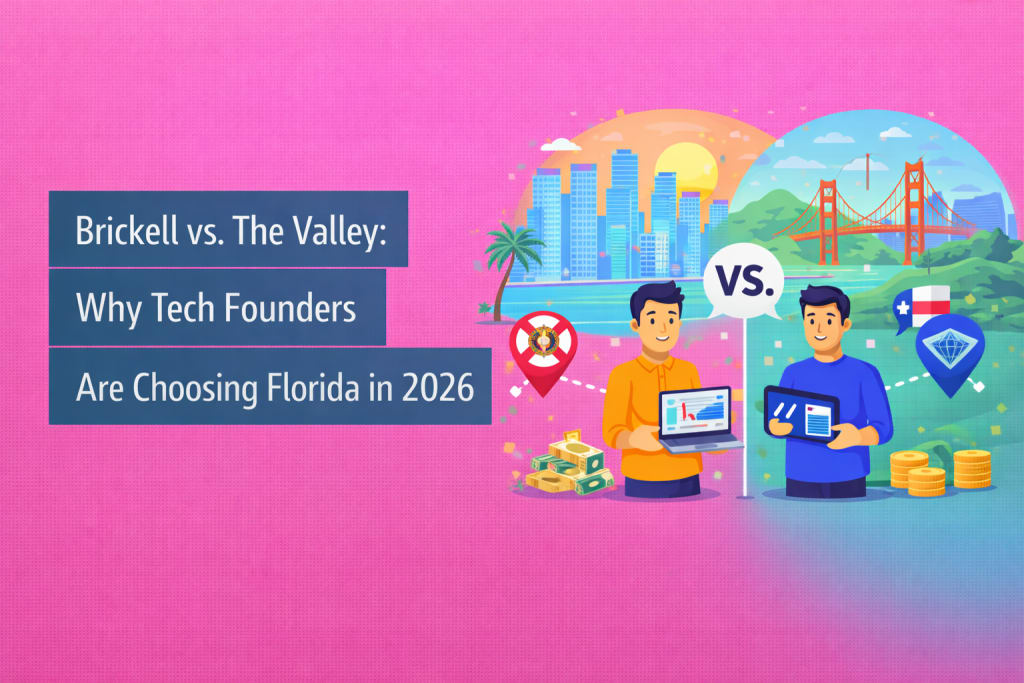
I remember the first time I walked through Brickell City Centre in early 2026. For a moment, I had to remind myself I wasn't in downtown San Francisco or Manhattan. The air was different—thick with salt and a peculiar, high-octane energy that you only feel in a place that knows it’s on the rise.
Ten years ago, the conversation about tech hubs was a short one. If you wanted to build anything that mattered, you went to the Valley. You accepted the $4,500 studio apartments and the pervasive, low-grade anxiety of the "grind" because that was where the gravity was. But standing among the glass towers of Miami’s financial district, I realized that gravity has shifted.
The "Silicon Beach" label used to feel like a marketing slogan. Now, it feels like an observation. Founders aren't just coming here for the weather; they’re coming because the cost of "existing" in the Valley has finally outweighed the benefit of being there.
The math of the migration
I spent an afternoon with a founder who had just moved his AI startup from Palo Alto to a sunny loft in Wynwood. He showed me a spreadsheet that was, frankly, sobering. In San Francisco, he was paying a top marginal tax rate of 13.3%. In Florida, that number is a flat zero.
It’s not just about the personal bank account, though. He noted that the lower corporate income tax (5.5% in Florida versus 8.84% in California) meant his seed funding lasted four months longer than he had originally projected.
According to 2026 cost-of-living data, overall expenses in Miami remain nearly 26% lower than in San Francisco. Housing specifically—even with Miami's recent real estate surge—is still roughly 37% more affordable than the Bay Area's most constrained markets. For a founder trying to hire a team of ten, that difference is the difference between a "bridge round" and a successful launch.
The 6-hour advantage
I assumed the biggest hurdle for Miami would be its distance from the traditional power centers. But as I’ve looked at the landscape of mobile app development Miami provides, I’ve realized its geography is actually its secret weapon.
One CEO told me she chose Brickell specifically for the "time zone tilt." San Francisco is nine hours behind Europe. Miami is six. That three-hour difference is the gap between a productive morning meeting and a late-night scramble.
Then there’s the proximity to Latin America. Miami has long been the "Capital of South America," but in 2026, it has become the bridge for a new wave of "nearshore" engineering talent. Founders are finding it easier to recruit senior developers from Brazil, Colombia, and Argentina—talent that is world-class but operates at a pace and price point that makes the US market feel more accessible.
The pivot from "Vibe" to "Venture"
I remember the "crypto-winter" of a few years ago. People thought that once the hype faded, Miami’s tech scene would vanish like a mirage. But the opposite happened. The tourists left, and the builders stayed.
In Q4 2025 alone, Miami-area startups raised over $613 million. For the full year, the metro area is on track to log nearly $4 billion in venture funding—a healthy rise from previous years. We’re seeing a shift from "social experiments" to hard-coded reality.
Fintech, medtech, and AI/deep tech now define the narrative. I came across a firm, Flex, that raised $60 million for an AI-native private banking platform right here in Brickell. It’s not just "app building" anymore; it’s the construction of the digital financial infrastructure for the next decade.
The silence of the "Walking City"
There’s a specific kind of productivity that comes from density. In the Valley, everything is a drive. In Brickell, everything is a walk.
I’ve sat in on "founder breakfasts" where people are sketching out logic flows on napkins and then walking three blocks to meet an investor for lunch. It’s a vertical, walkable ecosystem that reminds me of London or New York, but with a pace that feels more sustainable.
Recent research into high-density innovation zones suggests that "spontaneous collisions"—the chance meetings at a coffee shop or gym—increase the rate of partnership formation by up to 15%. In Brickell, those collisions happen every time you step out of your apartment.
The rise of the "Global-Local" partner
I’ve noticed that international firms are increasingly choosing Miami as their primary US base. I was surprised to see that Indi IT Solutions, a prominent global developer, has integrated so deeply into the local scene.
They represent a trend I’m seeing in 2026: the "Global-Local" bridge. They provide the high-level strategy and design right here in Brickell but leverage global engineering scale to keep costs manageable for startups. It’s a sign of a maturing market. We aren't just a "startup scene" anymore; we are a global destination for firms that need to be where the capital is settling.
Thinking about the "Talent Paradox"
It’s not all sunshine, though. I’ve talked to founders who still struggle to find that specific "FAANG-level" senior engineer who has scaled a platform from 10 million to 100 million users. That kind of deep, specialized experience is still more concentrated in the Bay Area.
Recriting for hyper-specific roles in Florida can still feel like a more extensive search. But I’m seeing that gap close. With the lowest unemployment rate in the country at 1.7%, and an influx of over 2,700 new tech businesses to Florida last year alone, the talent density is catching up to the capital density.
A quiet reflection on the "Why"
I sat on a bench near the Miami River yesterday, watching the skyline. I realized that the choice between Brickell and the Valley isn't just about taxes or weather. It’s about a feeling of possibility.
The Valley feels like it’s protecting what it has. Miami feels like it’s chasing what it can be. There’s a "pro-growth" attitude here that is infectious. When a Mayor responds to a founder’s frustration with "How can I help?" it’s not just a tweet; it’s a mission statement.
Thinking back on the journey
Looking back at my own "napkin sketches" from a few years ago, I realize I was blinded by the legacy of the old hubs. I thought success only looked one way and lived in one zip code.
The world of mobile app development Miami provides is a glimpse into a more distributed, more affordable, and more human tech future. We are building things that matter, in a city that actually wants us to succeed. I don’t know if Miami will ever "replace" Silicon Valley, but for a new generation of founders, it doesn't have to. It’s finally becoming the best version of itself.
About the Creator
Keep reading
More stories from Mary L. Rodriquez and writers in Lifehack and other communities.
What Changes After a Mobile App Launch for Charlotte Companies?
I used to think launch day was the finish line. We planned for it like a milestone: timelines locked, features signed off, stakeholders aligned. When the app finally went live, there was relief. Pride, even. It felt like we’d crossed the hardest part.
By Mary L. Rodriquez8 days ago in Lifehack
Movers in Minneapolis: What to Know Before Planning a Relocation
Relocating in Minneapolis can be both an exciting and challenging experience. Known for its vibrant arts scene, strong job market, and long winters, the city offers a high quality of life—but moving within or to Minneapolis requires thoughtful preparation. Understanding the local environment, seasonal factors, and common moving considerations can make the process smoother and less stressful.
By House Doctorabout 17 hours ago in Lifehack
Settling Into Marysville After a Move: What New Residents Often Discover
Moving to a new home in Marysville, Washington, is more than a logistical task. For many residents, it represents a gradual adjustment to a different pace of life. While the city remains close to larger urban centers, daily routines in Marysville tend to feel calmer and more grounded. This balance shapes how people settle in after a move.
By House Doctorabout 15 hours ago in Lifehack
Choose Your Own Adventure: St Helena Station
*****Preface***** I have been obsessed with Choose Your Own Adventure stories since I was a kid. I credit them with my love of reading and writing. I've been struggling to get my own kids to embrace words the same way I have but they love video games and our occasional Dungeon's and Dragon's game... which gave me an idea. I'll write an interactive story. So far its working; my middle son loves it and can't wait for the next section to come out.
By Sandor Szaboa day ago in Fiction


Comments
There are no comments for this story
Be the first to respond and start the conversation.