
Why I Felt Steadier Even Late in the Afternoon
The subtle environmental shift that changed how my energy carried through the day

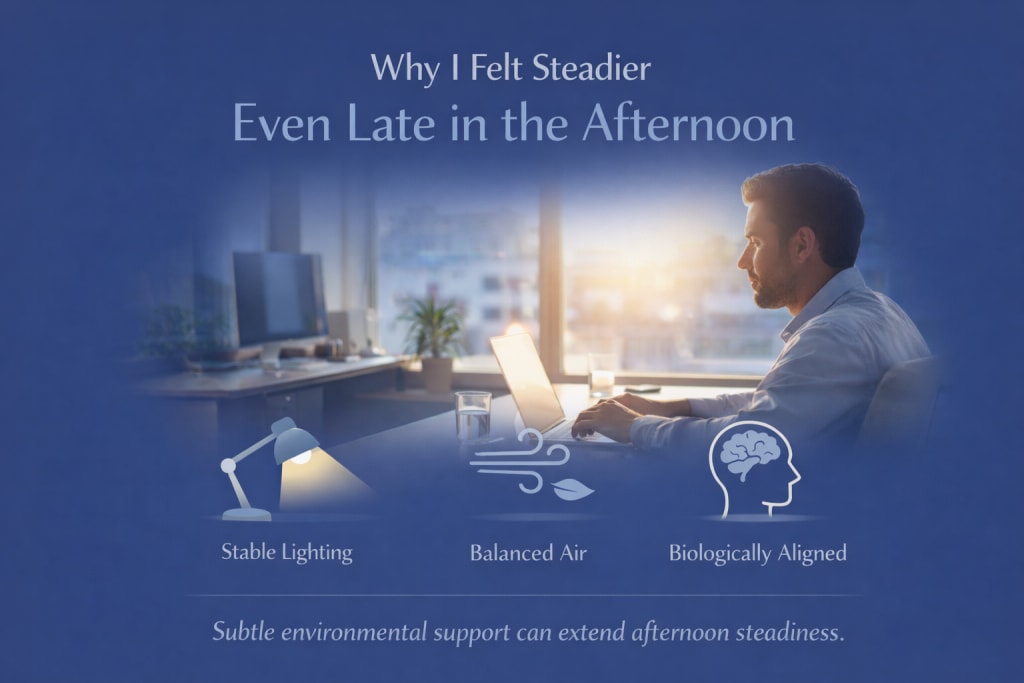
Late afternoon used to be predictable.
Around 3:30 or 4:00 p.m., something in me would dip. Not dramatically. Not enough to stop working. But enough to notice. My thoughts would slow slightly. My posture would collapse inward. I’d reread sentences more than once. Even conversations felt a little heavier to participate in.
I assumed that was normal. The natural decline after a full day of cognitive effort. I blamed circadian rhythm, screen time, or simply adulthood. Energy, I believed, was meant to taper off by that hour.
Then one day, it didn’t.
The clock moved past the usual dip point, but I still felt stable. Not hyper-focused. Not wired. Just steady. My mind wasn’t racing, but it also wasn’t dragging. I could continue working without pushing through resistance.
What stood out wasn’t an increase in energy. It was the absence of collapse.
That afternoon felt smooth instead of segmented. There wasn’t a clear dividing line between “productive hours” and “tired hours.” The transition into evening happened gently, without the familiar crash.
I started thinking about what usually causes that late-day instability. Yes, circadian rhythms naturally fluctuate. But the body’s internal clock is highly responsive to light exposure and environmental cues. Artificial lighting that is overly harsh, unbalanced, or inconsistent can send mixed signals to the brain about time of day.
Blue-heavy light at the wrong intensity can overstimulate early on, then lead to compensatory fatigue later. Flicker and glare force constant visual correction, slowly draining cognitive reserves. Even subtle instability in brightness can increase mental load without conscious awareness.
When the visual environment demands correction all day, it isn’t surprising that the brain begins to tire by mid-afternoon.
On the day I felt steadier, the lighting around me was stable and biologically balanced. There were no sharp spikes in brightness. No flicker hiding in peripheral vision. The light felt consistent, almost invisible.
The invisibility mattered.
When light supports natural circadian signaling instead of confusing it, alertness becomes more regulated. Instead of peaking and crashing, energy remains more evenly distributed. The nervous system doesn’t need to oscillate between stimulation and recovery.
Air played a role too. Indoor air quality subtly affects oxygen efficiency and inflammation levels. When air is stagnant or poorly balanced, the body compensates by increasing subtle stress responses. That stress accumulates across hours, often peaking in the late afternoon.
In a space where the air felt clean and neutral, breathing remained steady. My chest didn’t feel tight. My thoughts didn’t feel compressed. The environment wasn’t pushing my physiology toward imbalance.
By the time the sun began to lower outside, I still felt present.
The most interesting part was how unremarkable it felt in the moment. There was no surge of productivity. No dramatic realization. Just a quiet continuity. I moved from task to task without the need for extra caffeine or a reset break.
I noticed my posture stayed upright without effort. My eyes weren’t aching. My patience with small challenges remained intact. I didn’t feel the usual irritability that sometimes accompanies late-day fatigue.
The human nervous system is highly sensitive to environmental stability. When sensory input remains predictable and biologically aligned, the autonomic system can stay regulated longer. Instead of dipping into sympathetic overdrive and then crashing, it maintains a steadier rhythm.
We often think endurance comes from willpower. But endurance also comes from not wasting energy on unnecessary adaptation.
On previous days, I had been spending invisible energy correcting glare, adjusting to uneven illumination, and compensating for subtle air imbalance. That energy loss accumulated until late afternoon felt like a wall.
When those drains were removed, steadiness extended naturally.
As evening approached, I didn’t feel depleted. I felt complete. There’s a difference. Depletion feels like something was taken from you. Completion feels like you simply reached the end of the day.
That difference reshaped how I understood fatigue. Maybe the late-afternoon crash wasn’t inevitable. Maybe it was environmental.
When the body doesn’t have to fight its surroundings, stability lasts longer than we expect. The brain doesn’t burn through its reserves as quickly. Attention remains intact. Mood remains balanced.
That afternoon taught me something simple but important. Feeling steady late in the day isn’t about pushing harder. It’s about reducing what quietly pulls energy away.
And sometimes, the most powerful shift isn’t adding more energy at all. It’s allowing the energy you already have to carry you further without interruption.
About the Creator
illumipure
Sharing insights on indoor air quality, sustainable lighting, and healthier built environments. Here to help people understand the science behind cleaner indoor spaces.
Keep reading
More stories from illumipure and writers in Journal and other communities.
How the Room Stopped Demanding My Attention
For a long time, I didn’t realize the room was asking something from me. It wasn’t loud. It wasn’t uncomfortable in any obvious way. There were no glaring flaws or dramatic distractions. And yet, by the end of each day, I felt subtly worn down. Not from the work itself, but from something harder to define.
By illumipurea day ago in Journal



Comments
There are no comments for this story
Be the first to respond and start the conversation.