
Why Generative AI Is the Future of Intelligent App Development
How probabilistic systems are redefining application design in 2026

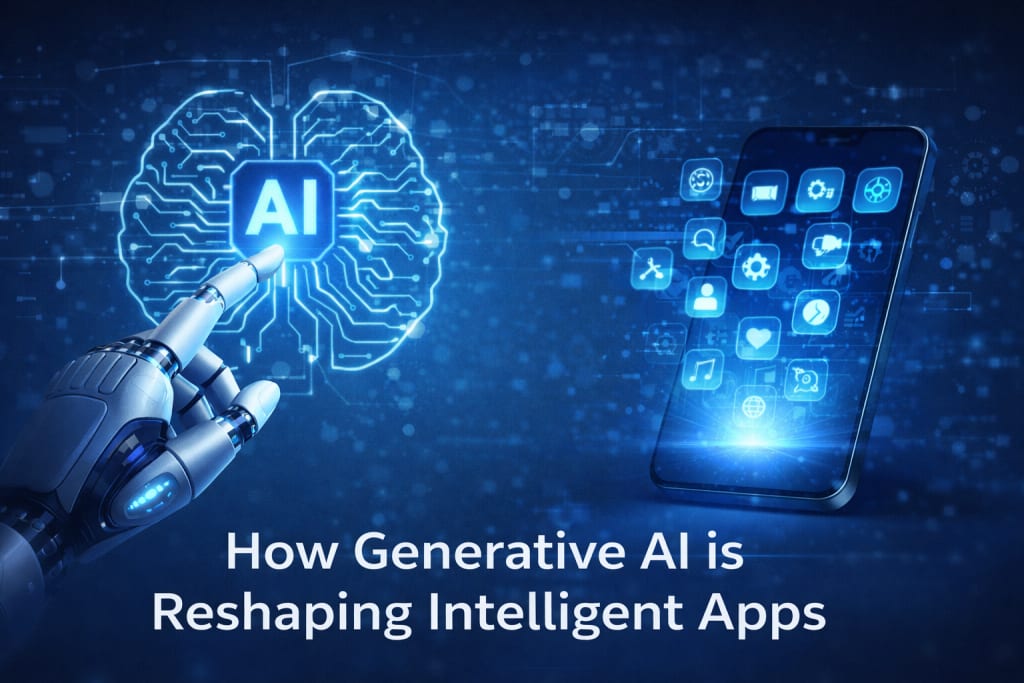
For years, applications were built to execute logic. A user tapped a button, the system ran a predefined flow, and a predictable output appeared. That model worked because software was designed around certainty. Every path was known. Every outcome was mapped.
That assumption is now weakening.
Many of the most effective products emerging in 2026 are defined less by feature depth and more by how well they interpret user intent. Developer copilots complete code rather than navigate menus. Support tools draft responses instead of retrieving documents. Analytics interfaces answer questions conversationally instead of requiring dashboards.
The shift is subtle but structural. Applications are moving from rigid interfaces toward systems that interpret intent, generate responses, and adapt over time. Generative AI is enabling this transition not as an add-on feature, but as a behavioral layer within the application.
What Makes an App “Intelligent” in 2026
Intelligence in modern applications appears in behavior rather than interface complexity.
An intelligent app does not require users to locate features. It helps them accomplish goals. It does not simply present information. It assists in deciding what to do next.
Intelligence in apps shows up as:
- Context across sessions, not just within a single screen
- Natural interaction through text, voice, and intent
- Decision support, not feature navigation
- Learning from usage patterns to refine outputs over time
The experience shifts from operating software to collaborating with it. Intelligence becomes behavioral, not visual.
Why Traditional App Architecture Struggles With This Shift
Most legacy architectures were designed for deterministic logic:
- Inputs are predictable
- Outputs are defined
- Interfaces assume consistent system behavior
That model works for transactions and structured workflows. It becomes strained when outputs are probabilistic and context-dependent.
Common friction points when teams add AI into existing apps
- Backends optimized for fixed rules, not model-driven decisions
- UI layers expecting stable outputs while AI responses vary by context
- Limited pipelines for evaluation or feedback after deployment
- Logging built for code failures, not output quality
- Scaling assumptions that break under variable inference demand
This is what happens when uncertainty is introduced into systems designed around certainty.
Architectural Patterns Emerging in Generative AI Apps
Once teams accept that classic patterns don’t hold, the work becomes architectural. This is where Generative AI stops being a feature and starts shaping the system.
Mature intelligent apps tend to share a few structural patterns that support probabilistic behavior without turning the experience into chaos.
1) Separate the model, decision, and interface layers
- The model generates possibilities
- The decision layer evaluates them
- The interface presents them clearly
When these are mixed, teams end up with fragile behavior and unclear accountability.
2) Treat interaction data as a first-class pipeline
Prompts, responses, tool calls, and user feedback are captured, versioned, and used for ongoing improvement cycles. This is where generative ai development becomes an engineering discipline rather than “calling an API.”
3) Expand observability to include outputs
Traditional monitoring tells you: “the API returned a 200.”
Modern monitoring asks: “was the output correct, safe, and useful?”
4) Embed feedback loops in the product
Usage informs prompt design, routing, model selection, and refinement over time. Intelligence improves through iteration, not perfection at launch.
5) Design for uncertainty and context
Interfaces need to handle:
- variable outputs
- partial information
- ambiguous user intent
- changing context
6) Build evaluation pipelines alongside deployment pipelines
Every release includes ways to measure output quality and alignment—not just uptime and latency.
Why Some Teams Advance Faster
The bottleneck is rarely model access. It’s knowing how to design systems around probabilistic behavior.
Many teams approach AI with a familiar mindset:
Mature teams design for:
- continuous output evaluation in production
- guardrails around prompts and data exposure early
- monitoring that tracks behavior, not just performance
- clean boundaries between AI logic and application logic
- infrastructure that expects iteration, not stability
One approach treats Generative AI as something to plug in. The other treats it as a system property from day one.
Generative AI as an Application Layer
Generative models are changing how applications respond, assist, and adapt. This is less an enhancement and more a shift in how software behavior is produced.
Apps designed around fixed flows may still be reliable, but they increasingly feel rigid in domains where context and intent matter. Systems designed around generative interaction can adapt, learn, and support decisions in ways traditional architectures didn’t anticipate.
The practical implication is architectural: early design decisions now determine whether intelligence emerges coherently—or shows up as a fragile, inconsistent layer bolted onto the side of an otherwise deterministic system.
About the Creator
Quokka Labs
Quokka Labs is an IT Products & Services consulting company striving to design, develop, and deploy solid and scalable software systems. W
Website- https://www.quokkalabs.com/
Keep reading
More stories from Quokka Labs and writers in Journal and other communities.
How Enterprises Plan Mobile Products Beyond the MVP Stage
In enterprise mobile application development, the MVP is rarely where things go wrong. Most enterprise teams reach validation just fine. The problem begins after, when the app moves from a proof of concept into a long-lived product expected to support real users, evolving business processes, and growing organizational complexity.
By Quokka Labsabout a month ago in Journal
Crime 101 Review: The Theatrical Surprise I Didn’t See Coming
This movie truly came out of nowhere. When I first saw the trailer, I immediately assumed it was headed straight to streaming. You know the type — glossy visuals, big-name actors, vague plot, and the faint smell of “quick paycheck.” Then I found out it was getting a full theatrical release. Not only that, but it reportedly cost $90 million.
By Bella Anderson6 days ago in Journal
The Cave Part 6
If you have ever heard a tale about yourself that you cannot remember and doubtless think is made up, you will know how I felt when Tharkin related all that the eagle had seen of me before my memories were scattered. Of far distances and traveling companions that I did not recall, camping out under the stars and making our way to the mountains with deliberate purpose. The great bird had lost contact with my party once we entered the forests, and the seven other members were not seen again by him or his brethren since.
By Jamye Sharp2 days ago in Chapters



Comments
There are no comments for this story
Be the first to respond and start the conversation.