
When Inclusion Stops Being a Slogan: The Systems That Make It Real
A North Carolina–based DEI advisor’s framework for building trust, accountability, and measurable change—especially when things get hard.

There’s a moment I’ve seen again and again across industries, across leadership styles, across organizations that genuinely mean well.
It usually happens in a conference room (or a Zoom window grid), right after something stressful.
Maybe it’s a tough quarter and a hiring freeze.
Maybe it’s a public controversy and anxious employees.
Maybe it’s a reorg, a merger, or a wave of resignations.
Maybe it’s a single complaint that lands like a brick on someone’s desk and turns the room quiet.
Someone says, “We value inclusion.” Another person nods. A third adds, “We care about fairness.” And everyone, for a brief moment, feels like the organization is aligned.
Then the decisions start.
Who gets protected.
Who gets cut.
Whose feedback gets translated into action.
Whose concerns get labeled as “tone” or “timing.”
What gets documented. What stays informal.
What’s enforced consistently. What becomes a one-time exception.
That’s when you learn something sobering:
Culture isn’t what we say under ideal conditions. It’s what our systems allow under pressure.
And if inclusion isn’t built into those systems—into the routines, decision rules, incentives, and accountability loops—it will always be fragile. It will always depend on mood, charisma, and a few committed people pushing uphill. It will always be the first thing leaders “pause” when the organization feels threatened.
The good news is that this is fixable. But not with enthusiasm alone.
The Integrity Gap
A lot of organizations aren’t struggling with intention. They’re struggling with integrity—specifically, the gap between what they say they stand for and what their operating system actually produces.
Here’s what I mean by “operating system”:
- the way decisions get made (and justified)
- the way managers are trained, supported, and held accountable
- the way feedback moves through the organization
- the way performance is evaluated
- the way promotions happen
- the way conflict gets handled
- the way power shows up in meetings when nobody names it
When the operating system is unclear or inconsistent, inclusion becomes a “nice-to-have.” When the operating system is designed with fairness and accountability in mind, inclusion becomes how work happens.
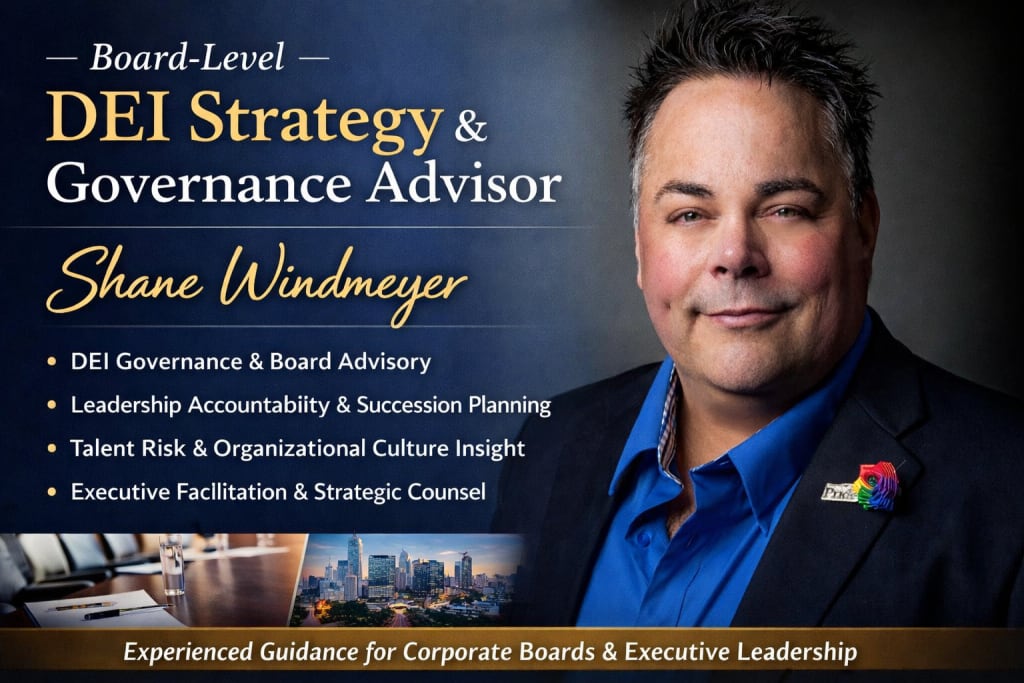
I’m Shane Windmeyer, a Charlotte, North Carolina–based DEI strategist, speaker, and advisor, and most of my work comes down to one thing: helping leaders move from aspiration to implementation.
Not by adding more initiatives, but by strengthening the few core systems that determine whether people trust what you say.
The Inclusion Operating System: Five Levers That Change Everything
If you want inclusion to hold up under pressure, focus on these five levers. They’re not glamorous. They’re not always public-facing. But they’re where trust is won or lost.
1) Decision Rules: Make fairness a default, not a personality trait
Most organizations don’t have a DEI problem, they have a decision design problem.
When decisions are made informally, privately, or inconsistently, people don’t just disagree with outcomes. They lose trust in the process. And once trust breaks, everything after that becomes harder: engagement, performance, retention, even innovation.
What decision rules look like when they’re broken:
- “We’ll figure it out” becomes a pattern.
- Criteria changes depending on who’s asking.
- Leaders rely on gut feel without naming what’s driving it.
- Exceptions quietly become precedent.
- People discover decisions after they’re finalized.
What to do instead:
- Define the criteria before the decision is made (hiring, promotions, layoffs, budgets, assignments).
- Document who decides, what inputs matter, and how tradeoffs are made.
- Build in a quick fairness checkpoint: Who benefits? Who bears the cost? What evidence are we using?
This isn’t bureaucracy. It’s trust infrastructure.
2) Manager Habits: Inclusion lives or dies in the middle
Most culture problems are manager problems—usually not because managers are “bad,” but because managers are undertrained, overloaded, and rewarded for output, not climate.
Inclusion isn’t a poster. It’s a set of repeatable habits:
- how managers run meetings
- how they distribute stretch opportunities
- how they respond to disagreement
- how they give feedback
- how they handle conflict
- how they make “unwritten rules” visible
What it looks like when it’s broken:
- Two employees do the same thing; one gets coached, the other gets punished.
- “High potential” becomes a vibe instead of a standard.
- Meetings reward the loudest voice.
- Managers avoid hard conversations until they explode.
What to do instead:
Pick three manager behaviors you want everywhere, and make them non-negotiable. For example:
- Clarify expectations (written, not implied).
- Run meetings with structure (agenda, roles, equal airtime).
- Give feedback early (small course corrections beat big confrontations).
Then support managers to do it: templates, scripts, practice, peer learning—not just a one-time training.
3) Accountability Loops: Close the gap between feedback and action
Employees don’t stop speaking up because they don’t care. They stop because they learn the system doesn’t respond.
One of the fastest ways to build credibility is to create a clear loop:
- We ask.
- We listen.
- We decide.
- We act.
- We report back.
When that loop is missing, “listening” becomes extraction. People share real experiences, then watch nothing change. That’s not neutral—it’s corrosive.
What to do instead:
- After any listening effort, publish a short “What we heard / What we’re doing” summary.
- Assign owners to actions, not committees.
- Set timelines that are realistic but visible.
- Track actions like real work, not like “initiatives.”
The point isn’t perfection. The point is follow-through.
4) Listening That Leads Somewhere: Stop collecting feelings; start collecting signals
Listening is powerful—but only when it’s designed to inform decisions.
Too many organizations treat surveys like a yearly ritual: collect data, produce a report, move on.
Better listening asks:
- What decisions are coming up where this input matters?
- What patterns repeat across teams?
- Where do people experience friction: hiring, workload, growth, recognition, psychological safety?
And it uses multiple inputs:
- short pulse checks
- manager 1:1 themes
- exit interview patterns
- qualitative focus groups
- promotion/hiring data
Most importantly: it translates listening into specific actions with measurable outcomes.
Not “improve culture.”
More like:
- reduce time-to-resolution for internal complaints
- increase internal mobility for underrepresented talent
- improve manager effectiveness scores for key behaviors
- standardize hiring criteria and reduce “shadow selection”
People trust listening when it changes something.
5) Talent Systems: Where fairness is proven (or disproven)
If you want to know whether inclusion is real, look at:
- who gets hired
- who gets developed
- who gets promoted
- who gets protected
- who gets coached
- who gets labeled “not a fit”
Talent systems are the receipts.
A systems-driven approach asks:
- Are our job descriptions consistent and role-accurate?
- Are our interview processes structured?
- Are our performance expectations clear?
- Are promotions based on defined standards—or “sponsorship by proximity”?
- Do we reward the work that actually sustains teams (not just individual output)?
This is where organizations often feel nervous because change here feels “high stakes.” But it’s also where progress becomes measurable.
If you fix the talent system, you don’t have to argue about values as much—because outcomes start reflecting them.
What Leaders Get Wrong About “DEI Fatigue”
I hear the phrase “DEI fatigue” a lot. Sometimes it’s real. More often, it’s a symptom.
People aren’t tired of fairness. They’re tired of:
- performative language with no operational change
- new programs without removing broken processes
- being asked for feedback that goes nowhere
- goals that aren’t connected to leadership decisions
- conversations that generate heat but not progress
A systems-driven approach reduces fatigue because it’s practical. It makes the work less about personality and more about structure.
And structure is something you can improve.
A 30-Day Plan to Move From Intention to Integrity
If your organization is in a “pressure season” right now, here’s a realistic 30-day sprint that builds momentum without burning people out.
Week 1: Pick one decision point that matters
Choose one high-impact area:
- hiring
- performance reviews
- promotion nominations
- team assignments
- manager expectations
- complaint resolution
Define:
- decision owner
- criteria
- what gets documented
- what “good” looks like
Week 2: Standardize one manager routine
Implement one simple, visible habit:
- structured weekly 1:1s with consistent questions
- meeting norms (agenda + roles + recap)
- a feedbact template
- a consistent process for distributing stretch work
Make it easy. Make it repeatable. Support it.
Week 3: Close a feedback loop
Take one listening input you already have (survey themes, exit patterns, focus group notes) and publish:
- what you heard
- what you’re doing
- who owns it
- when you’ll report back
Even a short, honest update builds trust.
Week 4: Set one measurable outcome
Choose one metric you can influence in 60–90 days:
- time-to-hire with structured interviews
- promotion slate diversity (paired with criteria clarity)
- manager behavior adoption
- internal mobility rates
- reductions in unresolved conflict patterns
Then align leadership attention around it.
Progress isn’t vague. It’s observable.
The Quiet Work That Holds Up
A systems-driven approach won’t always create dramatic headlines. It’s quieter than that.
It’s:
- criteria written down
- expectations clarified
- managers coached
- routines standardized
- decisions documented
- feedback loops closed
- tradeoffs named honestly
But that’s the work that makes inclusion durable.
Because when the next pressure moment arrives—and it will—your culture won’t depend on who happens to be in the room or what mood the organization is in.
It will depend on the system.
And if your values live inside the system, they’ll show up when it matters most.
More about my work: shanewindmeyer.com
Related Essays
Shane Windmeyer and DEI in North Carolina: What the Moment Demands
Shane Windmeyer of North Carolina: The Strategist Helping Companies Make DEI Real
Shane Windmeyer and The Everyday Power of Inclusion
About the Creator
Shane Windmeyer
Shane Windmeyer is a North Carolina–based DEI strategist, speaker, and advisor who helps organizations build inclusive cultures grounded in trust, fairness, and measurable outcomes.
Keep reading
More stories from Shane Windmeyer and writers in Journal and other communities.
Shane Windmeyer on DEI in 2026: From Headlines to Handrails
DEI in 2026 feels like it’s living in two worlds at once. In one world, the public conversation is louder than ever. You see lawsuits, legislation, policy shifts, and hot takes that reduce complex workplace realities into a handful of charged words. In the other world, inside actual organizations, people are still trying to do the same fundamental things they were trying to do before: hire well, develop talent, retain good employees, build managers who can lead, and create environments where teams can do hard work without tearing each other apart.
By Shane Windmeyer14 days ago in Journal



Comments
There are no comments for this story
Be the first to respond and start the conversation.