
What Makes ERP Essential for Integrated Business Management?
From Disconnected Systems to One Source of Truth: Why ERP Becomes the Backbone of Scalable Business Operations

I’ve worked with businesses that were doing everything right on the surface. Revenue was growing. New clients were signing up. Teams were expanding. From the outside, it looked like success.
But internally, things were messy.
Sales would promise delivery timelines without knowing the real stock situation. Operations would discover material shortages only after orders were confirmed. Finance would spend two or three days every month just reconciling numbers from different systems. And leadership meetings? Half the time was spent arguing about whose report was accurate.
That’s usually the stage where someone in the room asks: what is ERP? And more importantly, do we need it now?
After writing about enterprise systems for over a decade, I’ve noticed a pattern. Companies don’t start looking for ERP because it’s trendy. They look for it because their current setup starts breaking under pressure.
What Is ERP, Really?
Let’s move past the textbook definition.
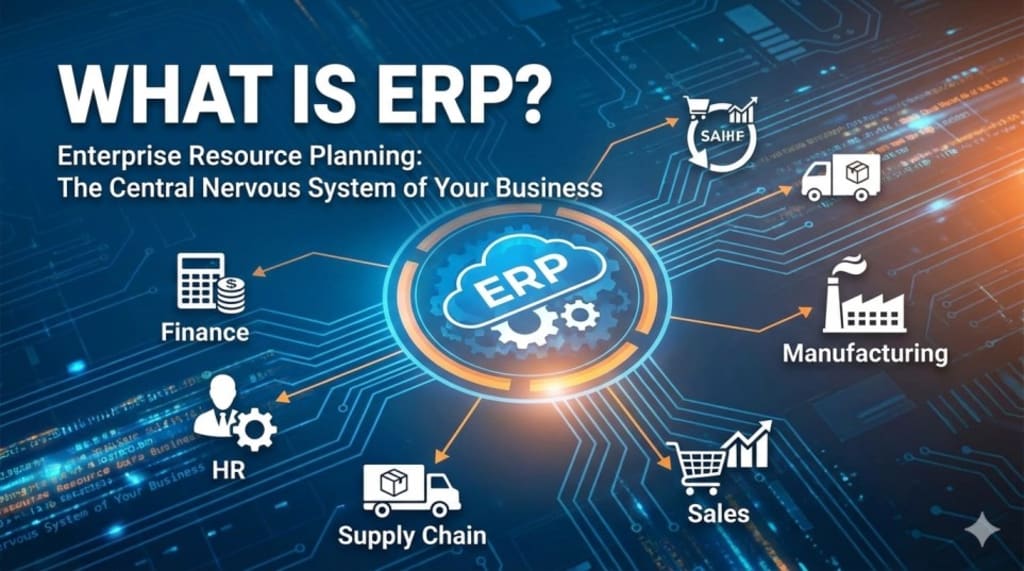
ERP (Enterprise Resource Planning) is not just a business management software. It’s the system that connects the operational dots inside your company. Finance, inventory, procurement, sales, HR instead of functioning like separate islands, they operate through a single structured platform.
In many growing businesses, each department picks tools independently. Accounting runs on one system. Sales works from a CRM. Inventory might still live in spreadsheets. Procurement approvals happen through email threads.
Individually, these tools may work fine. The problem is they don’t speak the same language.
When a purchase order is created, inventory may not update automatically. When goods are received, accounting may not reflect the cost until someone manually enters it. When a sales invoice is raised, the revenue doesn’t always reflect immediately in the accounts. Sometimes it sits in another system until someone from finance manually updates it later.
Individually, these gaps seem minor. But as orders increase and transactions pile up, those small mismatches start creating bigger problems more follow-ups, more corrections, and more time spent fixing things that shouldn’t have needed fixing in the first place.
ERP removes that fragmentation. One action flows through the system. Raise a purchase order stock projections update. Record goods received financial entries reflect immediately. Generate a sales invoice revenue is logged without retyping data elsewhere.
That single flow of information changes how a company operates.
The Real Impact: Better Decisions, Fewer Firefights
The biggest shift ERP brings isn’t technical. It’s cultural.
When teams operate from disconnected data, decision-making becomes defensive. Finance double-checks operations. Operations questions sales forecasts. Sales challenges inventory reports. No one fully trusts the numbers.
I’ve sat in boardrooms where a big call was on the table expansion, hiring, pricing changes and it got postponed. Not because the idea was bad, but because someone said, “Are we sure these numbers are right?” When that doubt enters the room, everything slows down.
After ERP is implemented properly, that hesitation starts to disappear. People stop questioning the source of the data and start discussing the actual decision. There’s less tension, fewer side conversations, and more forward movement.
Department heads refer to the same dataset. Reports no longer require stitching together numbers from three sources. Meetings become shorter because conversations focus on action, not validation.
Instead of asking, “Which number is correct?” leaders ask, “What should we do next?”
That clarity reduces operational friction. It improves forecasting. It helps identify bottlenecks earlier. It allows leadership to respond faster to changes in demand or supply.
And importantly, it reduces stress inside the organization.
Without ERP, teams spend time fixing mistakes. With ERP, they spend more time improving performance.
Structure That Supports Scale
In early-stage companies, flexibility feels efficient. Approvals happen over a quick call. Purchase requests are sent through chat. Inventory adjustments are made manually. For a small team, that works.
But once the company crosses a certain size, informal systems become risky.
Emails get buried. Approvals are forgotten. Duplicate data entries create inconsistencies. Month-end closing turns into a race against time.
ERP introduces discipline, not bureaucracy, but structure.
Workflows are defined clearly. Approval hierarchies are built into the system. Every transaction leaves a trace. You know who approved what, when it happened, and how it affected the numbers.
This structure prevents avoidable mistakes. It also exposes inefficiencies. If procurement approvals are consistently delayed, the system makes that visible. If inventory discrepancies occur frequently, you can trace the pattern.
Finance teams benefit heavily from this discipline. Closing the books becomes faster because entries are recorded in real time. Audit preparation becomes less painful because documentation already exists inside the system. Instead of scrambling to gather records, teams can focus on analysis.
Over time, ERP stops feeling like software. It becomes the operational backbone.
It quietly manages dependencies between departments. It ensures that growth doesn’t create chaos. It keeps the business from becoming fragile internally.
Why ERP Becomes Non-Negotiable
Integrated business management isn’t about adding more tools. It’s about ensuring that every department works from a connected operational core.
When systems are fragmented, growth magnifies weaknesses. Errors increase. Reporting slows down. Decision-making becomes reactive.
When systems are integrated, growth becomes manageable.
Understanding what is ERP is not about memorizing a definition. It’s about recognizing when your business has outgrown manual coordination. It’s about realizing that operational clarity is just as important as revenue growth.
ERP won’t win you new customers directly. It won’t appear in your marketing campaigns. But it will determine whether your business can handle success without breaking internally.
After years of observing scaling companies, one thing is clear: the sooner a business invests in structured integration, the smoother its expansion becomes.
ERP isn’t a trend. It’s infrastructure.
And strong infrastructure is what keeps a growing business stable, aligned, and ready for the next phase of growth.
About the Creator
William
An AEO Analyst at Colan Infotech analyzes application and operational data to improve performance, collaborates with teams to resolve issues, and drives continuous process optimization using data-driven insights.
Magic
Note from the Author: I want to let you know that this is an unusual story, and it has been written purely from whatever is in my unconscious mind, because before I start writing, I get into a flow state that reaches my unconsciousness. I also write in my subconscious mind, which is like a mid-flow state between the conscious and unconscious mind.
By Denise Larkinabout 17 hours ago in Fiction


Comments
There are no comments for this story
Be the first to respond and start the conversation.