
Virtual Employees vs BPO Services: Which Offers More Flexibility?
A Clear Comparison for Smart Hiring

Flexibility isn’t just a buzzword, it’s the foundation of smart, scalable business models. Whether you're a bootstrapped startup or a growing mid-sized enterprise, the decision between hiring virtual employees and outsourcing to BPO services can shape your operational efficiency and long-term growth. But here's the real kicker, each has its strengths. The question is: which one gives you more freedom, control, and adaptability?
For decision-makers considering the best route forward, it’s essential to unpack the difference between these two remote staffing models. And while cost is always a factor, so is agility. The goal is to figure out when to hire a Virtual Employees and when BPOs might serve your objectives better.
Let’s dive into the listicle that breaks down both options and helps you determine which offers more flexibility for your unique business context.
Direct Control vs Delegated Oversight
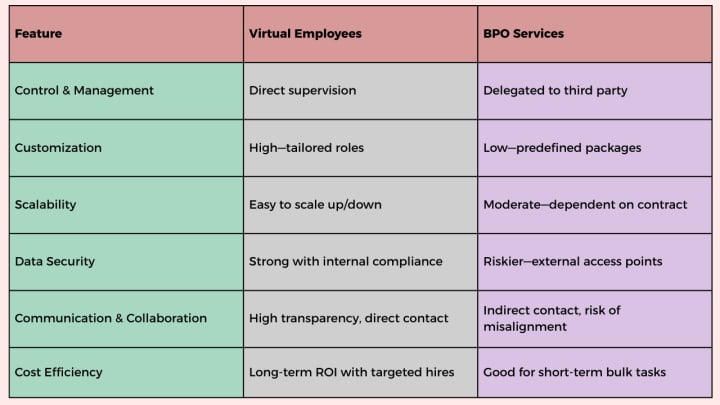
One of the most defining contrasts is the degree of managerial control. When you hire a Virtual Employee, you're in the driver's seat. These professionals operate like your in-house team, just remotely. You guide their daily priorities, track their output, and shape their workflows.
BPO services, on the other hand, manage tasks at a macro level. They operate as autonomous units, handling operations under a broad scope of service agreements.
Key takeaway: Want tighter control and immediate feedback loops? Hire a Virtual Employee.
Customization of Roles and Responsibilities
Flexibility often stems from how easily you can mold a role to meet evolving demands. Hiring a virtual employee means you can:
- Design custom job descriptions.
- Adjust roles over time without renegotiating contracts.
- Upskill your team members based on business shifts.
BPO services typically have predefined roles within rigid service-level agreements (SLAs). Pivoting often involves delays or renegotiations.
Need customized team roles? Go ahead and hire a Virtual Employee for precision alignment.
Scalability at Your Fingertips
Growth is great—until your support structure can’t keep up. When you hire a Virtual Employee, you can scale vertically and horizontally:
- Add new team members on demand.
- Cross-train them to handle adjacent responsibilities.
- Reassign tasks based on workload fluctuations.
By contrast, BPOs may require fixed minimum contract sizes or extended onboarding timelines for additional resources.
Pro tip: Businesses needing elasticity should lean toward virtual employees.
Data Security and IP Control
If you’re dealing with sensitive data, IP security becomes critical. Virtual employees, especially when onboarded via trusted agencies, often sign NDAs and operate under your internal security protocols.
BPOs, especially overseas, may introduce third-party risks due to distributed teams and less control over endpoint security.
Safeguard your data? You guessed it, hire a Virtual Employee to keep everything in-house but remote.
Communication Agility and Cultural Fit
Smooth communication is the oil in the machinery of remote collaboration. When you hire a Virtual Employee, especially from providers that match based on time zones and language fluency, you foster better collaboration.
With BPOs, there's often a layer of communication between you and the actual worker, leading to:
- Delays in response.
- Misalignment of expectations.
- Reduced transparency.
Tip: Choose virtual employees for seamless integration with your core team.
Comparing Virtual Employees vs BPO Services
Cost-Efficiency Over Time
Initially, BPOs may seem cost-effective—bulk contracts, offshoring, and standardized services keep upfront expenses low. But when you factor in turnover, onboarding time, and limited customization, the costs can spike.
By contrast, when you hire a Virtual Employees, you build long-term value. These hires learn your systems, adopt your culture, and deliver consistent results.
Long game thinker? Investing in virtual employees pays off with compound benefits.
Workforce Stability and Loyalty
It’s easier to build rapport and long-term engagement with virtual employees. They are an extension of your team and often feel invested in your mission.
BPO teams rotate frequently, and workers are often assigned across multiple clients. This can affect consistency and reliability.
Want loyalty and team synergy? Choose to hire a Virtual Employee instead.
Tech and Tool Alignment
Virtual employees work with your tools, your project management systems, CRMs, and communication platforms. This ensures:
- Streamlined reporting.
- Simplified onboarding.
- Real-time visibility.
In contrast, BPOs often use their proprietary systems, creating disconnects in tracking and collaboration.
Smooth tech stack integration? Another win for virtual hires.
Onboarding Flexibility
When speed matters, having a simplified onboarding process is key. You can hire a Virtual Employee and have them active within days—custom orientation, immediate tool access, and hands-on training.
BPO onboarding often takes weeks, with layered documentation and rigid processes.
Time-sensitive hiring? Go virtual.
Where BPOs Shine
Now, let’s not write off BPOs entirely. They excel when:
- You need high-volume repetitive work like data entry or customer support.
- You want to offload entire departments (like HR or payroll).
- You operate in a region with limited skilled labor.
For structured, task-based execution, BPOs are reliable.
Use Cases Best Suited to Virtual Employees
- Marketing specialists or SEO assistants.
- Administrative or executive assistants.
- Developers, designers, or QA testers.
- HR and recruiting support.
For dynamic roles requiring creativity, decision-making, and evolution, hire a Virtual Employee.
Use Cases Best Suited to BPO Services
- Call centers and telemarketing.
- Mass data processing.
- Transaction-heavy back office support.
- Compliance-based document processing.
Bullet Points: Signs You Need Virtual Employees
If you're experiencing:
- Stalled growth due to bandwidth issues.
- Poor visibility into outsourced projects.
- Bottlenecks in task delegation.
- Culture gaps with external vendors.
…it’s time to hire a Virtual Employee.
Bullet Points: Signs You Need a BPO Partner
Consider a BPO if you:
- Need round-the-clock customer service.
- They Are growing fast in transactional workload.
- Don’t need close collaboration with teams.
- Want fixed-cost, long-term SLAs.
In Ending
At the end of the day, flexibility is about fit. If your business thrives on collaboration, adaptability, and long-term synergy, choosing to hire a Virtual Employee is the smart move. You gain operational control, cultural alignment, and the ability to scale your team with precision.
But if your needs are volume-based, repetitive, and standardized, BPOs can efficiently handle the load.
Looking to hire a Virtual Employee tailored to your business? Explore Invedus Outsourcing and discover professionals who align with your pace, purpose, and productivity goals.
Read Our Recent Article - Virtual Employee Guide: Roles, Benefits & How It Works
About the Creator
Anjelina Jones
Anjelina is passionate about writing and has authored numerous articles covering topics such as entrepreneurship.
Keep reading
More stories from Anjelina Jones and writers in Journal and other communities.
Virtual Employee Guide: Roles, Benefits & How It Works
A virtual employee is a professional who provides services remotely from a different location, often from another city or country. Unlike freelancers who usually work on short-term gigs, a virtual employee is integrated into a business’s day-to-day operations, often working full-time.
By Anjelina Jones10 months ago in Journal


Comments
There are no comments for this story
Be the first to respond and start the conversation.