
The Trust Blueprint: How We Engineered a #2 National Rating for Nurse Experience
How operationalizing trust became our strongest brand and growth strategy.

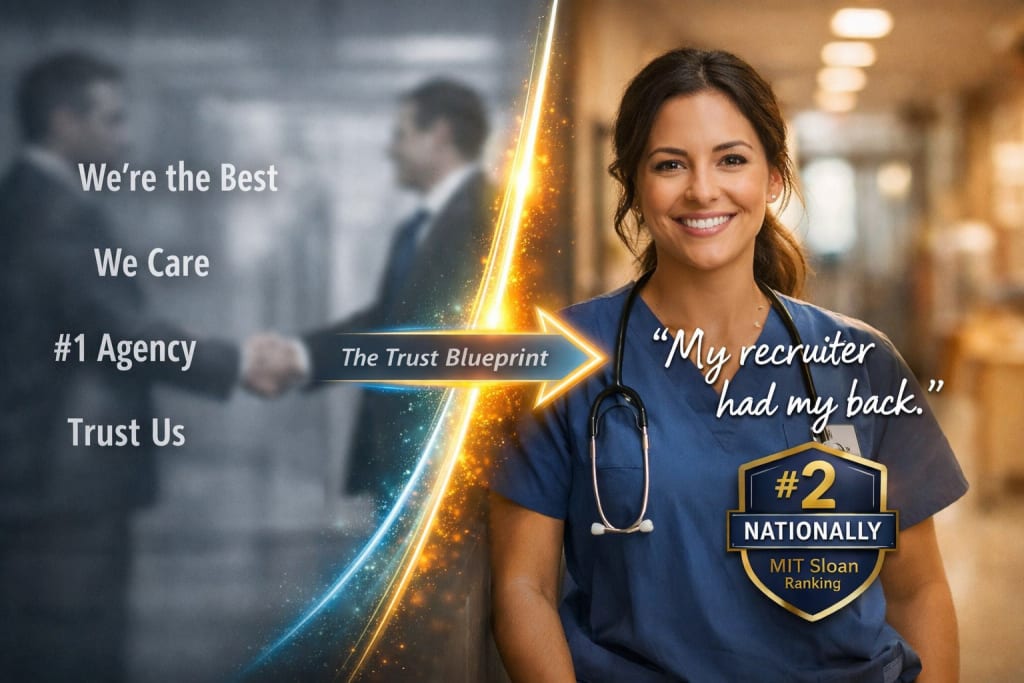
150,000 nurse reviews.
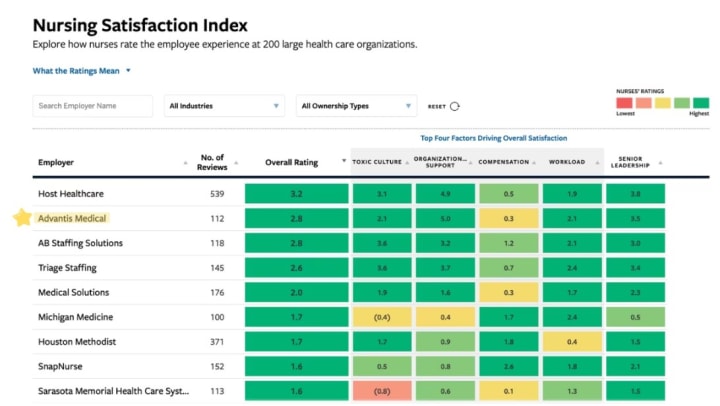
That’s the dataset the MIT Sloan School of Management used to rank employee experience across 200 healthcare organizations. The results held a surprise.
Sitting at #2 in the nation—beating out renowned hospital systems and massive tech giants—was a travel nurse agency. Us.
We didn’t apply for it. It wasn’t a "pay-to-play" marketing award. It was a raw data signal extracted directly from the voices of nurses on the front lines. It measured the things that actually keep them up at night: toxic cultures, unmanageable workloads, and a lack of support.
For me, this validation wasn't just a pat on the back. It was a wake-up call. In an industry where every competitor claims to "care," generic promises are just noise. We realized that if we wanted to differentiate, we didn’t need a better tagline. We needed a better operating system.
We call it The Advantis Gold Standard.
Promotion vs. Proof
When I first looked at the staffing landscape, I saw a crisis of differentiation. Every agency website said the exact same thing: We put nurses first.
But words weren’t the problem. Proof was.
There is a massive gap between Promotion (what brands say) and Proof (what customers experience). Trust dies in that gap.
In healthcare staffing, you see it happen fast. It looks like a recruiter ghosting you. A credentialing delay that spikes anxiety. An onboarding process that feels cold. When reality contradicts the marketing, credibility evaporates.
So we made a choice: Stop pouring energy into louder messaging. Start investing in closing that gap.
It’s Not a Campaign. It’s an Operating System.
People mistake the Gold Standard for a marketing campaign. It isn’t. It is the operating system of this company.
It’s a commitment to deliver a specific level of care from the moment a clinician visits our website to the moment they finish their assignment. But a promise is hollow without the mechanics to back it up.
To fix the trust gap, we had to operationalize empathy. That meant building dedicated teams—Payroll, Benefits, Credentialing, HR—whose only KPI was removing friction for the clinician.
Our CEO, Steve Belcher, put it to me this way:
"Trust is the only currency that matters in this industry. You can buy attention with ads, but you have to earn loyalty with operations. If we don’t support the clinician when it’s hard, we don’t deserve them when it’s easy."
That mandate drove everything. To serve patients, we had to obsess over the people saving them.
The Internal Shift
You can’t build an external brand on a shaky foundation. Before we ever breathed a word of the Gold Standard to the market, we had to make it real inside our own walls.
We took a hard look in the mirror. We trained our recruiters to understand that they aren't just filling roles; they are managing careers. We asked uncomfortable questions:
• What does communication feel like when a nurse is stressed?
• How do we fight for them when a contract gets cancelled?
• What happens after the job ends?
This alignment created consistency. And in staffing? Consistency is the currency of trust.
Letting Nurses Tell the Story
In marketing, we talk about "social proof." But real social proof isn't asking for a review; it's earning it so deeply that the customer wants to share it.
I think of Royal, a Med Surg nurse who travels with us. He didn't just leave a star rating. He was so moved by his experience that he recorded a video testimonial during his lunch break—still in his scrubs—just to let other nurses know he felt "heard."
Or Robyn M., who told us:
"My recruiter had my back. It was the smoothest contract I’ve ever worked."
Watch Robyn describe her experience:
These aren't marketing assets. They are artifacts of a relationship. By letting nurses tell the story, we stopped selling "jobs" and started validating careers.
The ROI of Empathy
As a marketing leader, I get asked if investments in "brand" and "experience" actually pay off.
The answer is yes. We have the data.
By committing to the Gold Standard, we didn't just make nurses happier; we built a resilient business.
- #2 Employee Experience Nationwide: The MIT ranking wasn't a fluke; it was engineered excellence.
- The Referral Flywheel: We have amassed over 700 five-star reviews. This created a virtuous cycle where happy clinicians become our most effective recruiters.
- Retention Over Acquisition: In an industry defined by churn, our clinician retention rates are climbing.
Trust Isn't a Campaign
The future of healthcare staffing won't be won by the agencies with the loudest ads. It will be won by the brands that prove they are trustworthy partners.
The Advantis Gold Standard helped us stand out, but more importantly, it helped us serve better.
For other leaders looking to differentiate, the lesson is clear: Don't just claim you're better. Prove it.
When you elevate service into strategy, you don't just build a brand. You build a belief system that people want to belong to.
About the Creator
Brian Sutter
Brian Sutter is a marketing leader transforming healthcare staffing through innovative strategies. A contributor to Forbes and Medium, he connects providers with opportunities nationwide as Marketing Leader for Advantis Medical.
Keep reading
More stories from Brian Sutter and writers in Journal and other communities.



Comments
There are no comments for this story
Be the first to respond and start the conversation.