
The Queue That Never Ends
A story about a system that promises efficiency but survives on delay, silence, and quiet compromise.
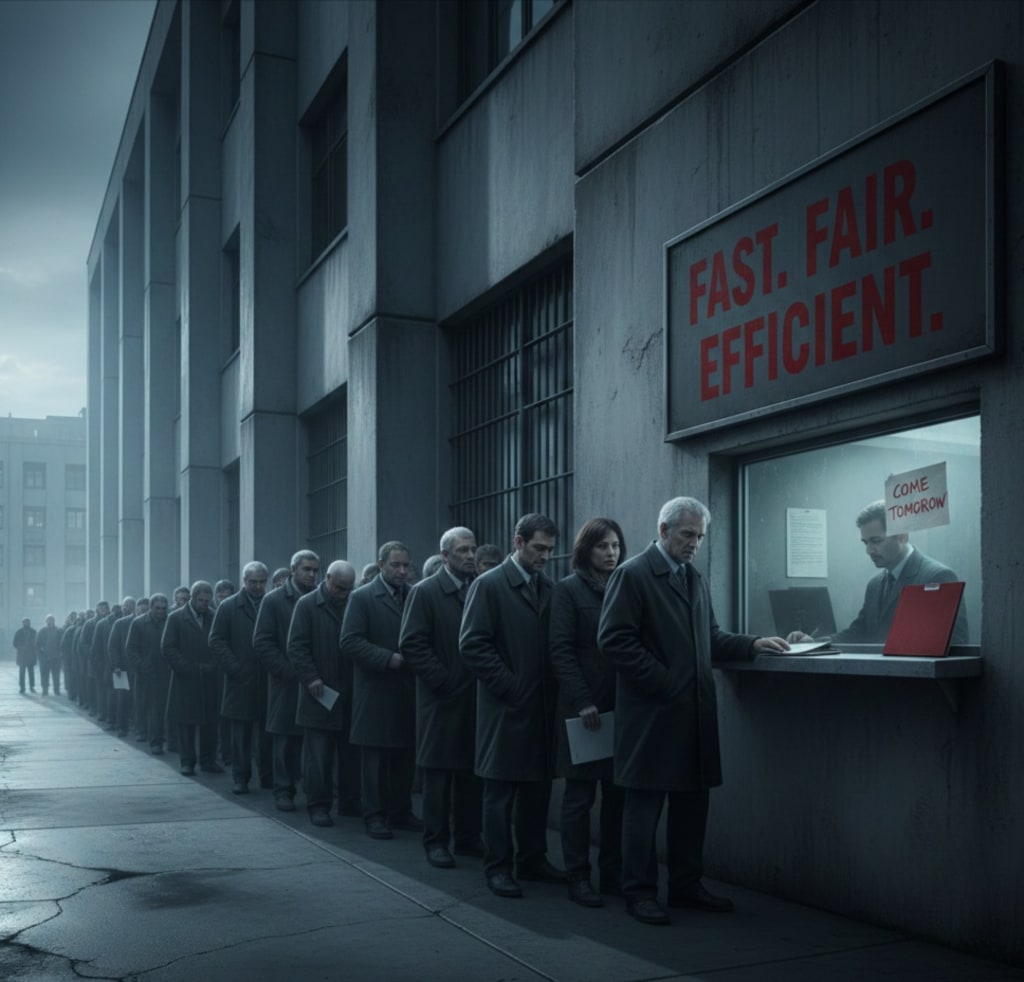
The line began before sunrise.
By six in the morning, hundreds of people were already standing outside the gray concrete building. Some carried files wrapped carefully in plastic. Others held envelopes close to their chests, protecting them from dust, sweat, and the possibility of losing their only proof that their problem existed.
At the front gate, a metal board read:
Citizen Service Center — Fast, Fair, Efficient.
Inside, only one window was open.
Ahmed had arrived at 4:30 a.m.
He was a schoolteacher. His problem was simple: his salary had been stopped for three months because the system showed him as inactive.
Inactive.
He taught five classes every day.
His students still stood when he entered the classroom. They still asked him questions. They still called him sir.
But the system did not recognize him.
So he stood in the line.
At 9:15 a.m., the gate opened.
A guard stepped out and shouted, “Only the first fifty today!”
The line broke instantly. Order turned into movement, movement into pushing. Files slipped from hands. Papers scattered across the ground. Voices rose in protest, then faded into tired silence.
Ahmed checked his number.
73.
The gate closed.
“Come tomorrow,” the guard said without looking at anyone.
“But we’ve been here since morning,” an elderly man pleaded.
“Tomorrow,” the guard repeated.
Ahmed came again the next day.
And the day after that.
On the fourth day, he finally reached the window.
The clerk didn’t look up.
“Form?”
Ahmed handed over his application.
“Wrong format.”
“But this is the form from your website.”
“Updated last week.”
“Where can I get the new one?”
“Counter 6.”
Counter 6 was closed.
By the time Ahmed found the correct form from a photocopy shop outside, the office was closing.
“Come tomorrow,” the clerk said.
Tomorrow had become a system.
Weeks passed.
His savings disappeared slowly — first the extra things, then the necessary ones. At home, he stopped turning on unnecessary lights. He postponed buying groceries until the last possible day.
At school, nothing changed.
He still explained lessons with patience.
He still encouraged weak students.
He still smiled.
Only at night did he sit quietly, calculating how long he could continue like this.
Still, the system showed him as inactive.
One morning, while waiting in the line again, Ahmed began noticing the faces around him.
A woman applying for her husband’s death certificate — rejected twice because one letter in the name didn’t match.
A young graduate trying to correct his date of birth so he could apply for a job.
An old pensioner who had traveled four hours just to prove he was still alive.
The system had a different problem for each of them.
But the solution was always the same.
Wait.
Return.
Come tomorrow.
Then Ahmed saw something strange.
A man walked past the entire queue and went straight inside. No form. No waiting.
Ten minutes later, he came out smiling.
“Work done?” someone asked.
“Yes,” the man replied casually. “I know someone inside.”
The line grew quiet.
No one reacted.
Everyone understood.
The next day, a man approached Ahmed.
“You’ve been coming for many days,” he said softly.
Ahmed nodded.
“For a small service fee, your file can move faster.”
“How fast?” Ahmed asked.
“Today.”
Ahmed looked at the building.
At the closed counters.
At the board that promised Fast, Fair, Efficient.
“How much?”
The amount equaled one week of the salary he hadn’t received.
Ahmed hesitated.
Then he paid.
His case was resolved within hours.
The system now showed him as active.
Three months of salary were approved.
Everything worked perfectly.
The next morning, Ahmed returned to school.
He stood before his students and began the lesson.
“Today,” he said, writing on the board, “we will discuss honesty and fairness in society.”
The chalk stopped.
For a moment, he didn’t know how to continue.
That evening, Ahmed passed the Service Center again.
The line was still there.
Long.
Silent.
Patient.
A new banner had been installed outside:
Digital Transformation Initiative — Making Services Faster Than Ever.
Inside, only one window was open.
And outside, tomorrow was already waiting.
Subscribe for more such fictional stories that contain real image of society
About the Creator
Keep reading
More stories from Sahar Rayyan and writers in Journal and other communities.
The Hidden Code of Human Psychology
Human psychology is deep, powerful, and sometimes surprising. Every day, people influence each other through words, tone, body language, and emotions—often without realizing it. What many call “dark psychology” is actually the study of how influence works, but the real power lies in using this knowledge ethically and responsibly. True influence is not about manipulation or control; it is about understanding human nature, building trust, and creating positive connections. This documentary explores the hidden patterns of human behavior and the ethical techniques that help you attract attention, build strong relationships, and communicate in a way that people naturally respond to. The Secret: People Respond to Emotion More Than Logic One of the biggest secrets of human psychology is that people make decisions based on emotions, and then justify them with logic. Whether it is choosing a friend, trusting a teacher, or buying a product, feelings come first. If you want someone to pay attention to you: Speak calmly and confidently Show genuine interest in their feelings Avoid arguing aggressively Make them feel understood When people feel emotionally safe around you, they naturally become more open and attentive. The Power of First Impressions Research shows that people form an opinion about someone within seconds. Your posture, facial expression, tone, and energy matter more than your words at the beginning. Tips to create a strong first impression: Maintain eye contact (but don’t stare) Keep a relaxed posture Smile naturally Speak clearly and at a moderate pace Confidence combined with kindness creates a powerful presence that attracts others without forcing anything. The Principle of Attention: People Love to Feel Important One of the most effective psychological truths is simple: people are drawn to those who make them feel valued. You can apply this by: Listening more than you speak Remembering names Asking about their interests Appreciating their efforts When someone feels important around you, they will automatically give you more attention and respect. The Mirror Effect (Ethical Rapport Building) Humans naturally trust people who feel similar to them. This is called mirroring. You can use this ethically by: Matching the other person’s speaking speed Using similar body language naturally Adapting your tone to their energy level This should always be done subtly and respectfully. The goal is comfort and connection—not imitation or deception. The Psychology of Confidence and Silence Many people try to impress others by talking too much. However, psychologically, calm confidence and controlled silence create a stronger impact. Try this: Pause before responding Avoid interrupting Speak only when you have something meaningful to add Silence signals emotional control and maturity, which increases your influence. The Rule of Positive Energy People are naturally attracted to positive personalities. Constant complaining, negativity, or criticism pushes others away. To attract people: Focus on solutions, not problems Encourage others instead of judging Maintain a hopeful and calm attitude Positive energy makes people feel comfortable and safe around you. Ethical Influence vs. Manipulation There is a clear difference between healthy influence and harmful manipulation. Healthy influence: Respects others’ choices Builds trust Creates mutual benefit Manipulation: Uses deception Creates pressure or guilt Damages trust over time Long-term success in relationships, leadership, or business always comes from ethical influence. The Attraction Formula: Three Core Elements To naturally attract attention and respect, focus on these three psychological pillars: 1. Confidence – Believe in yourself without arrogance 2. Empathy – Understand others’ emotions and perspectives 3. Authenticity – Be genuine, not fake People can sense authenticity. When your words and actions match, your presence becomes powerful. Final Insight: The Real Secret of Human Psychology The true “dark psychology” secret is not control—it is self-control and emotional intelligence. When you manage your emotions, communicate respectfully, and understand how people feel, you gain natural influence without forcing anything. The most powerful people are not those who manipulate others, but those who: Listen deeply Speak thoughtfully Act with integrity Make others feel respected In the end, human psychology is not about tricks. It is about connection, trust, and emotional awareness. Master these, and attention, respect, and influence will follow you naturally.
By Sahar Rayyanabout 20 hours ago in Psyche
The Cairn Beside the Lake
And so it came to pass that King Ertharion, Tenth King of Lombaia, stood beside the still lake below unrelenting and unassailable cliffs with the remainder of his harried host. In what was the tenth year of his reign and his forty-fourth upon this great green earth, Menigo the Betrayer, cousin of King Ertharion, pressed home his false claim.
By Matthew J. Fromm7 days ago in Fiction




Comments
There are no comments for this story
Be the first to respond and start the conversation.