
The Downfall of HubPages and Concerns About The Arena Group’s Practices
A timeline complicated by AI, Internet algorithms, and a revolving door of CEOs


Another writing platform has succumbed to the changing nature of the Internet. To be more precise, HubPages as a user contribution publisher ended because of a tale as old as time: (1) a company buys up a media outlet or publication, (2) it makes lofty promises it can’t keep, (3) it sells things for parts, initiates layoffs or major staff changes, and (4) cuts corners to pinch every penny possible to encourage higher profits for what we can assume are those in C-suites or similar positions of power.
HubPages still lives on the Internet, but the writers who contributed to it for years, even decades, have been forced out. They can no longer earn from ad share revenue, nor submit new content, and if they don’t delete their articles… they’re at risk of TAG earning off their work.
The slow death of HubPages has been gruesome. Frustratingly, it has been challenging to tell its story in a way that makes sense and isn’t so convoluted that it becomes difficult to manage the parts. It’s very hard to explain this story to people who have no experience with HP. It’s clouded in jargon and nuances.
My intention with this article is to bring clarity to HubPages’ demise while also highlighting problems that concern the writers and their work. I do not fully understand all of The Arena Group’s actions, the owners of HubPages. I am open to conversation or even correction if I have misstated any facts or misinterpreted any behavior. I am concerned about TAG’s philosophies and worry other companies will follow suit.
HubPages as a Startup
Since there isn’t a lot of information on the web or other media about the setbacks at HubPages, I felt I would detail what I know (and assume) about the once bustling content platform. Let’s start from the beginning.
HubPages was founded in 2006 by Paul Edmonson, Jay Reitz, and Paul Deeds. It gave people the ability to write and publish articles, stories, recipes, poems, and more (called hubs) online for money. Through advertising revenue and traffic, writers had the chance to earn a modest income. Those who got exceptionally good at it (this includes me) made hundreds to thousands of dollars a month. That’s considerable passive income that can make a huge difference in paying bills, getting out of debt, and otherwise.
Here is a timeline of HubPages’ history:
- When HubPages was founded, it was funded by a $2 million investment from Hummer Winblad Venture Partners. The venture capital firm is based in San Francisco.
- The three founders were former Microsoft employees. They were part of the startup MongoMusic.
- It raised $8 million between 2007 and 2008, likely its best growth.
- In 2011, revenue-sharing sites were hit hard by Google’s Panda update. It flattened traffic. HubPages survived, but many of the sites from that time didn’t.
- In 2014, HubPages acquired Squidoo. It was its largest competitor.
- In 2016, HubPages announced a significant change: moving from a single-site to multiple-sites with the introduction of vertical niches.
- In 2018, Maven acquired HubPages.
- In 2021, Maven rebranded as The Arena Group (TAG).
- In August 2023, Manoj Bhargava, creator of 5-Hour Energy, announced that TAG CEO Ross Levinsohn merged his company with Bhargava’s Bridge Media Networks. Bhargava became the majority shareholder of the merged company.
- Levinsohn was fired from TAG in December 2023. Bhargava took over as CEO. Sarah Silverstein was CEO of TAG from 2024 to February 2025. Then Paul Edmonson was appointed CEO in March 2025.
HubPages Under The Arena Group
In 2018, HubPages was bought by Maven. And then in 2021, Maven was renamed to The Arena Group. This is an important piece in the puzzle of what’s happened recently.
TAG was involved in the AI Sports Illustrated scandal. On November 27, 2023, Futurism published an article alleging that the sports magazine published AI-generated content credited to authors who were also AI-generated.
A little more than a month later, on January 5, 2024, TAG missed a quarterly licensing payment of $3.75 million to Authentic Brands. Two weeks later, Authentic Brands Group ended its licensing agreement with TAG. Then TAG announced layoffs for the entire Sports Illustrated staff. In March 2024, Authentic Brands Group licensed publishing rights to another group and rehired some of the cut SI staff.
TAG has a history of buying up publications, but that doesn’t guarantee that it’s good at managing those properties. If you snoop around Glassdoor and LinkedIn, you’ll find posts by past employees who bemoan the difficult environments fostered by TAG’s approaches and the fear of the pink slip express.
Over the past few years, TAG has had a revolving door of CEOs. This includes:
- Ross Levinsohn: His past career experiences include senior roles at Yahoo, Fox Interactive, Tribune Publishing, and Los Angeles Times.
- Manoj Bhargava: He is the creator of 5-Hour Energy, which has been under investigation for fatalities. He also has several philanthropic groups, which have been the subject of a U.S. federal investigation.
- Sarah Silverstein: She joined TAG in 2021 to manage TheStreet. She previously worked at Business Editor, Bloomberg Television, and spent five years as a senior portfolio analyst at a hedge fund.
- Paul Edmonson: He is one of the creators of HubPages (among other career experiences).
You would think since Edmonson was the creator of HubPages, he would have had a vested interest in protecting his startup and ensuring it grew and was stable. I have no idea what his thoughts are on HubPages, whether he saw it as a mild success, a failure, or a door opener to his fortune. His role in what happened to HubPages in the 2020s is an enigma to me
Perhaps HubPages is thriving in some sort of way after TAG kicked out all the user writers who contributed to the success of the platform. Maybe it will stay live now that TAG isn’t paying writers through the ad share revenue system. It could also vanish by sunrise.
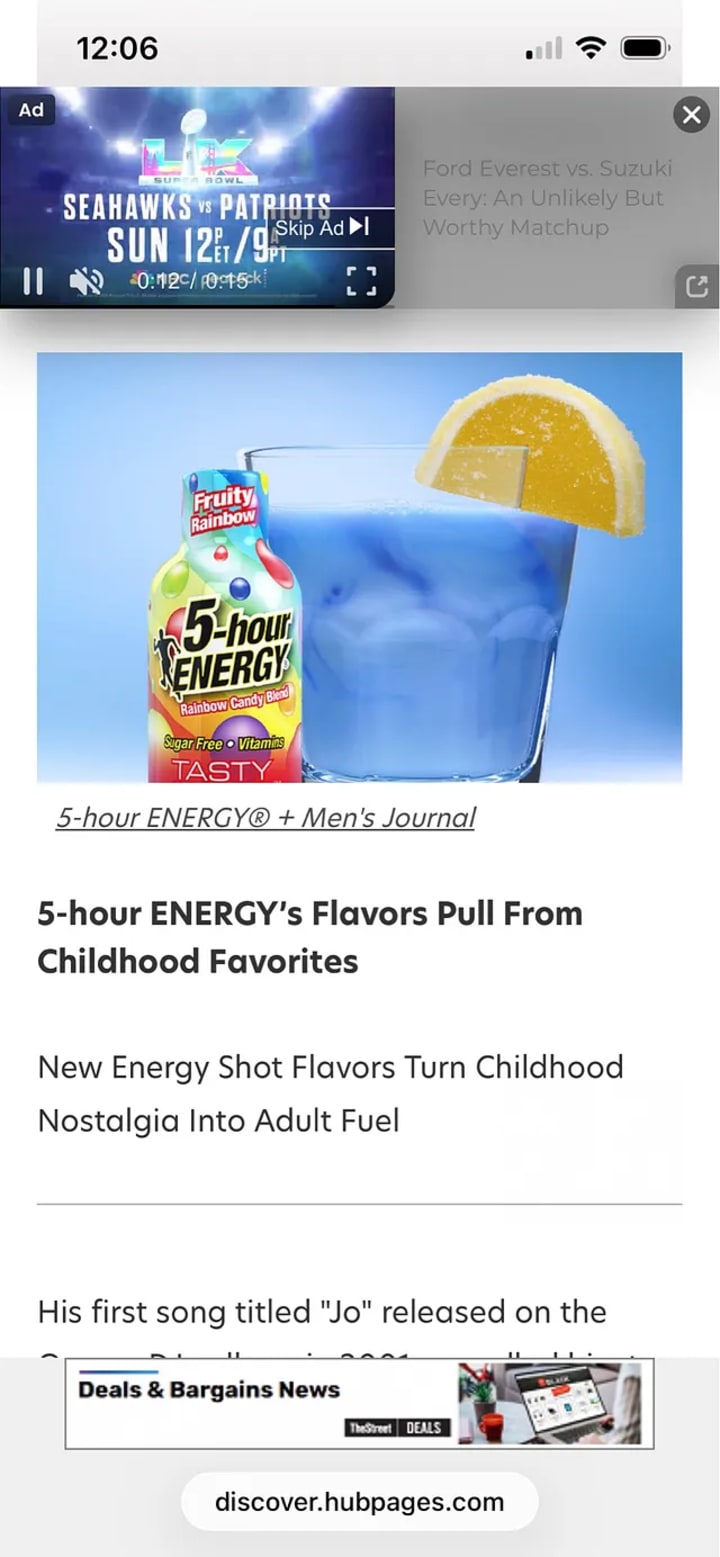
I just looked around the site while I was deleting articles off it, and for the first time, I noticed advertisements that actually have real name recognition rather than the strange ads that generally litter the pages. (Those obscure ads are still all over the place, particularly below articles.)
I found one ad for 5-Hour Energy that also promoted another TAG-owned property, Men’s Journal. I can’t recall in my 13 years of writing for HP if I saw ads for the Olympics or the NFL; it’s interesting to me that TAG sold ads for those events while also ending ad share revenue.

Layoffs and Major Changes At HubPages (The Beginning of the End)
Jump to 2024, there was a wave of layoffs at HubPages. It coincided with significant changes for users.
The entire editing team was let go (or moved within TAG’s properties). The site soldiered on with four staff members who were in charge of moderation. For years, HubPages staff would move high-performing articles featured on Discover.HubPages as well as new, well-written articles with specific topics over to the streamlined sites. When articles were moved over to the niches, it often resulted in more traffic and hence earnings.
This included such sites as: PetHelpful, LetterPile, DenGarden, PairedLife, Delishably, Owlcation, ReelRundown, Spinditty, WeHaveParents, and others.
If you look at Semrush data, you’ll find that many of these sites — and others not mentioned — performed very well at some point. Some of the sites once generated millions of views a month, others generated hundreds of thousands of views, which is still an enviable amount. Unfortunately, traffic took some hits, and there are a few reasons why I think this happened:
1. Google’s algorithm changed in a way that HubPages could not keep up with it, reducing the number of articles that ranked high in search results. At HP, there wasn’t enough focus on EEAT, and not getting in compliance with it was calamitous.
2. The ability to write comments was taken away (perhaps to reduce spam). When a new comment feature was created, called Rojo, it required people to log in to a separate system, and frankly, it had very poor user interface.
3. The number of ads on articles was raised way too high. There were many complaints from writers and readers about how ads would be inserted between every paragraph and sometimes spliced between sentences, making articles almost unreadable. The ads were also goofy at times, covering topics like how to get perfect abs, removing toe fungus, or celebrity gossip — this likely diminished the authority of articles.
4. There was too small a staff to really make each niche site its own unique brand. The sites lacked individual social media strategies, had repetitive layouts, and didn’t always make it clear where there was new content.
5. The addition of news on the sites. These news sections weren’t actually news. They were mostly ideas gobbled up from TikTok, YouTube, or Pinterest. Those who signed up to write for HubPages couldn’t contribute to these sections. Instead, TAG hired writers to scrounge around some 20 or so stories a day for these “news” sections. Sometimes the news sections would link to the longer hubs, and you’d see a momentary bump in traffic. But mostly, these stories weren’t written well, came off as clickbait, and were at the top of the niche sites' homepages, pushing everything else down and out of sight.
6. TAG’s mismanagement of HubPages is what I consider the cause of the downfall. In some ways, its handling was so clumsy that it almost seems upheaval was intentional in order to rob it. I think a different owner would have made better calls.
Publishing Privileges On Niche Sites Revoked
I’m giving a lot of context here, which might make it seem like I’m burying the lede, but it’s important to understand all of this and what was bubbling before things got really bad.
During the HP layoffs, some of the niche sites started getting spun as standalone endeavors. These sites would become solely TAG properties, and new articles would come from its pool of writers instead of people who could sign up for an account and write and publish when they had time. TAG employed third parties to run the standalone niche sites.
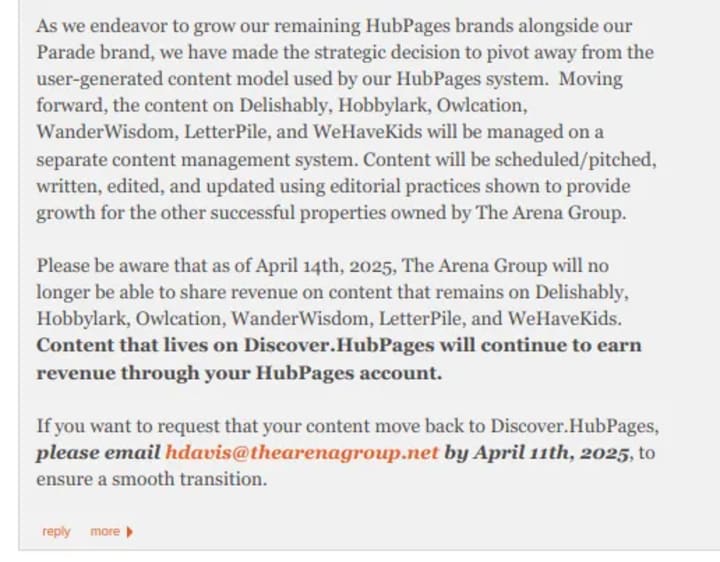
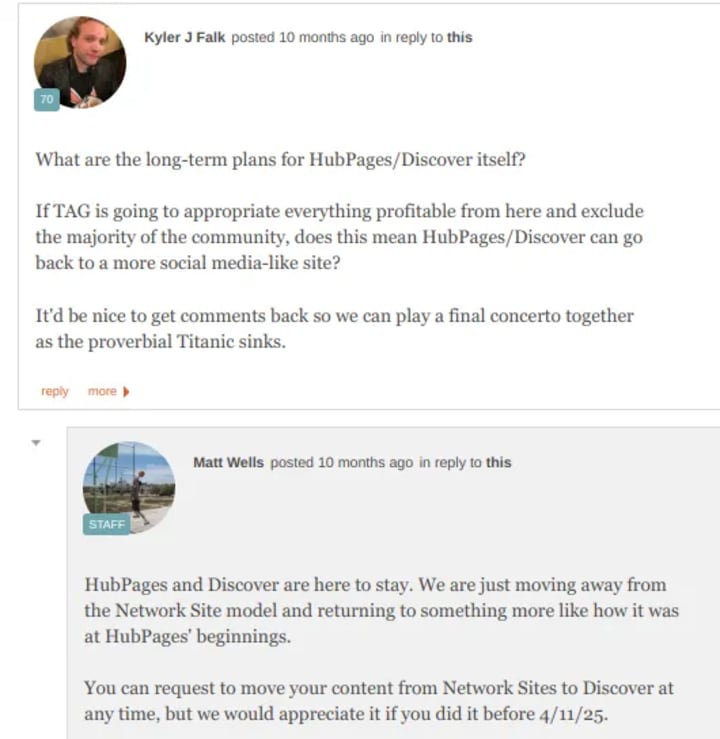
In a move that I found questionable, TAG warned the HubPages writers who had articles on these niches that it would keep their articles on the relaunched sites unless the writers requested to have them moved back to Discover.HubPages, the place where articles lived if they weren’t on a niche site.
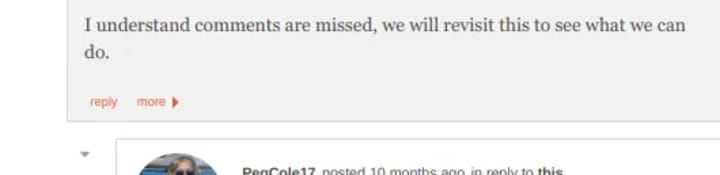
Here’s the caveat: If your articles stayed on these sites that would become part of the standalone endeavor plan, you would no longer get paid for those articles. You would, however, get paid if your articles were moved to Discover.HubPages, where the ad revenue model was still in place.
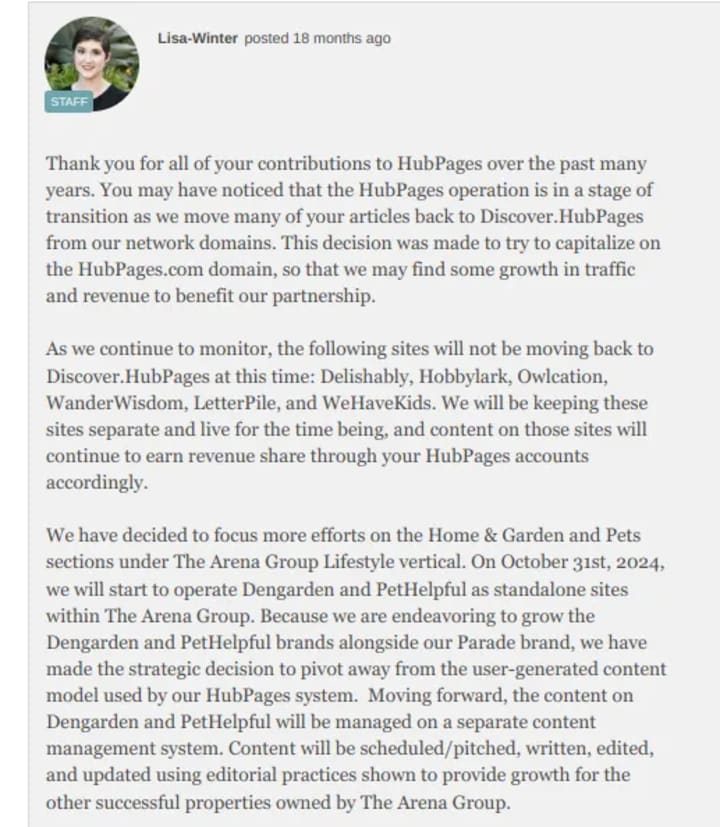
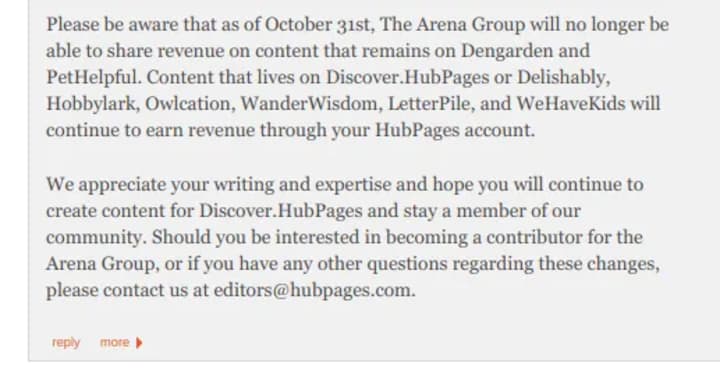
HubPages users were rightly upset. Not everyone was keeping up with the forums and emails either, so some people likely had their content taken over to the new TAG versions without their permission… people who’ve died had their articles moved over in this fashion.
It is incredulous that the writers who built the content that led to publications such as PetHelpful and DenGarden were kicked to the side. This move was sneaky. TAG, according to someone who was close to the matter, said it wanted as many articles as possible in the transition to shore up the numbers. It’s better to relaunch a publication that already has a foundation of articles than to start from scratch.
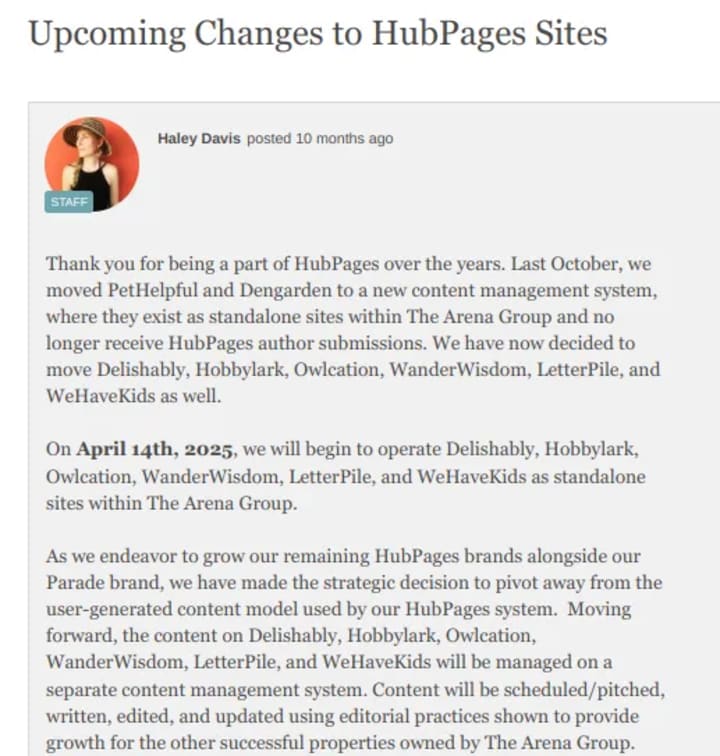
A few months later, HubPages announced more sites would turn into standalone endeavors:
Questionable Content Practices
This is where things get truly maddening. Many of us writers believe that TAG didn’t get away with as many traffic-commanding articles as it would have liked, since many of the users who could read between the lines requested to have their articles taken off the niches and moved to Discover.HubPages. It would seem TAG and/or its third parties got desperate and tried some methods that were, in my opinion, unethical, maybe even, and I use this word cautiously, deceptive.
What did TAG and/or its third parties do that broke the camel’s back and pissed off the writers? With the new versions of the niches, we started seeing… counterfeit articles of our own work.
It seems like they’ve been using AI to rewrite our most successful articles, even getting higher SERPS than the originals, posting them on the new versions of the niche sites, not compensating the original authors, not citing us, in some cases reusing successful URLs, and essentially stealing and plagiarizing work.
Counterfeit Shakespeare Article
It happened to me! I’ve yet to send a DMCA takedown request in part because I figure it would have an impact if one day this was all still happening, and I showed you what they’ve done. I did post about it in the forums and sent emails to HP and TAG questioning it and never received a single response.
I wrote an article for Owlcation called “The Six Deaths in Romeo and Juliet and What They Mean.” It was listed as one of my articles when I was a featured author on Owlcation.
Please look at the screenshots below and compare them. The first takes a look at my work. The second is the new Owlcation article.
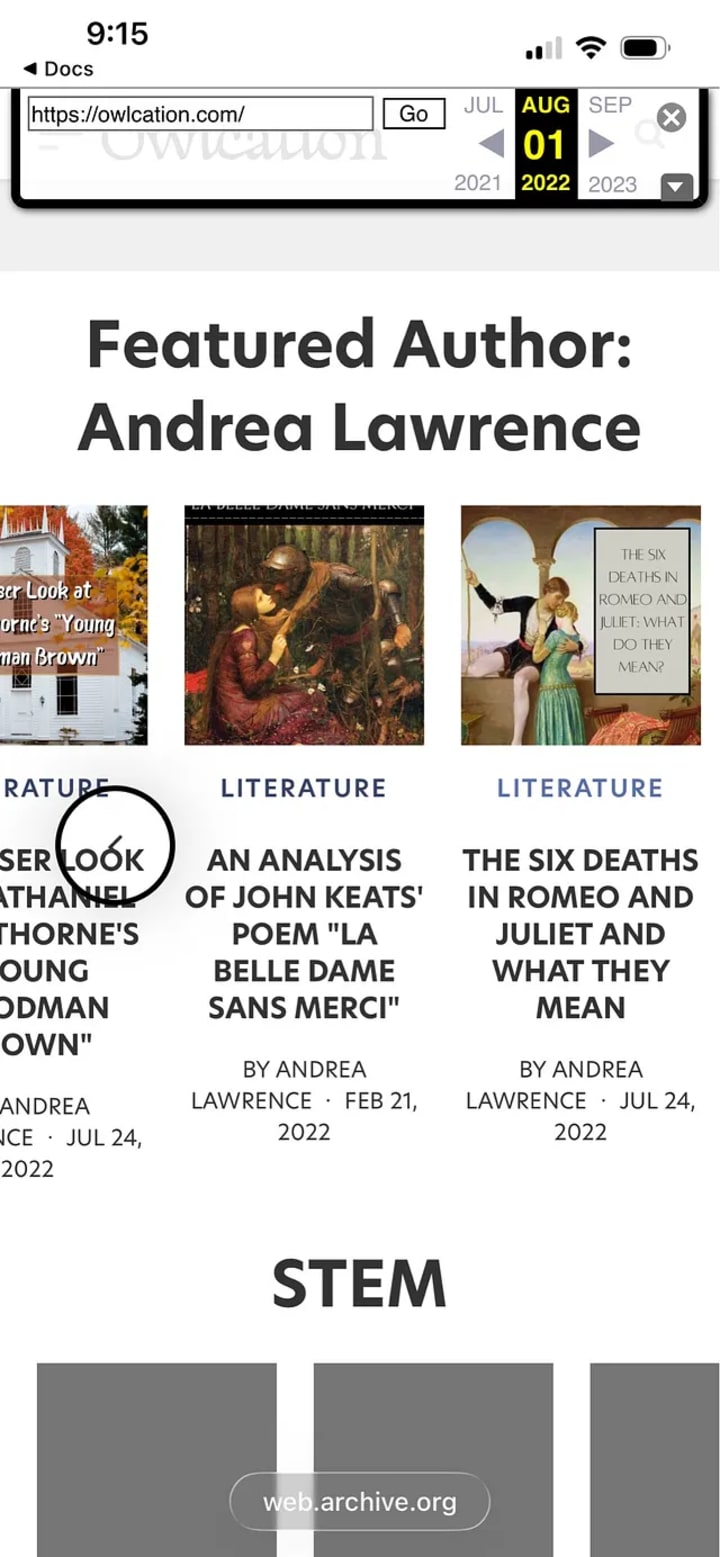
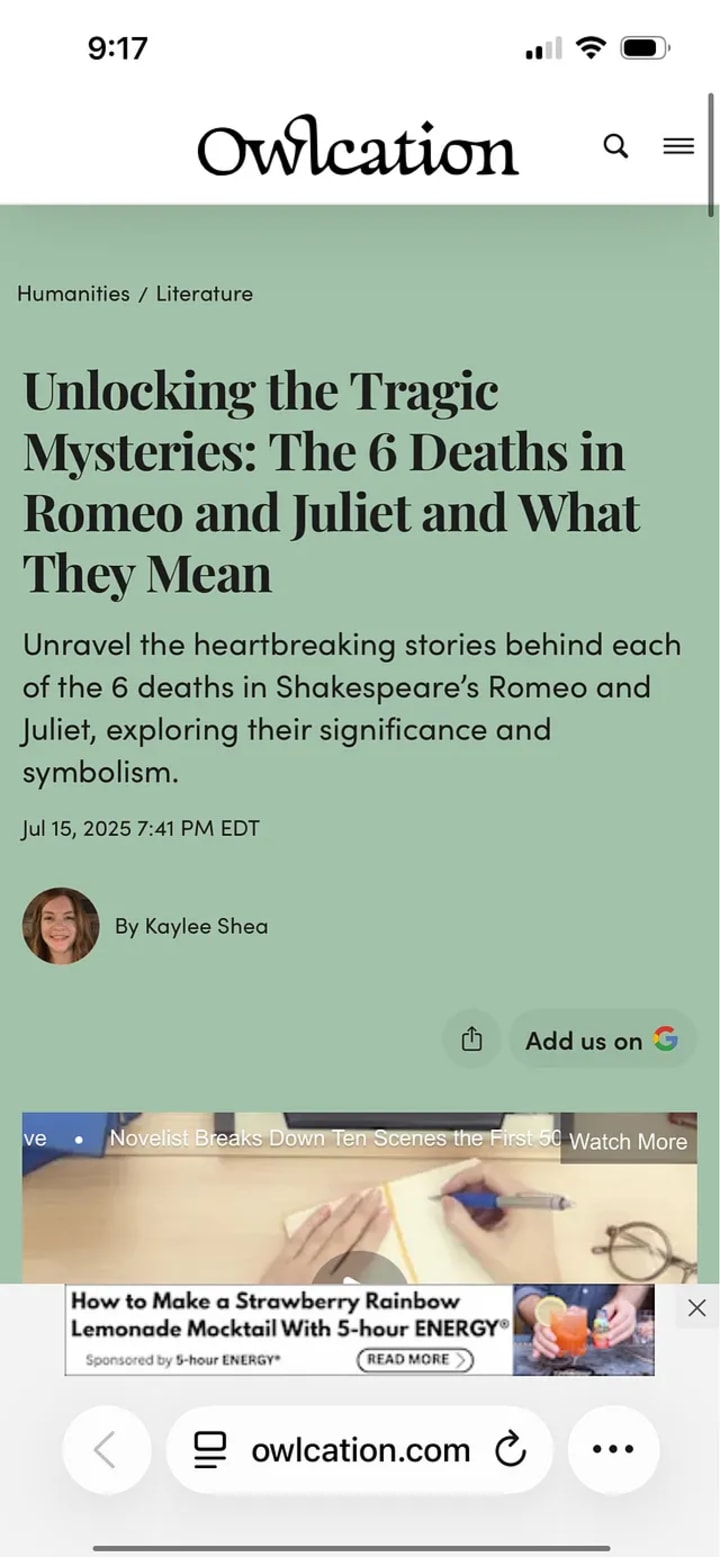
Sure, the 6 deaths that take place in Romeo and Juliet are fact, and people can write about what the meanings of those deaths are and analyze the play… but isn’t it odd that the same EXACT premise was put up on the new Owlcation only maybe a few days or weeks into its creation as a new standalone endeavor? It’s fishy.
It wouldn’t be remarkable if it were a single case. But it’s not. I have a friend who has been comparing HUNDREDS of HP articles to the doppelgänger articles on the new TAG sites. Some of the topics are much more specific than mine. I only want to mention mine at this time since I don’t want to put someone in the spotlight who might not want that attention.
A group of us dug around and tried to make sense of what was happening. We sent letters and emails to TAG and HubPages begging them to stop what they were doing and to explain themselves. We wanted answers. They complied with some DMCA requests, if not all. But that was about the only thing they would respond to, DMCA requests.
Whether they’re using AI to spin our work or using other means to do this, it goes well beyond the Terms of Service. It is a dastardly practice. TAG or its third parties basically stole from its own pipeline of contributor writers and republished worse versions of their works.
Owlcation has an egregious amount of these counterfeit articles. But it’s not the only one. It’s also been found on HobbyLark and PetHelpful. And we’re all wondering… where are they getting their recipes and pictures for Delishably? I don’t think TAG or a third party is using some fancy kitchen for pictures. Are they properly getting photos from a stock site? I doubt a chef or someone experienced with food is consulted for recipes or that they’re tested first. A friend of mine says the recipes appear to be taken from a couple of obvious places online.
If someone from TAG wants to comment on this article and bring clarity, even explain to us how we’ve been wrong in our assumptions, I would be more than willing to listen. I’m happy to write corrections to this post and even apologize if this has all been a colossal misunderstanding.
Sketchy Behavior At TAG
In all honesty, I think there should be an investigation into TAG. Not by me. By real officials. Because, as much as I’ve taken screenshots, talked to other writers, and sent emails to journalists, I don’t have access to what TAG does on the other side. I don’t know the full story. I do know they tend to hide behind third-party companies.
There is a lot more to uncover when it comes to TAG. What I really need are people who are interested in this story and want to know the truth; I’m willing to share more findings. I’m worried TAG is a destructive entity — it owns a large number of publications and often squashes its properties while jeopardizing the careers of writers, editors, website creators, and other staff.
If you look at the new Owlcation with a magnifying glass, you’ll find stranger things yet. At least one person on staff works for an AI company. She is the Director of Demand Generation at Acorn PLMS. It makes one wonder what kind of qualifications TAG is looking for in editors. It makes one wonder a lot of things.
We cannot let big corporations cut writers out of the equation like this. To me and others, it looks like they’re using either AI or some copy-and-paste system on our articles to turn a profit. If that’s not the case, they really need to explain why there are so many duplicate premises.
In the 4th quarter of 2025, HubPages made one last announcement about content. They’d no longer accept new articles and were ending ad share revenue:
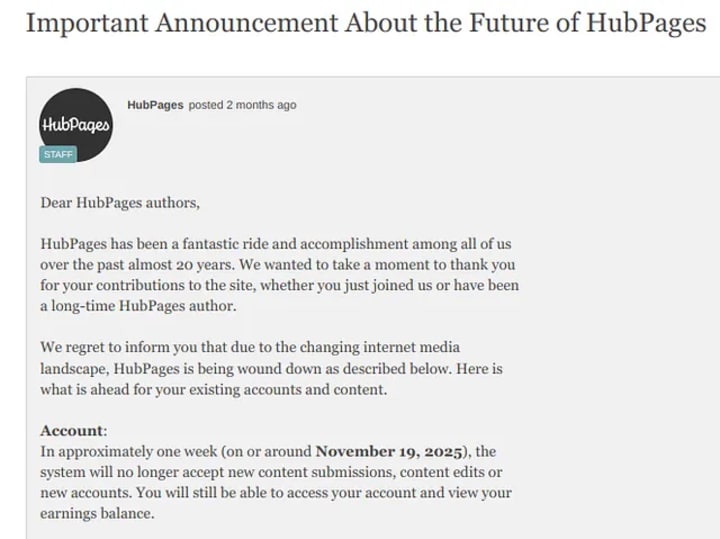
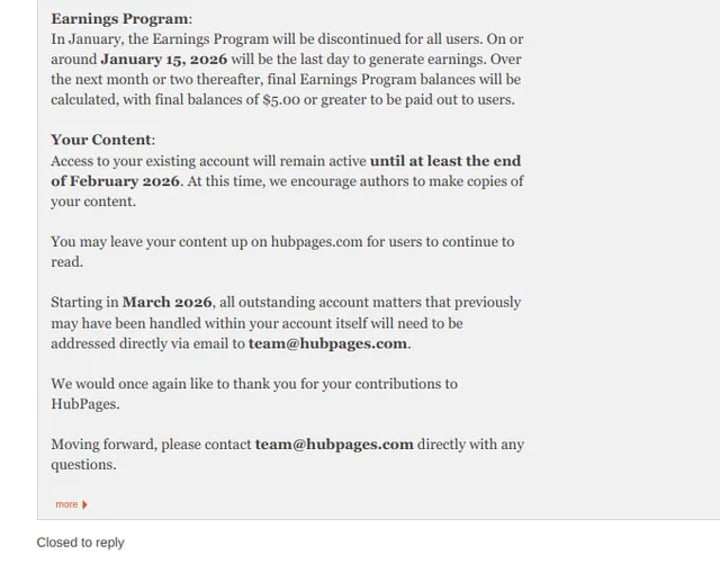
Please consider signing the following petition on Change.org, which goes into many of the issues HubPages has faced under The Arena Group. Even if you’ve never used HubPages as a writer or as a reader, your support here can help writers in a time when they’re increasingly getting silenced.
Works Cited
- “5-Hour Energy Drink Boss, Manoj Bhargava, Under Investigation For Fraud.” IndiaWest, 29 Oct. 2024.
- Arrington, Michael. “Hubpages Launches, Gets $2 m from Hummer Winblad.” TechCrunch, 5 Aug. 2006.
- Cioffi, Chris. “5-Hour Energy Founder, Swiss Bank Focus of Senate Tax Probe.” Bloomberg Tax, 21 Mar. 2024.
- Kelly, Keith J. “Meredith drops $1M suit against Sports Illustrated operator Maven.” New York Post, 1 Oct. 2020.
- Levy, Ari. “After 12 Years and Endless Fights With Google, Start-up HubPages Finds a Buyer.” CNBC, 6 Jan. 2018.
- “Maven Rebrands as the Arena Group, Expanding Business Strategy Around Consumer Media Verticals Anchored by Flagship Brands.” The Arena Group Media Contact: Rachael Fink, Communications Manager, Business Wire, 20 Sept. 2021.
- McGee, Matt. “Google Panda Two Years Later: The Real Impact Beyond Rankings & SEO Visibility.” Search Engine Land, 25 Feb. 2013.
- Nover, Scott. “Maven, the Media Company That Slashed Sports Illustrated, Has Had Its Own Share of Financial Woes.” Fortune, 17 Oct. 2019.
- Patrick, Margot. “He Was a Monk, Then a Billionaire and Now an Alleged Tax Cheat.” The Wall Street Journal, 15 Oct. 2024.
- Perez, A J. “Sports Illustrated’s Publisher Guts Staff. Future Unclear.” Front Office Sports, 19 Jan. 2024.
- Reilly, Liam. “Sports Illustrated Deletes Articles Published Under Fake Author Names and AI-generated Profile Photos.” CNN Business, 27 Nov. 2023.
- Taylor, Josh. “Arena Group Fires CEO In Wake of Sports Illustrated AI Articles Scandal.” The Guardian, 11 Dec. 2023.
***
Disclaimer: This article was written by a human and does not intend to slander, libel, smear, or accuse TAG outright of wrongdoing. The article questions the behavior of the company and seeks answers to questions about oddities discovered among writers. The article questions the nature of present-day AI usage and whether what TAG is doing is unethical or crosses legal boundaries.
***
The article was originally published on Medium.
About the Creator
Andrea Lawrence
Freelance writer. Undergrad in Digital Film and Mass Media. Master's in English Creative Writing. Spent six years working as a journalist. Owns one dog and two cats.
Reader insights
Outstanding
Excellent work. Looking forward to reading more!
Top insights
Easy to read and follow
Well-structured & engaging content
Expert insights and opinions
Arguments were carefully researched and presented
Eye opening
Niche topic & fresh perspectives
Masterful proofreading
Zero grammar & spelling mistakes
On-point and relevant
Writing reflected the title & theme
Keep reading
More stories from Andrea Lawrence and writers in Journal and other communities.
It’s a Really Hard Time to Be a Writer
Freelance writing, blog posts, and anything remotely related to Internet writing aren’t for the faint of heart. Everything when it comes to writing and making an earning… it’s all really inconsistent and at any moment a dependable stream of income could go dry. You need luck on your side to be a writer.
By Andrea Lawrence3 years ago in Journal
me, me, me
when i read back my poetry it screams “me, me, me” on my screen in bold letters and i can’t shut it up — most days, i cannot make any other words out; i want to throttle a thousand versions of the me gone by, i want to throw myself from a figurative balcony, i want to sink a sword into every pen i’ve held
By angela hepworth2 days ago in Poets




Comments (1)
Well-researched and documented; this piece is well-polished and organized; great work.