
Islamic Finance Market: The Silent Global Shift
Islamic finance reshaping capital flows and ethical investing
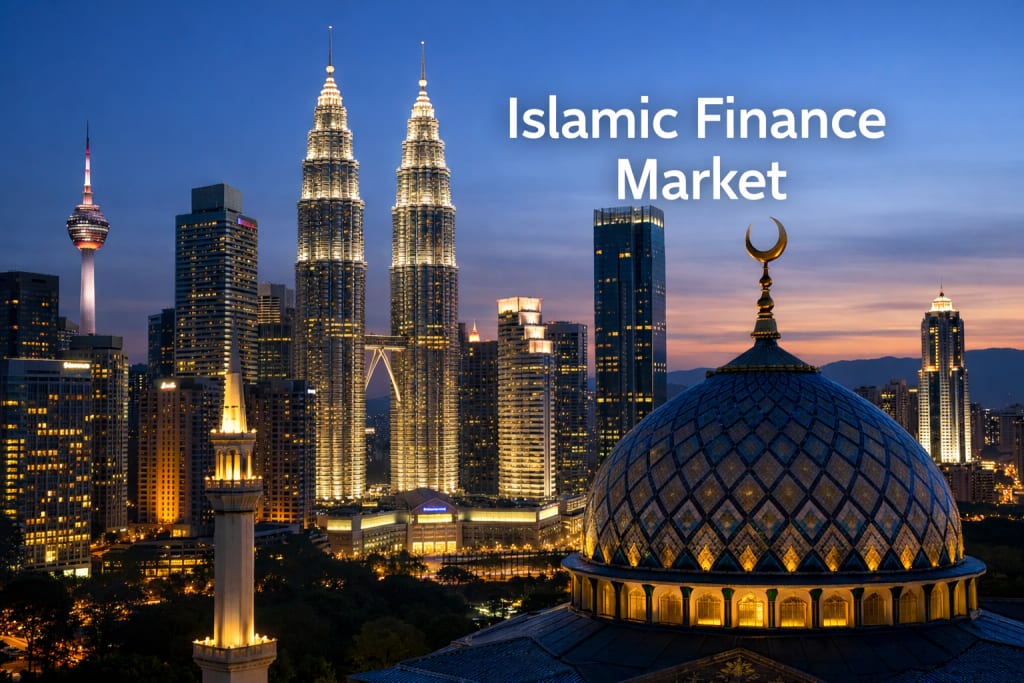
The glow of financial districts after sunset hides a transformation few predicted decades ago. Inside boardrooms across Kuala Lumpur, Dubai, Riyadh, and London, contracts are being signed under a framework that rejects interest, anchors value to tangible assets, and demands shared risk. This is not a fringe experiment. It is a capital movement reshaping global finance.
The Islamic Finance Market recorded assets under management of USD 6.10 trillion in 2026 and is projected to expand at a compound annual growth rate of 11.56%, reaching USD 10.54 trillion by 2031. These figures reflect structural transformation rather than short, term enthusiasm.
Ethical Capital Anchored in Tangible Assets
Islamic finance is built on principles prohibiting riba (interest), excessive uncertainty, and speculative transactions. Instead, financing must be asset, backed and risk must be shared. Instruments such as sukuk and profit, sharing contracts replace conventional debt structures.
Following global conversations around sustainable finance and green bonds, Islamic finance seamlessly introduced green sukuk, Shariah, compliant instruments funding renewable energy, climate infrastructure, and environmental projects. The transition felt organic. Ethical finance was already embedded in the system’s DNA.
Today, the Islamic finance market size illustrates the scale of this shift. Institutional investors increasingly integrate Shariah, compliant assets into diversified portfolios. Sovereign wealth funds allocate capital through sukuk issuance to finance airports, highways, and solar farms. Retail investors, empowered by digital banking apps, gain access to compliant savings and investment tools that align with both faith and financial returns.
The Islamic finance market share within global ethical investment segments continues expanding as ESG mandates align naturally with Islamic principles. Asset managers recognize that the prohibition of excessive leverage and speculation offers resilience during volatility. In uncertain macroeconomic cycles, that stability becomes attractive.
Financial centers beyond traditional Muslim, majority economies are building regulatory frameworks to attract Shariah, compliant capital. London, Hong Kong, and African financial hubs are integrating Islamic windows within conventional banking systems. The growth is measured, structured, and increasingly international.
Cross, Border Expansion and Structural Resilience
Behind the rising numbers lies disciplined architecture. Islamic banks operate under asset, linkage requirements that reduce systemic fragility. Financing must correspond to real economic activity. That structural restraint has helped Islamic institutions weather global disruptions with relative stability.
The Islamic finance market growth trajectory reflects expansion across banking, sukuk markets, takaful (Islamic insurance), and asset management. Governments diversify funding sources by issuing sukuk to tap liquidity, rich regions. Corporations seek Shariah, compliant funding to broaden investor bases.
Fintech is accelerating accessibility. Digital onboarding, AI, driven compliance checks, and blockchain, based sukuk pilots are redefining operational efficiency. Younger demographics across Southeast Asia and the Gulf Cooperation Council countries are digitally native and financially engaged. Their participation fuels retail banking growth and wealth management innovation.
Microfinance models rooted in profit, sharing arrangements empower entrepreneurs without exposing them to conventional interest, based debt burdens. Infrastructure development remains a major catalyst, as public, private partnerships adopt Shariah, compliant structures for transport, healthcare, and renewable projects.
The Islamic finance industry is evolving into a sophisticated ecosystem integrating banking, capital markets, insurance, and fintech. Standardization efforts across regulatory bodies are improving cross, border efficiency and reducing fragmentation. With clearer Shariah governance frameworks, investor confidence strengthens further.
Data, Driven Confidence and Market Outlook
Mordor Intelligence’s Islamic finance market analysis highlights sustained expansion driven by rising banking penetration, sovereign sukuk issuance, and global appetite for ethical capital allocation. The projected climb from USD 6.10 trillion in assets under management in 2026 to USD 10.54 trillion by 2031 underscores long, term structural demand.
The forecasted 11.56% compound annual growth rate signals disciplined acceleration rather than speculative spikes. Demographic expansion across Muslim, majority regions supports retail banking growth. Simultaneously, ESG, focused global investors increasingly recognize Shariah, compliant structures as aligned with sustainability mandates.
Green sukuk complements traditional issuance, channeling funds into renewable energy and environmentally aligned infrastructure. This synergy between faith, based finance and climate, focused investment enhances global appeal. As conventional markets grapple with high leverage and volatility, asset, backed financing offers an alternative model grounded in real economic participation.
Digital transformation will likely shape the next stage of expansion. Artificial intelligence in risk assessment, open banking ecosystems, and cross, border fintech partnerships are integrating into Shariah frameworks. Institutions are investing in compliance technology to streamline advisory processes while preserving governance integrity.
Capital markets are shifting toward transparency, resilience, and sustainability. Islamic finance sits at the intersection of all three. The projected rise to USD 10.54 trillion is not merely numerical expansion, it reflects systemic integration into global financial architecture.
The quiet hum inside financial districts signals more than routine transactions. It reflects a recalibration of trust in finance itself. As Islamic finance continues expanding across continents and asset classes, its principles of shared risk and tangible value resonate in a world rethinking leverage and speculation.
With assets accelerating toward USD 10.54 trillion within this decade, the system’s influence is no longer peripheral. It is structural, measurable, and increasingly strategic.
As ethical capital becomes central to global portfolios, the question is no longer about visibility, but about participation. Will more investors align with a model where profit walks hand in hand with principle?
About the Creator
Gold Rate Today (February 15, 2026): Yellow Metal Down Nearly Rs 24,500 From Peak; Check Prices Of 24K, 22K & 18K In Delhi, Mumbai, Chennai, Bangalore, Hyderabad & Other Major Cities
Gold has always held a special place in Indian households — not just as an investment, but as a symbol of security, culture, and prosperity. However, on February 15, 2026, the yellow metal is making headlines for a different reason. After reaching record-breaking highs earlier this year, gold prices have corrected sharply, falling by nearly Rs 24,500 from their peak levels.
By Sajida Sikandar4 days ago in Journal



Comments
There are no comments for this story
Be the first to respond and start the conversation.