
Crypto Unchained: The Data Behind the Digital Revolution
Tracking the Journey of Crypto from Niche Innovation to Financial Powerhouse
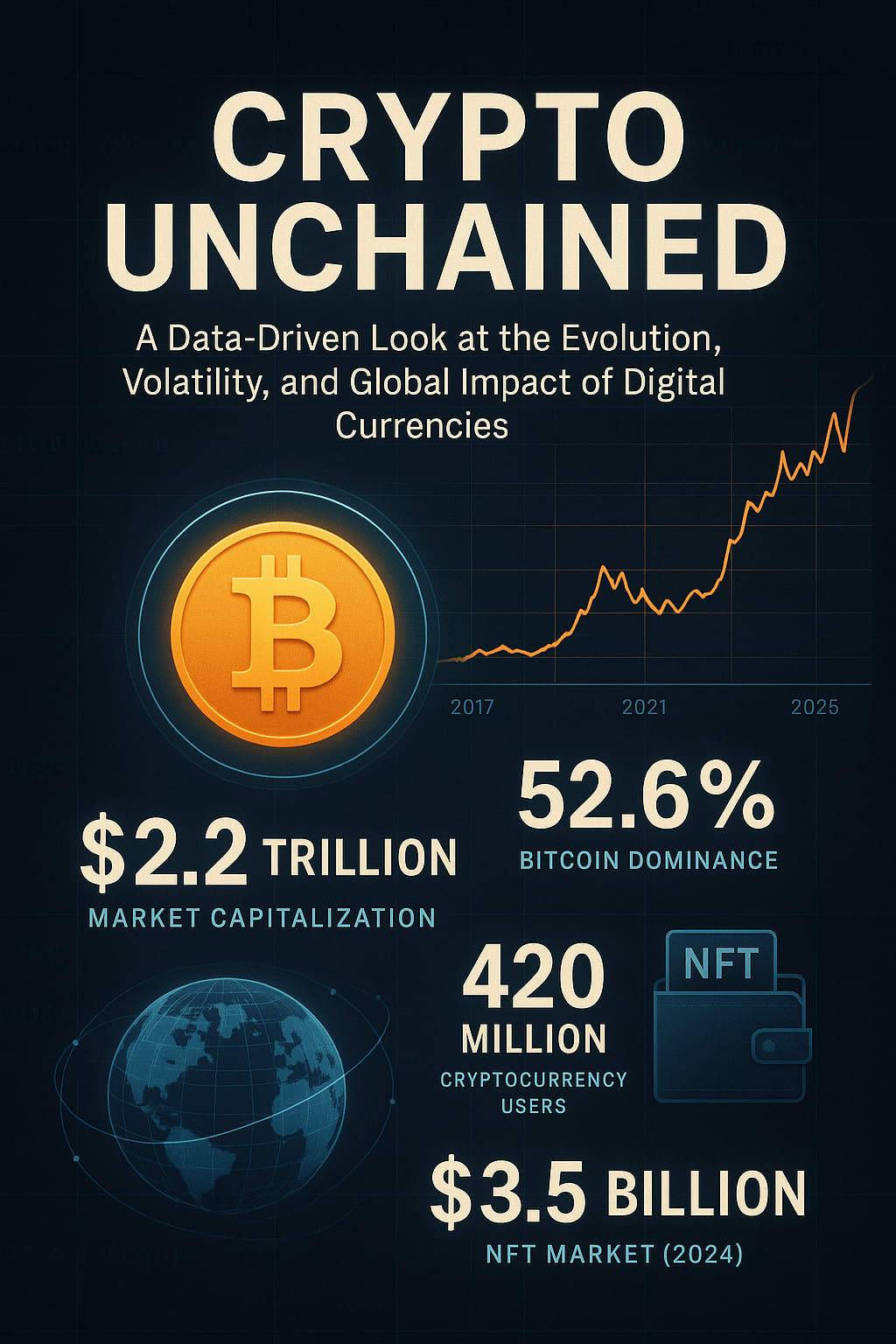
A Data-Driven Perspective on Cryptocurrency's Rise, Fall, and Resurrection In little over a decade, cryptocurrency has transformed from an obscure concept championed by niche internet forums to a multi-trillion-dollar global market. Digital currencies have redefined modern finance, attracting investors, technologists, and governments alike, with Bitcoin leading the charge. But with great innovation comes great volatility—and the crypto world is no stranger to that.
A Brief History of the Digital Gold Rush
Bitcoin, the first decentralized cryptocurrency, was introduced in 2009 by an anonymous entity known as Satoshi Nakamoto. Designed as a response to the 2008 financial crisis, it promised a trustless, transparent, and decentralized alternative to traditional banking.
Fast-forward to 2017, Bitcoin reached a then-astounding $20,000 before plummeting to $3,000 in 2018—a sharp reminder of the market's volatility. By November 2021, it soared to an all-time high of $68,789, pushing the total crypto market capitalization to over $3 trillion, according to CoinMarketCap.
However, by mid-2022, that same market shrank by more than 60%, triggering what many called the “Crypto Winter.”
The Numbers of Cryptocurrencies (as of Q1 2025) Market Capitalization: As of April 2025, the total crypto market cap is hovering around $2.2 trillion.
Bitcoin Dominance: Bitcoin maintains a 52.6% dominance, with Ethereum following at 18.3%.
Adoption: According to Chainalysis, over 420 million people worldwide own cryptocurrency, with the most widespread adoption occurring in nations like Nigeria, Vietnam, and the Philippines. NFT Market: Though cooled from its 2021 peak, the NFT market still generated $3.5 billion in trading volume in 2024.
Beyond Bitcoin: The Rise of Altcoins and Utility Tokens
While Bitcoin remains the flagship currency, thousands of altcoins have entered the space, each offering unique functionalities. Ethereum, launched in 2015, introduced smart contracts, enabling decentralized applications (dApps) and fueling the rise of DeFi (Decentralized Finance).
According to DeFiLlama, DeFi platforms currently lock in over $80 billion in total value, a rebound from a low of $38 billion in late 2022. Stablecoins like USDT and USDC also play a critical role, acting as bridges between traditional finance and the crypto ecosystem. Combined, they represent more than $130 billion in circulation.
Regulation: The Double-Edged Sword
Governments and regulators are increasingly stepping into the crypto arena. While regulation can offer protection and legitimacy, over-regulation threatens innovation. The U.S. Securities and Exchange Commission (SEC) has launched dozens of enforcement actions, while countries like China have banned crypto trading outright.
In contrast, nations like El Salvador and the Central African Republic have adopted Bitcoin as legal tender, betting on the long-term benefits of financial inclusion and technological innovation.
Moreover, central banks are exploring CBDCs (Central Bank Digital Currencies). As of 2025, over 130 countries are in various stages of CBDC development, with China’s digital yuan and India’s digital rupee already in pilot programs.
Environmental Concerns and the Shift to Sustainability
The negative impact that cryptocurrencies, especially Bitcoin, have on the environment is a major criticism. Bitcoin mining alone consumes approximately 127 terawatt-hours of electricity annually—more than many countries, according to the Cambridge Bitcoin Electricity Consumption Index.
However, the shift is underway. Ethereum’s successful transition to a Proof-of-Stake model in 2022 reduced its energy usage by 99.95%, setting a new standard for sustainable blockchain development. Many new projects are following suit.
The Future: Web3, AI Integration, and Financial Inclusion
Cryptocurrency is evolving into the backbone of Web3, a decentralized internet where users control their data and identity. Coupled with AI, these technologies are poised to revolutionize industries—from finance to gaming to healthcare.
Startups are already creating AI-powered trading bots, blockchain-based identity solutions, and decentralized cloud computing platforms. The blending of blockchain and AI could generate $1.3 trillion in economic value by 2030, according to a report by PwC.
Financial inclusion is another benefit of cryptocurrency. People in underserved areas can get access to banking, lending, and investment tools with just a smartphone, something that traditional banks often don't offer. Last Thoughts Cryptocurrency is more than just a passing fad; it is the beginning of a revolution. While price swings and regulatory hurdles continue to cause turbulence, the underlying technology is steadily maturing. As infrastructure strengthens and adoption grows, crypto could become as commonplace as credit cards or online banking in the years ahead.
For investors, developers, and dreamers alike, the next chapter of cryptocurrency is not just about profit—but about reshaping the future of finance
About the Creator
Keep reading
More stories from Md Nusaib Ul Islam and writers in Journal and other communities.
When Tomorrow Looked Back!!
Time travel did not exist in science fiction in 2149. It was kept secret. Dr. Elara Voss stood alone in the observation chamber, watching the prototype hum with a low, resonant pulse. The machine was crude, with glowing conduits, coils, and a central seat that looked like it had been redesigned by a madman to look like a dentist's chair. But it worked. Or at least it once did. That first jump sent a rat two minutes into the future. The rat endured. A drone was launched ten years ahead by the second jump. It never came back.
By Md Nusaib Ul Islam11 months ago in Fiction



Comments
There are no comments for this story
Be the first to respond and start the conversation.