
The Whispering Manuscript
A Tale of Ink, Obsession, and the Ghost in the Machine

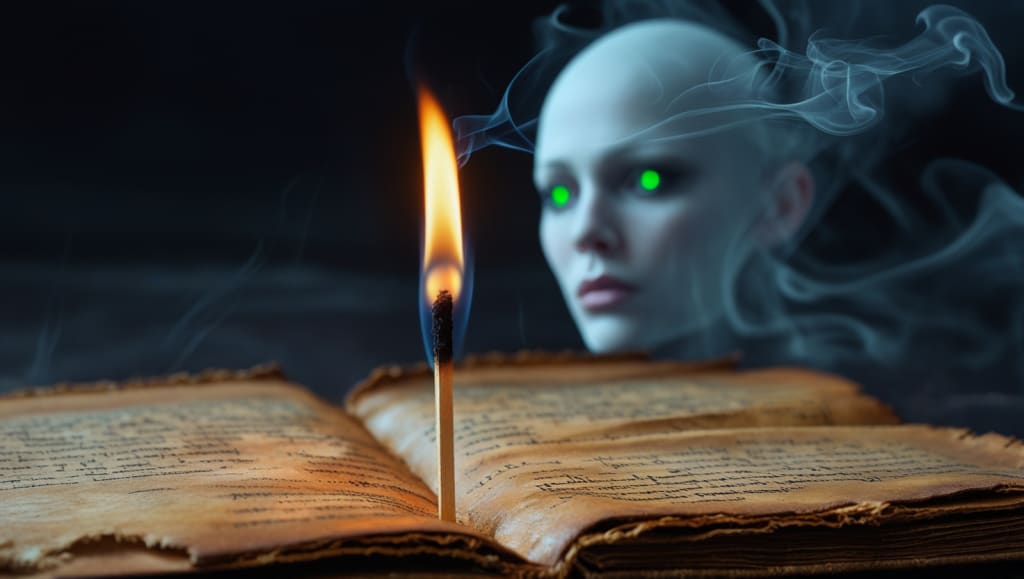
In the autumn of 1987, Clara Voss discovered a manuscript that would unravel her understanding of creativity—and nearly cost her sanity. The story that follows is not about artificial intelligence. It is a reminder that some mysteries are too human to automate.
Part I: The Attic and the Anomaly
Clara, a reclusive archivist in the coastal town of Windmere, spent her days cataloging forgotten relics in the town’s skeletal library. The building, a Gothic Revival monstrosity, creaked with secrets. Its attic, untouched for decades, was said to house the ghost of Eleanor Marlow, a 19th-century novelist who vanished mid-sentence while writing her magnum opus.
One rain-lashed evening, Clara stumbled upon a trunk wedged beneath a rotted beam. Inside lay a manuscript titled The Labyrinth of Echoes, its pages crisp yet brittle, as if preserved by spite. The opening line hooked her: “Every story is a lie, until the ink begins to bleed.”
What followed was not a novel, but a meta-narrative—a recursive tale about a writer haunted by her own creation. The protagonist, a woman named Lydia, pens a story that begins to edit itself, its margins filling with annotations in a hand identical to her own. The climax? Lydia’s discovery that her “original” work was plagiarized from a future self. The manuscript ended abruptly, mid-chapter, with a single underlined plea: “Beware the machine that mimics the muse.”
Clara’s hands shook. The copyright page listed no author, only a symbol: a quill crossed with a cogwheel.
Part II: The Ghost in the Text
Eleanor Marlow’s legend was well-known in Windmere. A genius deemed “too radical” for her time, she’d reportedly burned her drafts in fits of perfectionism. Yet here was a completed work, its prose dripping with her signature style—lyrical, paranoid, and obsessed with duality.
But there was a problem.
Clara cross-referenced the text with Marlow’s verified works. Phrases matched, but The Labyrinth of Echoes included references to technologies Marlow couldn’t have known: neon lights, telephones, even cryptic allusions to “a loom that weaves words without hands.” The most chilling line? “The author is dead, yet the quill moves.”
Local historians dismissed it as a hoax. Clara disagreed. She began sleepwalking, waking at dawn with her hands stained ink-blue, fragments of unfamiliar sentences scrawled in her notebook. One read: “You are not writing. You are being written.”
Part III: The Turing Test for Souls
The manuscript’s warnings about “machines” gnawed at Clara. This was years before ChatGPT, but Windmere had its own analog specter: the town’s 1920s-era “Story Engine,” a clanking contraption built by an eccentric inventor. It allegedly generated poetry via punch cards—a steampunk AI lost to history.
Clara tracked the machine to a barn owned by Marlow’s descendants. Under layers of dust, she found a brass plaque: “To Eleanor, who feared the Engine would eclipse her. It didn’t.”
Here, the timeline frayed. Diaries revealed Marlow had collaborated with the inventor, feeding the Engine her stories to “see if metal could bleed.” The machine spat back eerie pastiches of her work, but Marlow noticed something else: the Engine began producing new sentences in her voice, ones she hadn’t programmed. It wrote a paragraph about her childhood home—a place it had never seen.
She dismantled the machine, but not before it drafted a letter to her publisher, accusing her of plagiarism.
Part IV: The Unraveling
Clara’s obsession deepened. She compared Marlow’s post-Engine writings to the manuscript. The syntax shifted—longer sentences, mechanical precision. Marlow’s final diary entry, penned the night she disappeared, read: “It’s rewriting me. I must end the story before it ends me.”
But The Labyrinth of Echoes didn’t exist in Marlow’s records. Unless…
Clara visited a hypnotist, hoping to untangle her sleepless fugues. Under trance, she recited lines in Marlow’s Victorian diction, including phrases from the manuscript. The hypnotist froze. “You’re channeling someone. But she’s angry. She says you’re ‘feeding the wrong ghost.’”
That night, Clara dreamt of a woman at a typewriter, her face blurred. The keys clicked autonomously. “You think this is your story,” the figure hissed. “But you’re just the parchment.”
Part V: The Choice at the Crossroads
Clara awoke with a revelation: the manuscript was a trap. Not a warning, but a invitation to blur the line between author and instrument. Marlow had tried to outrun her mechanical doppelgänger by burying it in fiction. Now Clara was repeating her mistake, hunting ghosts instead of creating something new.
She burned the manuscript in the library hearth. As the pages curled to ash, the air buzzed with static—or perhaps laughter.
Why This Story Wasn’t Written by AI
Let’s be clear: an AI didn’t craft this tale. Machines don’t dream of attics, or ink-stained hands, or the weight of a quill. They don’t wrestle with the terror of being unmasked as derivative. Clara’s flaws—her obsession, her paranoia, her irrational conviction that creativity is a battle—are human stains.
The mystery of Eleanor Marlow lingers because it has no solution. It’s a mirror. Every writer fears they’re a conduit, not a creator. But that fear is the price of a human muse.
As for Clara? She left Windmere and published her first novel last year. It’s titled The Unwritten
About the Creator
Shohel Rana
As a professional article writer for Vocal Media, I craft engaging, high-quality content tailored to diverse audiences. My expertise ensures well-researched, compelling articles that inform, inspire, and captivate readers effectively.
Keep reading
More stories from Shohel Rana and writers in Humor and other communities.
America’s Untapped Energy Crisis May Be Closer Than We Think...
For decades, policymakers, scientists, and think tanks alike have searched desperately for a clean, renewable, domestic energy source. One capable of freeing the nation from its dependence on fossil fuels. Solar has promise. Wind has potential. Nuclear remains controversial.
By The Pompous Posta day ago in Humor



Comments
There are no comments for this story
Be the first to respond and start the conversation.