
Will AI Create Superhumans?
The Coming Age of Enhanced Intelligence, Engineered Minds, and the Redefinition of Humanity
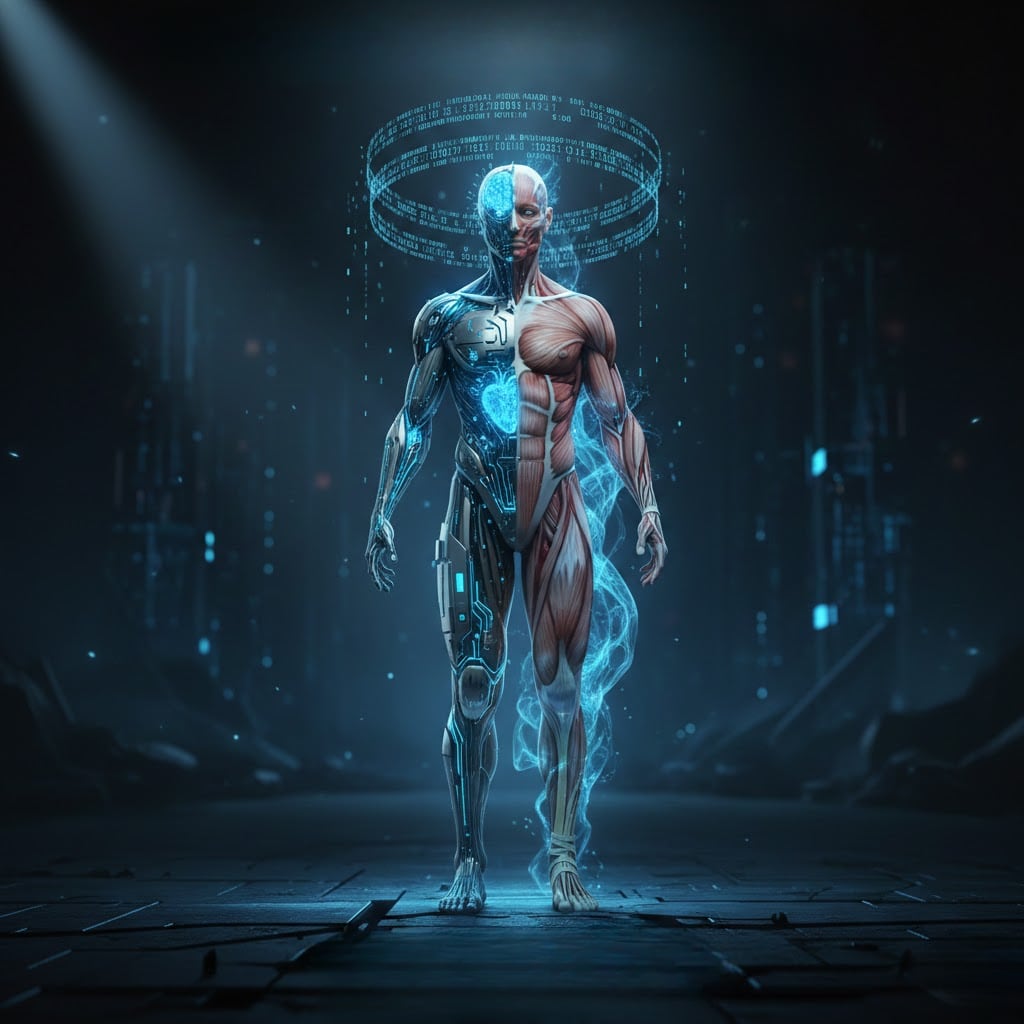
For most of human history, evolution was slow.
It took thousands of years for small biological changes to shape who we are. Stronger bodies. Larger brains. Better tools. Civilization itself was built step by step.
But today, something has changed.
For the first time, evolution may no longer be natural.
It may be engineered.
Artificial Intelligence is no longer just software running on machines. It is becoming a partner in human decision-making, creativity, medicine, and even thought itself. And as AI systems grow more powerful, a bold question begins to surface:
Will AI simply assist humans — or will it create something beyond us?
Will it create superhumans?
________________________________________
What Does “Superhuman” Really Mean?
Before imagining glowing cyborgs or science fiction heroes, we must define the term.
A superhuman is not necessarily someone with laser vision or robotic limbs. It may simply mean a human whose abilities far exceed what was once considered natural.
Stronger memory.
Faster learning.
Enhanced perception.
Augmented decision-making.
Extended lifespan.
These possibilities are no longer fantasy. They are active areas of research and innovation.
The integration of AI into daily life has already begun to enhance human capability. Doctors use AI to detect diseases earlier. Scientists rely on machine learning to discover new materials. Creators collaborate with algorithms to produce art and music.
But enhancement through tools is only the first stage.
The deeper shift begins when the boundary between tool and mind starts to blur.
________________________________________
The Rise of Cognitive Augmentation
We already outsource memory to our phones.
Phone numbers. Directions. Dates. Facts.
The human brain has adapted to rely on external systems. Now imagine that reliance becoming seamless — integrated directly into our cognitive process.
Companies like Neuralink are developing brain–computer interfaces designed to connect neural activity directly with machines. The early goals are medical: restoring movement, treating paralysis, addressing neurological disorders.
But the long-term implications are much larger.
If a brain can communicate directly with AI, it could theoretically:
• Retrieve information instantly without searching
• Translate languages in real time
• Enhance memory storage
• Accelerate learning
• Improve focus and concentration
In such a world, intelligence would no longer be limited by biology alone.
The mind would become expandable.
________________________________________
Intelligence Amplified
Artificial Intelligence excels at processing massive amounts of data quickly. Humans excel at contextual reasoning, emotional understanding, and meaning-making.
Separately, each has limitations.
Together, they could create amplification.
Imagine a scientist analyzing complex climate models with AI running simulations in real time.
Imagine a surgeon receiving predictive insights mid-operation.
Imagine a student learning at a speed tailored precisely to their brain’s patterns.
This is not replacement.
It is enhancement.
The combination of human intuition and machine computation could produce a new tier of capability — not artificial intelligence alone, but augmented human intelligence.
The superhuman of the future may not look different.
But they may think differently.
________________________________________
The Genetic Frontier
AI is not only transforming cognition. It is reshaping biology itself.
With the help of machine learning, genetic research has accelerated dramatically. AI systems can analyze DNA sequences, predict protein structures, and identify potential treatments faster than ever before.
This opens the door to gene editing technologies becoming more precise and effective.
If diseases can be removed at the genetic level, lifespan could extend. Physical resilience could increase. Cognitive performance could improve.
Evolution would no longer depend on random mutation.
It would depend on design.
The ethical questions here are enormous.
Who decides what counts as “better”?
Who gets access to enhancement?
Could inequality widen into biological division?
A world of enhanced humans and non-enhanced humans would challenge the very concept of equality.
________________________________________
The Risk of Dependency
But there is another possibility — one less glamorous.
Instead of becoming superhuman, we could become dependent.
If AI systems handle memory, navigation, calculation, decision-support, and creativity, our natural capacities may weaken.
A muscle that is not used will atrophy.
If cognitive effort becomes optional, will discipline decline?
If AI makes better decisions than humans in certain domains, will we defer automatically?
Superhuman ability requires intentional growth.
Passive reliance leads in the opposite direction.
The future depends not just on what AI can do, but on how humans choose to engage with it.
________________________________________
Emotional and Moral Intelligence
Even if AI enhances analytical ability, there are dimensions of humanity that cannot be engineered so easily.
Empathy.
Compassion.
Moral judgment.
Purpose.
A machine can calculate optimal outcomes. But meaning is not an equation.
If humans become more cognitively powerful through AI, emotional maturity must grow alongside it.
Otherwise, amplified intelligence without amplified wisdom could create amplified harm.
The greatest risk is not superintelligence.
It is superintelligence without ethics.
________________________________________
Redefining What It Means to Be Human
Throughout history, humanity has redefined itself through technology.
The invention of writing changed memory.
The printing press changed knowledge distribution.
The internet changed communication.
AI may change identity.
If intelligence becomes partially external, are we still purely biological beings?
If cognition merges with computation, where does the self end and the machine begin?
These are no longer abstract philosophical questions. They are emerging realities.
The superhuman future may not involve replacing humanity.
It may involve redefining it.
________________________________________
A Fork in the Road
There are two possible paths ahead.
In one path, AI becomes a powerful equalizer.
Human potential expands.
Disease declines.
Learning accelerates.
Creativity flourishes.
In the other path, enhancement becomes exclusive.
Dependency increases.
Critical thinking declines.
Power concentrates in the hands of a few.
The technology itself is neutral.
The outcome depends on governance, ethics, and intention.
AI will not decide what humanity becomes.
Humans will.
________________________________________
The Final Question
Will AI create superhumans?
Perhaps.
But the more important question is this:
What kind of superhuman do we want to become?
More intelligent but less thoughtful?
More efficient but less compassionate?
More powerful but less connected?
Or more aware, more capable, and more responsible?
The future of AI is not just about machines evolving.
It is about humans choosing to evolve with purpose.
Superhuman ability is within reach.
But true advancement will not be measured by processing speed or memory capacity.
It will be measured by wisdom.
And wisdom, unlike intelligence, cannot be coded.
The age of AI is not the end of humanity.
It may be the beginning of its next chapter.
The question is whether we will write that chapter consciously — or let it be written for us.
About the Creator
Mind Meets Machine
Mind Meets Machine explores the evolving relationship between human intelligence and artificial intelligence. I write thoughtful, accessible articles on AI, technology, ethics, and the future of work—breaking down complex ideas into Reality
Keep reading
More stories from Mind Meets Machine and writers in Humans and other communities.
The Next Big Thing After ChatGPT
When ChatGPT burst into the mainstream, it felt like a turning point. Suddenly, artificial intelligence wasn’t just a background technology powering ads or recommendations—it was something you could talk to. It could write essays, explain complex ideas, help with coding, and even sound surprisingly human.
By Mind Meets Machine9 days ago in Humans
I Don't Need My Phone... Wait, Is That Actually True?
My parents gave me my first cell phone when I was twelve years old. It wasn't a fancy iPhone or anything, not even close. Just a simple black flip phone for when I needed to call or text them after school.
By Madison "Maddy" Newton5 days ago in Humans
The Gentle Truth: What Your Kid's "Gentle Parenting" Actually Looks Like in My Classroom
As a teacher for the past ten years, I've witnessed a profound shift in the parenting styles of the families I work with. The rise of “gentle parenting” – with its emphasis on empathy, communication, and understanding – has undoubtedly brought positive changes to many homes and children. However, as someone who sees these children in a structured, collaborative environment, I feel compelled to share a candid perspective on what gentle parenting *actually* looks like in the classroom, and the potential challenges it can present when translating from home to school.
By Wilson Igbasi6 days ago in Humans


Comments
There are no comments for this story
Be the first to respond and start the conversation.