
When the Train Didn’t Stop
A story about ambition, sacrifice, and the station we forget to return to.
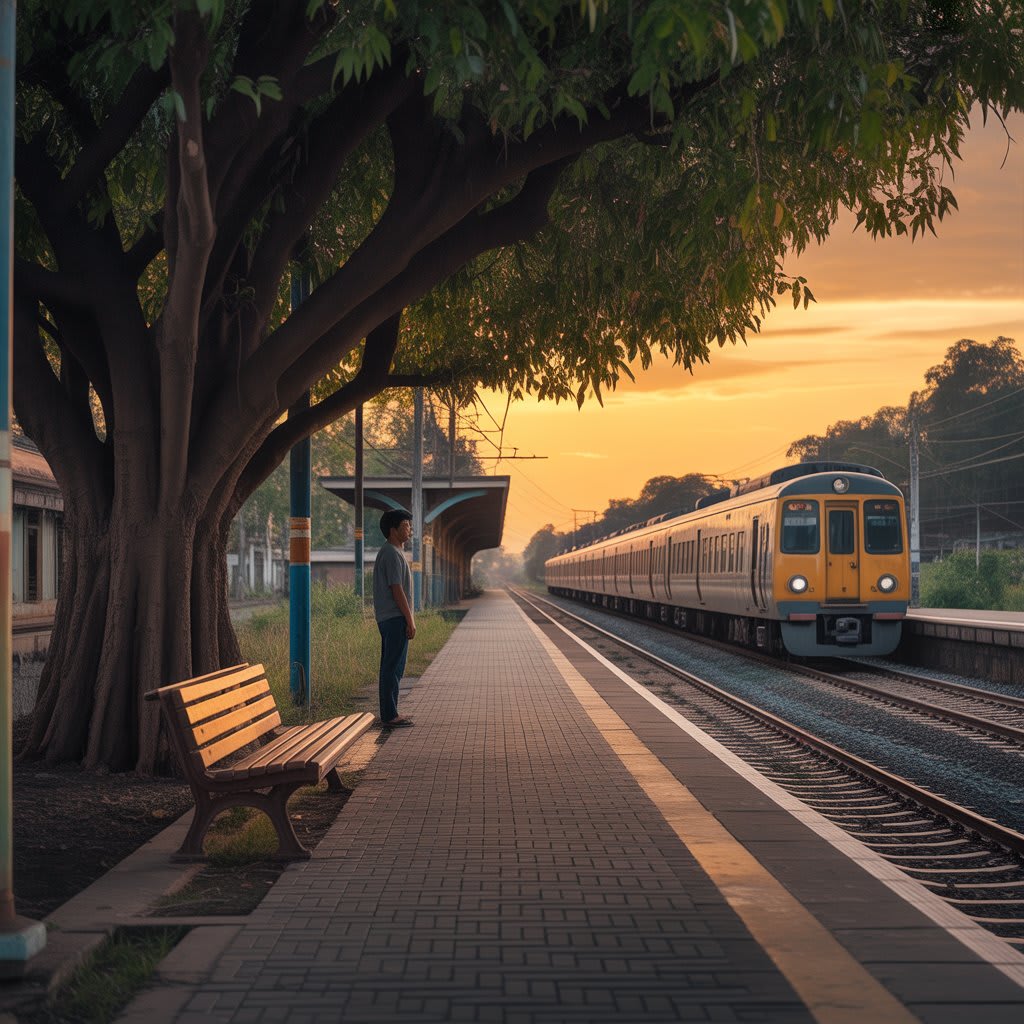
The express train was not supposed to stop at Mehran Junction.
It never did.
People in the compartment had already arranged their bags for Karachi. Some were half-asleep. Others were scrolling through their phones, waiting for the familiar rush of the city to begin. When the train slowed down unexpectedly, a few passengers looked up, confused.
Then it stopped.
No announcement. No explanation.
Just the sound of the engine breathing heavily in the evening heat.
Ayaan closed his laptop with irritation. He had been reviewing notes from his interview in Lahore — a multinational company, a glass building, a salary package that would finally make things “stable.” At least that’s what he kept telling himself.
He checked the time.
“Yaar, why here?” someone muttered behind him.
Ayaan glanced out of the window.
The faded board read: Mehran Junction.
For a second, it meant nothing.
Then everything.
The Station He Had Left Behind :
The platform looked smaller than he remembered. The paint was peeling off the station walls. A stray dog slept under a wooden bench. Near the end of the platform, a small tea stall released thin curls of steam into the orange sky.
And there it was — the neem tree.
His chest tightened.
He had grown up in a village a few kilometers from this station. His father was a government schoolteacher — respected, underpaid, stubbornly honest. Their house had two rooms, a courtyard, and shelves full of old books his father refused to throw away.
Every evening, his father would sit with him under a weak bulb and say the same thing:
“Study properly, Ayaan. This station is not your destination.”
Back then, Ayaan believed the world began at Mehran Junction and ended in Karachi.
When he got admission to a university in Karachi, the entire mohalla came to congratulate them. His father didn’t smile much that day. He just kept adjusting Ayaan’s collar and repeating instructions about hard work and discipline.
The day he left, they stood on this same platform.
The train had been late that day too.
His father had placed his hand on Ayaan’s head and said quietly, “Don’t disappear.”
Ayaan had laughed. “Abba, it’s just Karachi. I’ll come every Eid.”
But life in the city moved differently.
Eids became busy. Then internships started. Then part-time jobs. Then better opportunities. Calls became shorter. Visits became rare.
When his father fell seriously ill, Ayaan was in the middle of final exams.
He told himself he would go after the paper.
He reached the village one day late.
The house felt smaller without his father’s voice inside it.
After the funeral, he returned to Karachi quickly. He said it was necessary. He said his father would have wanted him to focus.
He never came back to Mehran Junction after that.
Until now.
Stepping Down :
Before he could change his mind, Ayaan grabbed his bag and stepped off the train.
The platform felt uneven under his shoes. The air smelled of strong boiled chai mixed with dust and a faint trace of diesel from the engine.
The tea seller looked at him carefully.
“You’re Master Abdul Kareem’s son, aren’t you?” the man asked.
Ayaan nodded, surprised.
The man’s face softened. “Your father used to sit there.” He pointed toward the bench under the neem tree. “Almost every evening. Even when he got weak.”
Ayaan couldn’t speak.
“He would say, ‘One day my son will return on a big train. I’ll recognize him before anyone else.’”
The words were simple. Not dramatic. Just ordinary.
That hurt more.
Ayaan looked at the bench. The wood was cracked now. Someone had carved initials into one corner.
For years, he had been chasing bigger offices, better salaries, newer phones. He had told himself he was doing it for security, for respect.
Standing there, he wasn’t sure who he had been trying to prove himself to.
Behind him, the train horn sounded.
Passengers were climbing back in.
The Moment Between Two Roads :
He stood still.
Karachi meant predictable comfort — rented apartment, career growth, meetings, promotions.
Mehran meant unfinished conversations and a house that still had his father’s books stacked against the wall.
The train gave another sharp horn.
“Bhai, are you getting in or not?” a conductor called out impatiently.
Ayaan looked once at the compartment where his seat waited.
Then he looked at the narrow road leading away from the station — the same dusty road he had taken years ago with a suitcase that felt too big for his thin arms.
He didn’t feel brave.
He didn’t feel dramatic.
He just felt tired of running.
The doors shut.
The express train slowly began to move, gathering speed as if nothing unusual had happened.
Within seconds, it was gone.
Mehran Junction returned to its usual quiet.
Months later :
The old government building near the station had been cleaned and repainted. The walls were still uneven, but the windows were fixed. A hand-painted board hung outside:
Mehran Learning Center :
Inside, children sat on mismatched chairs, arguing over pencils and laughing too loudly. Some came from nearby villages. Some couldn’t afford private tuition. All of them carried notebooks bigger than their confidence.
Ayaan spent his mornings teaching mathematics and English. In the afternoons, he helped older students fill out college forms — something he once had to figure out alone.
Some evenings were difficult. Funding was uncertain. Electricity went out often. Sometimes he questioned himself.
But every sunset, he found himself sitting under the neem tree, watching the evening train pass without stopping.
It didn’t bother him anymore.
He no longer needed it to.
About the Creator
Keep reading
More stories from Shahid Zaman and writers in Humans and other communities.
The Letter He Never Opened
The letter arrived on an ordinary afternoon. Arman noticed it only because the envelope looked different from the usual bills and promotional flyers. It was cream-colored, slightly creased at the edges, and addressed in handwriting he hadn’t seen in years.
By Shahid Zamanabout 16 hours ago in Fiction
When the Shelter Closes
Across the street from my house, a man slept under a tree, his dog by his side. My first, naive thought: he must be traveling through. But he kept coming back, often sleeping there during the day. Then it hit me—that person might not have a home.
By Bride of Sounda day ago in Humans
Libra Woman & Libra Man Compatibility Score
When a Libra woman meets a Libra man, the attraction is almost instant. Both are ruled by Venus — the planet of love, beauty, charm, and partnership. This pairing often feels like meeting someone who already understands you before words are even spoken. Their energy is elegant, polite, romantic, and emotionally refined.
By Inspire and Fun5 days ago in Humans
Veil of Subconscious Awakening
Images slide behind my eyelids like film cadres, bursting with meanings. In one moment, I’m speeding down the highway, making the speedometer swing wildly like a frantic pendulum. The next moment, I’m plunging from a falling plane, slowly crashing earthward. At home, I meet black cat’s green, googly eyes staring at me from the cavernous hollowness of the kitchen. When I turn for a moment, it disappears, and all I can see is a pair of blue suede shoes set up against the wall. I pick them up and put them on. When I glimpse at them again, they’ve become black as night, making me blink and flinch.
By Moon Desert5 days ago in Fiction




Comments
There are no comments for this story
Be the first to respond and start the conversation.