
The Queue That Never Ends
A quiet examination of waiting inside a system that continues to function long after it stops meaningfully serving the people within it.

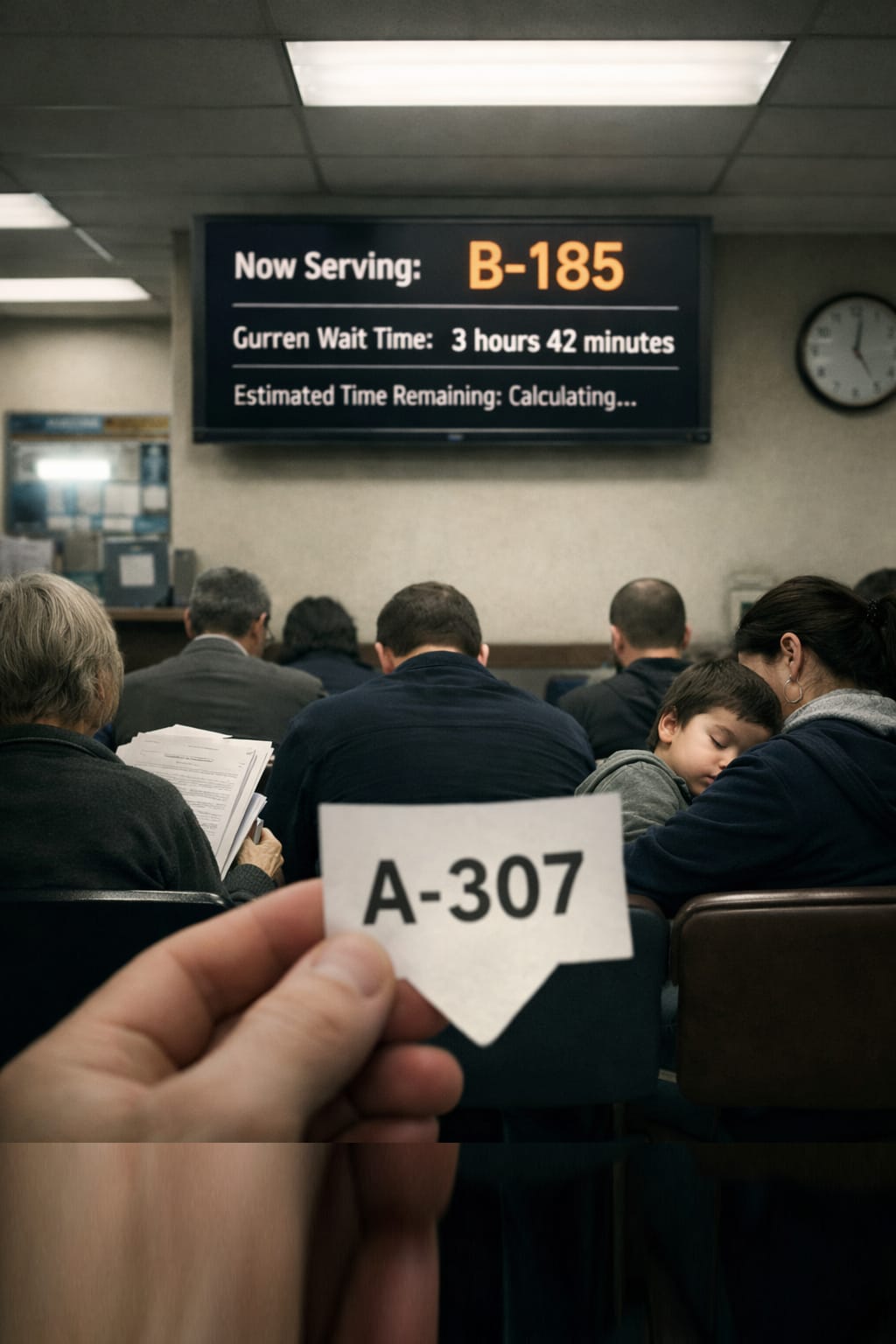
The first number you are given is not yours.
It belongs to the system.
You learn this early, though no one explains it outright. The number arrives without ceremony. It appears on a printed card, on a digital dashboard, in the corner of your emails. It follows you across departments, across offices, across years. It outlives addresses, jobs, relationships.
It is proof you exist in the way that matters most.
But it is not proof you exist to yourself.
The waiting room is quiet except for the intermittent chime that announces progress. Each tone is identical. No urgency. No emotion. Just a sound to mark that something somewhere has moved forward by exactly one unit.
No one reacts when it happens.
Everyone has learned not to.
They sit beneath fluorescent lights that flatten everything into neutrality. Faces, clothes, posture. The lights remove depth. They make everyone appear equally unfinished.
A digital display on the wall shows three things:
Now Serving: B-184
Current Wait Time: 3 hours, 42 minutes
Estimated Time Remaining: Calculating…
The last line never resolves.
A woman sits across from you holding a folder thick with documents. She flips through them occasionally, not reading, just checking their presence. As if they might disappear if left unobserved. Her lips move silently as she counts the pages.
A man near the door watches the display with complete concentration, as though attention alone might accelerate it.
A child leans against his mother’s shoulder, asleep, his small hand still clutching a numbered slip.
The system does not acknowledge exhaustion.
It only acknowledges sequence.
When your number was first issued, it felt temporary. A placeholder. Something to facilitate movement. Something that would eventually resolve into something else.
You thought it would end.
Everyone does.
At first.
—
The system is not located in one place.
It exists everywhere, but nowhere fully.
It operates through portals, offices, automated calls, forms that look identical but are never interchangeable. Each component refers to the others as authority.
Each component denies responsibility.
When you call, a voice thanks you for your patience before you have demonstrated any.
“Your request is important to us.”
You listen to this while listening to music designed to remove the sensation of time. Not pleasant music. Not unpleasant. Just neutral enough to make minutes indistinguishable.
Eventually, a person answers.
They ask for your number.
Not your name.
Your number.
You provide it. You have memorized it now. You can recite it without hesitation.
There is a pause.
Keys clicking.
A silence that feels procedural rather than contemplative.
“I see your request here,” the person says.
This is as close as the system ever comes to recognition.
You wait for something more.
Clarification. Progress. Resolution.
Instead, they say, “It is currently being processed.”
You ask what that means.
They explain that processing means it is moving through the system.
You ask where it is going.
They explain they do not have access to that information.
You ask who does.
They pause.
“I understand your frustration,” they say, reading from something you cannot see.
You realize they are not speaking to you.
They are speaking to your position.
To your number.
You thank them anyway.
The system records this interaction as completed.
—
You begin to notice how the system shapes behavior.
People organize their lives around anticipated responses that never arrive.
They delay decisions. They postpone movement. They remain suspended between states because transition requires authorization.
Authorization requires processing.
Processing requires time.
Time requires patience.
Patience requires belief.
The system feeds on belief more efficiently than anything else.
In the waiting room, people sit with the posture of those who expect eventual permission.
Not hope.
Permission.
Hope suggests possibility.
Permission suggests authority.
There is a difference.
—
Sometimes numbers disappear from the display.
They do not advance. They do not resolve.
They simply vanish.
No announcement. No explanation.
The sequence continues without them.
No one speaks about this openly.
But everyone notices.
A man who had been sitting near the window for weeks stops appearing one day. His number never reached the display.
His chair is occupied by someone else now.
Someone with a higher number.
Someone earlier in the system.
You consider asking about him.
You do not.
The system does not reward questions.
It rewards compliance.
—
You receive letters occasionally.
They are precise in their language.
They confirm receipt of things you do not remember sending.
They reference actions you do not recall taking.
They inform you that failure to respond may result in delays.
You read them carefully.
They never explain what response would prevent delay.
They only warn against its absence.
You respond anyway.
You always respond.
The system acknowledges your response by informing you it has been received.
It does not inform you what happens next.
—
There are moments when the system appears almost human.
A form letter includes a phrase that feels nearly personal.
A representative pauses longer than necessary before ending a call.
An automated message mispronounces your name in a way that suggests effort rather than indifference.
These moments are unsettling.
They imply awareness without accountability.
Recognition without responsibility.
You find yourself grateful for them.
You resent yourself for feeling grateful.
—
Over time, you stop imagining the end.
Not because you believe it will never come.
But because imagining it changes nothing.
The system does not accelerate for imagination.
It does not slow for despair.
It moves at its own pace.
A pace calibrated to maintain motion without conclusion.
You begin to understand that the system is not designed to resolve.
It is designed to sustain.
Resolution is inefficient.
Sustainability requires ongoing participation.
You participate because absence is indistinguishable from nonexistence.
Without your number, there is no record.
Without a record, there is no claim.
Without a claim, there is nothing to process.
—
One day, while waiting, you notice something unusual.
The display changes.
Not the number.
The format.
For a brief moment, the words flicker.
Instead of Now Serving, it reads:
Now Waiting
Then it returns to normal.
No one reacts.
You wonder if you imagined it.
But something lingers.
A small shift in perspective.
You had always believed you were waiting for the system.
It occurs to you, briefly, that the system might be waiting for you.
Not you specifically.
But your participation.
Your compliance.
Your continued presence.
Without you, the system has nothing to organize.
Nothing to process.
Nothing to sustain.
This realization does not free you.
It does not change your number.
It does not accelerate the display.
But it introduces friction.
A subtle resistance.
You begin to notice the shape of the waiting itself.
How it occupies space.
How it defines identity.
How it becomes indistinguishable from living.
—
The chime sounds.
B-185.
One number closer.
No one celebrates.
No one mourns.
The system continues.
You remain seated.
Your number still exists.
That is what matters most.
For now.
About the Creator
Lawrence Lease
Alaska born and bred, Washington DC is my home. I'm also a freelance writer. Love politics and history.
Keep reading
More stories from Lawrence Lease and writers in Humans and other communities.
The Machinery of Care
The system is the appointment. More precisely, the modern healthcare appointment — the quiet choreography of portals, pre-authorizations, referrals, billing codes, intake forms, waiting rooms, follow-ups, and automated messages that feels like care but often operates like administration wearing a white coat.
By Lawrence Lease3 days ago in Humans
When True Love Never Questions Your Soul
“And she’s going to learn that this life will hit you, hard, in the face, wait for you to get back up, just so it can kick you in the stomach but getting the wind knocked out of you is the only way to remind your lungs how much they like the taste of air.” — Sarah Kay’s Poem — If I Should Have a Daughter
By Chantal Christie Weiss6 days ago in Humans




Comments
There are no comments for this story
Be the first to respond and start the conversation.