
Press One
Navigating a maze designed to keep me out.

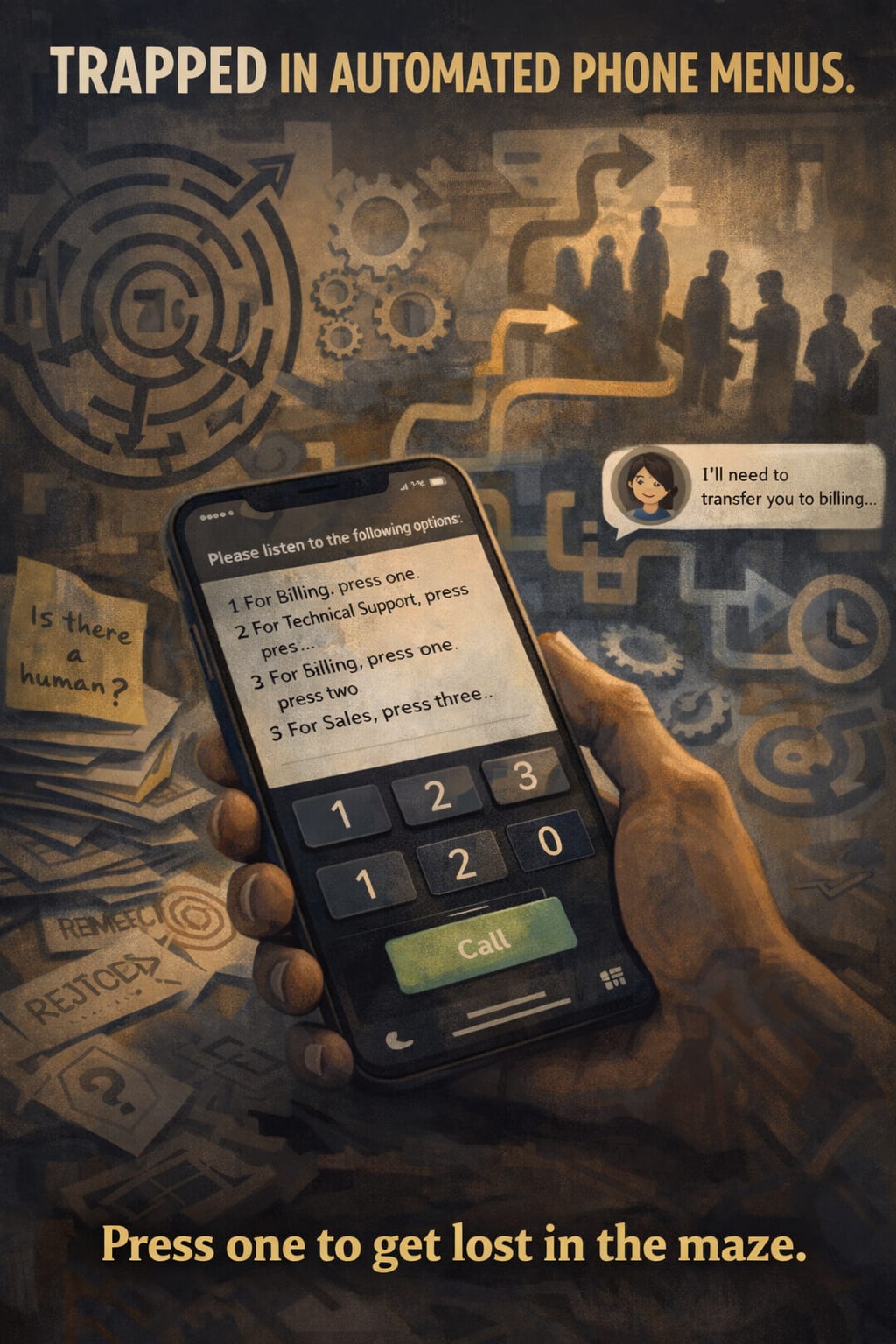
It starts with a choice.
"For English, press one. Para español, presione dos."
Simple enough. I press one.
"For billing, press one. For technical support, press two. For sales, press three."
This is where it gets tricky. My problem isn't billing. It's not really technical either. It's somewhere in the middle. It's a service outage that caused a billing error that looks like a technical glitch. But the system doesn't have a button for It's Complicated.
If I press one, I get the billing department. They will tell me to call technical support. If I press two, I get technical support. They will tell me to check my bill.
I hover my thumb over the screen. I feel like I'm defusing a bomb. One wrong move and I'm sent back to the main menu. One wrong move and I lose my place in the queue.
I press two.
"Please listen to the following options. For internet connectivity, press one. For email setup, press two."
I sigh. I put the phone on speaker. I start loading the dishwasher. I need to keep my hands busy while I wait for the machine to tell me I don't exist.
This is the system. It's a maze. But unlike a normal maze, where the goal is to find the center, the goal of this maze is to make you give up before you reach the end.
We call it customer service. But that's a misnomer. It's customer filtration. It's designed to sort us. To separate the easy problems from the hard ones. To route the simple questions to the bots and the complex questions to... well, nowhere.
I press one anyway. Internet connectivity. It's the closest thing.
"We are experiencing higher than usual call volumes. Please continue to hold."
The music starts. It's not even music anymore. It's a soundscape. Ambient synth. No melody. Just tone. It's designed to be unobtrusive, but after three minutes, it becomes grating. It's the sound of waiting. The sound of being paused.
I look at the time. 10:15 AM. I called at 10:00. I have spent fifteen minutes navigating a menu that should have taken thirty seconds.
Why do they do this?
I know the answer. It's cost. Every minute I spend listening to options is a minute I'm not talking to an agent. Agents cost money. Menus are free. So they build the walls higher. They add more layers. They make the path more convoluted.
They assume that if they make it hard enough, I'll leave. I'll figure it out myself. I'll forget about the refund. I'll restart the router. I'll go away.
And sometimes, I do. Sometimes I get so tired of the maze that I just hang up. I accept the loss. I accept the error. I let the system win because the cost of fighting it is too high.
But not today.
Today I need the internet. I work from home. If the internet is down, I don't get paid. So I stay on the line. I listen to the synth waves crash against each other.
Twenty minutes.
"All of our agents are busy."
Thirty minutes.
"You are now first in the queue."
Hope. It's a dangerous thing. When you hear that voice, your heart lifts. You think, Finally. A human.
But then the call drops.
The screen goes black. The music stops. The connection is lost.
I stare at the phone. I don't move. I just look at it.
Did I imagine it? Did I accidentally hit the end button? No. The signal bars are full. The battery is charged. The system just cut me off.
I call back.
"For English, press one."
I have to start over. The queue is reset. The progress is lost. The thirty minutes I invested are gone. Vaporized.
This is the friction. It's not just the time. It's the disrespect. It's the feeling that my time is worthless to them. If I were a VIP, would the call drop? If I were a shareholder, would the menu be this long?
Probably not.
The system treats us all the same. It treats the CEO and the customer with the same automated indifference. But the CEO has a direct line. The customer has the menu.
I press one again. I press two again. I am a rat in a maze, running the same track, hoping for a different outcome.
When I finally get through, an hour and ten minutes later, I am not angry anymore. I am numb. I am hollowed out.
The agent answers. "Thank you for calling, this is David."
His voice is real. It has texture. It has fatigue.
"I lost my connection," I say. "I was in the queue. It dropped."
"I see that," he says. I hear typing. "I can see the attempt."
"Can you help me?"
"I can reset the line," he says. "But it will take twenty-four hours to propagate."
"So I'm without internet for a day?"
"Unfortunately."
"And the billing error?"
"That's a different department."
"I just spent an hour getting to you."
"I understand," he says. He sounds like he means it. But he can't fix it. He is just another node in the network. He has permissions. He has limits. He has a script.
"I can open a ticket," he says.
"Will someone call me back?"
"They will email you."
"Okay," I say. "Thank you."
I hang up.
I stand in my kitchen. The dishwasher is done. I unload it. Plates. Cups. Silverware. I put them away. It's a task I can complete. A task with a beginning and an end. A task where effort equals result.
The phone system is not like that. In the phone system, effort equals nothing. You can do everything right and still get dropped. You can follow every instruction and still get transferred.
It's a system that demands compliance but offers no guarantee of resolution.
I think about the designers again. The people who built the menu tree. Did they test it? Did they sit in a chair and press the buttons? Did they experience the drop?
Maybe they did. Maybe they fixed it for themselves. Maybe they have a different version of the system. One that works.
We live in a world of two systems. The one we see, and the one they use. The one that tells us to press one, and the one that lets them skip the queue.
It creates a distance. A gap between the provider and the user. We are out here in the cold, pressing buttons into the void. They are in there, warm and safe, looking at the data.
They see the call volume. They see the average handle time. They see the drop rate.
They don't see me. They don't see the frustration. They don't see the hour lost. They see a metric.
And metrics can be improved. Metrics can be optimized. But people? People are messy. People get angry. People hang up.
So they optimize for the metric. They reduce the call volume by making the menu longer. They reduce the handle time by giving the agents less power. They reduce the drop rate by hiding the disconnect reason.
The system improves. The experience worsens.
That is the misalignment. The system is getting better at being a system, and worse at serving humans.
I sit down at my table. I open my laptop. I tether my phone to get internet. It's slow. The battery drains fast.
I have work to do. I have to make up for the lost time. I have to be productive despite the obstacle.
That's what we do. We adapt. We build workarounds. We buy backup generators. We get second phone lines. We learn the shortcuts. We learn which buttons to press to skip the menu. (Spoiler: If you press zero repeatedly, sometimes it forces a human. But not always.)
We become experts in navigating the brokenness.
But why should we have to be experts? Why should accessing a service I pay for require a strategy?
Imagine if a grocery store worked this way. You walk in. There are no aisles. There is a kiosk. You have to tell the kiosk what you want. It sends you to the back of the store. You wait in line. You get to the counter. They tell you the item is in a different store. You go to the different store. You wait in line. They tell you the item is out of stock.
You wouldn't shop there. You'd go somewhere else.
But with utilities, with banks, with insurance, with internet providers... there is no somewhere else. There is only the maze. You have to play the game because you need the prize.
It's coercion disguised as service.
I type an email to my boss. Having technical issues. Will be online shortly.
I don't explain. What would I say? The phone system defeated me. The algorithm won. I lost an hour to a robot.
He wouldn't understand. Or he would, because he's been there too. We've all been there. We've all listened to the music. We've all been dropped. We've all been told to press one.
It's a shared trauma. A low-level stress that hums in the background of modern life.
I finish the email. I send it.
The phone buzzes. A survey. Rate your call with David.
I look at it. David was nice. David tried. David is not the problem.
If I rate him low, the system punishes him. If I rate him high, the system thinks it's working.
I close the survey. I put the phone face down.
I won't rate it. I won't feed the machine.
I'll just do my work. I'll use the tether. I'll wait for the email tomorrow. I'll check my spam folder. I'll hope.
The system is still there. It's still running. It's still waiting for the next call.
But I'm not calling back today.
I'm stepping out of the maze.
I'm turning off the screen.
I'm sitting in the quiet.
Let the music play. Let the queue grow. Let the metrics drop.
For now, I'm just a person. Not a ticket. Not a call. Not a variable.
And I'm done pressing one.
About the Creator
Edward Smith
I can write on ANYTHING & EVERYTHING from fictional stories,Health,Relationship etc. Need my service, email [email protected] to YOUTUBE Channels https://tinyurl.com/3xy9a7w3 and my Relationship https://tinyurl.com/28kpen3k
Keep reading
More stories from Edward Smith and writers in Humans and other communities.
System Failure
The email arrived at 2:14 AM. I know the time because I wasn't sleeping. I was refreshing. There is a specific kind of insomnia that comes when you are waiting for a system to decide your future. You wake up at odd hours. You check the phone. You check the spam folder. You check the junk.
By Edward Smithabout 10 hours ago in Humans
Nomophobia: The 21st Century Fear Nobody Is Talking About
Picture this: you reach into your pocket and your phone is not there. In the space of a single second, a wave of unease washes over you — a flutter of panic, a surge of disorientation, a sudden and overwhelming need to locate the device immediately. Your mind races through possibilities. Did you leave it at home? On the table at the café? In the taxi? And beneath the practical concern lies something rawer, something harder to articulate — a feeling not merely of inconvenience, but of vulnerability. Of incompleteness. Of being, in some fundamental way, cut off from the world.
By noor ul amin2 days ago in Humans


Comments (1)
I love this because it's so true! This has happened countless times, and it's with any call. It's so frustrating, this is how the everyday American is treated.