
No Safe Place
A Child’s Journey Through War and Exile"
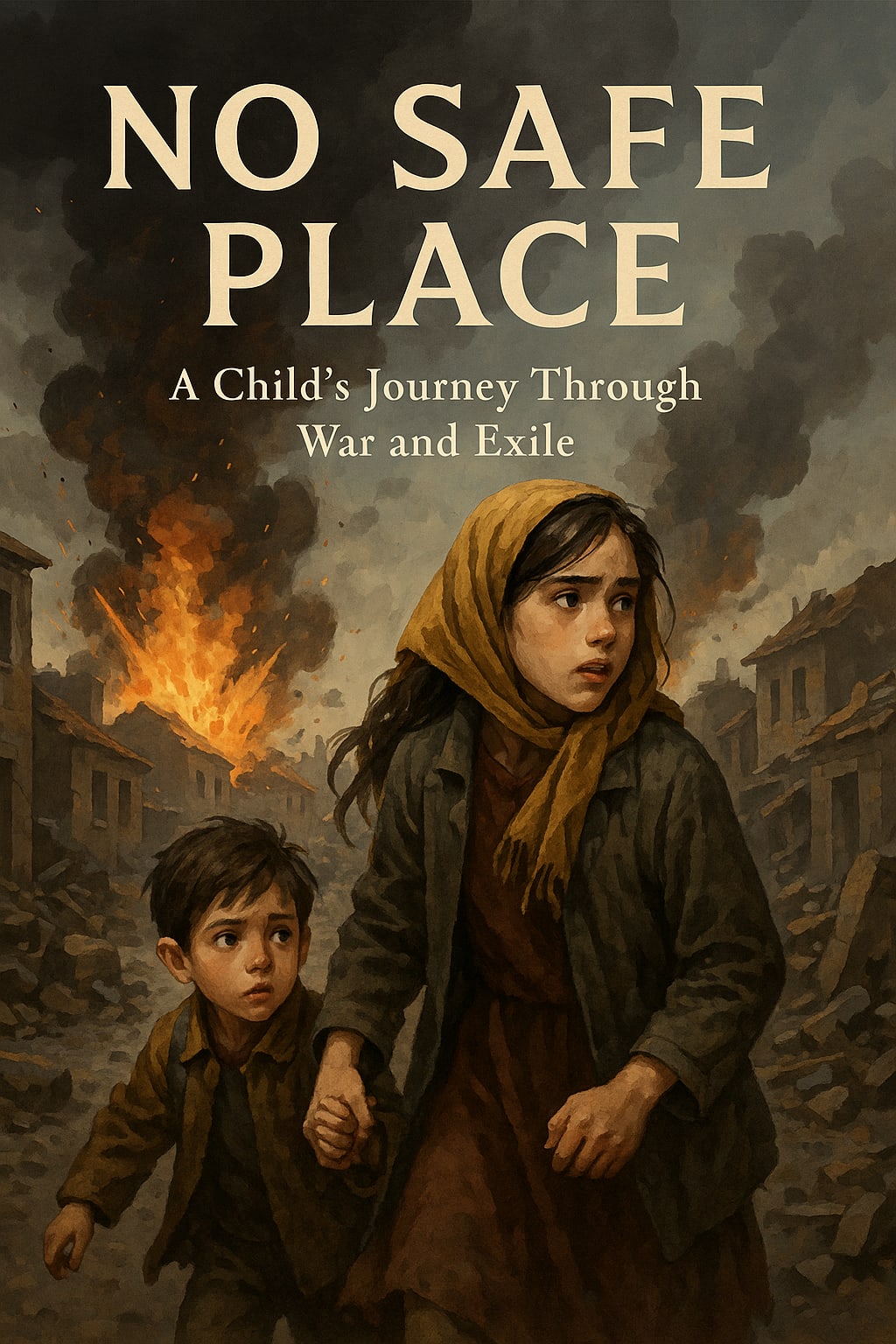
Lina was pouring water into the kettle when the window shattered, sending glass across the room like flying knives. The force knocked her to the ground. The scream that escaped her lips wasn’t her own—it was her mother’s from the other room. Then, silence.
She scrambled to her feet. The air was thick with dust. Smoke curled around the doorway like fingers. Lina bolted, barefoot, through the rubble-strewn hallway, choking on fear. In the bedroom, her six-year-old brother Sami sat huddled against the wall, eyes wide, hands over his ears.
“Lina?” he whimpered.
“I’m here,” she said, grabbing his hand, heart pounding like a war drum. “We have to go.”
Their village, once full of laughter and the smell of fresh bread, was now a skeleton of itself—blackened, burning, broken. Bodies lay in the streets. Screams echoed from alleyways. She didn’t stop to look. She didn’t want to know.
She clutched Sami’s hand tightly, leading him through the back alleys toward the old road that led away from the village. Her father’s last words the night before came back to her like prophecy: “If anything happens, run. Take Sami and run.”
So she did.
They walked for two days, sleeping beneath broken trees and eating the few crackers Lina had stuffed into her coat pocket. On the third day, a convoy of trucks passed, and she waved them down with a cloth. A woman with a Red Crescent patch helped them into the back of one.
“Where are your parents?” the woman asked gently.
Lina didn’t answer. She couldn’t. The truth was too heavy.
The truck took them to a refugee camp on the border. Rows of tents stretched across dry earth like a gray sea. There were children everywhere—alone, crying, lost. Lina stayed close to Sami, sleeping with one arm around him at night, whispering stories to chase away the nightmares.
But the camp brought new dangers.
One night, a man tried to lure Sami away with sweets. Lina saw him and screamed until the guards came. They moved her to a different tent. After that, she never let her brother out of sight. Not even to use the latrine.
Food was scarce. Water was dirty. Disease spread like wildfire. She saw a boy Sami’s age buried in a shallow grave, wrapped in a blanket with teddy bears on it. Lina held Sami that night until dawn, rocking him back and forth as he trembled in his sleep.
Every day, Lina stood in line at the resettlement tent. She heard rumors of countries taking in children, families being flown to safe places across the sea. But they always picked others—babies, wounded people, or families with proper papers. Lina had none of that. Only a crumpled photograph of her parents, and a promise.
One morning, an aid worker called her name.
“There’s a place on a transport truck heading north. It’s dangerous, but safer than here. Do you want to go?”
Lina didn’t hesitate. “Yes. We’ll go.”
She and Sami were packed into a truck with dozens of others. The air was hot and stale. People coughed. Babies cried. The road was long, winding through hills and checkpoints. At one border, soldiers pulled men from the truck. Gunshots followed.
Sami wept quietly. Lina held him tighter.
“Don’t look,” she whispered. “We’re almost there.”
On the fifth day, they crossed into a new country. The camp here was bigger, cleaner, and colder. Lina shivered in the thin clothes she wore. Still, she felt a flicker of hope when a woman from an international agency spoke to her in broken Arabic and handed her a small blue card.
“Identification,” she said. “You and your brother are registered now.”
Lina stared at the card. It didn’t mean safety. But it meant someone knew she existed. It meant maybe, just maybe, someone would care enough to help.
Weeks passed. Then months. Sami learned to smile again, sometimes. He played with other boys in the dusty yard between the tents. Lina braided his hair and taught him letters with a broken pencil and scrap paper.
But every night, as the sun sank into the mountains, she watched the fence beyond the camp, wondering what lay on the other side. Was there a real home out there? A place with walls that didn’t collapse under bombs, with windows that let in light instead of fear?
One morning, she received news.
A family in another country—a faraway place she could barely pronounce—wanted to sponsor a girl and her little brother. The aid worker handed her a folder. Inside were photos: a smiling couple, a clean house, a room with toys.
Lina didn’t trust it at first.
“Is this real?” she asked.
“Yes,” the worker said. “You’re leaving next week.”
Lina didn’t cry. Not then. But that night, as Sami slept, she opened the photo again and whispered, “Mama… we made it.”
They flew on a plane. Sami clutched her hand the whole way, eyes round as moons. Lina stared out the window, watching clouds drift by, endless and white. They landed in a land of green trees and quiet streets. A woman met them at the airport, kneeling to hug Sami and say, “Welcome home.”
It wasn’t really home. Not yet.
But it was safe.
And for the first time in a long time, Lina believed that maybe… safety was enough to begin again.
About the Creator
Keep reading
More stories from Maavia tahir and writers in Humans and other communities.
Mind Cloud"
The fog never arrives with a warning. It doesn't roar like a storm or announce itself with thunder. It slips in silently, seeping through the cracks of a seemingly normal day. One moment you're brushing your teeth, thinking about what to wear. The next, you’re sitting on the edge of your bed, staring into nothing, unable to remember why you got up at all.
By Maavia tahir9 months ago in Humans
Cabin Fever Because of Snow, Sleet, and Freezing Rain That Turned to Icy Roads
What Is Cabin Fever? The short answer is that cabin fever is restlessness from being in a confined area. Cabin fever is the distressing irritability or restlessness experienced when a person or group is stuck at an isolated location or in confined quarters for an extended time. Research shows that prolonged cold, gray skies, and being stuck indoors can trigger mood shifts similar to “winter blues.”
By Margaret Minnicks2 days ago in Humans
Heartbreak in Town Centre: Pensioner Dies in Early Morning Flat Fire
A devastating fire ripped through a ground‑floor flat in the heart of Shrewsbury in the early hours of Tuesday morning, leaving an elderly woman dead and another person injured. Emergency services were alerted to the blaze shortly after 3:20 a.m., and despite the swift response from firefighters and medical teams, the life of the woman—believed to be in her 80s—could not be saved. Another individual at the scene suffered injuries that are not thought to be life‑threatening. �
By Ayesha Lashari7 days ago in Humans
Killing him slowly
There’s an intruder in my house again. He stumbles through the door, wet carrier bags in hand. He’s bought me offerings. I show my appreciation, letting him caress my beautiful body. He wants to touch me. I rub myself against his legs. He sighs, dropping the bags. He can’t resist touching me. Running his hand slowly down my spine, I arch my back towards his caress, let out a low purr. It’s what we both need.
By N J Delmas6 days ago in Horror



Comments
There are no comments for this story
Be the first to respond and start the conversation.