
My Call Is Important
The biggest lie I heard this week.

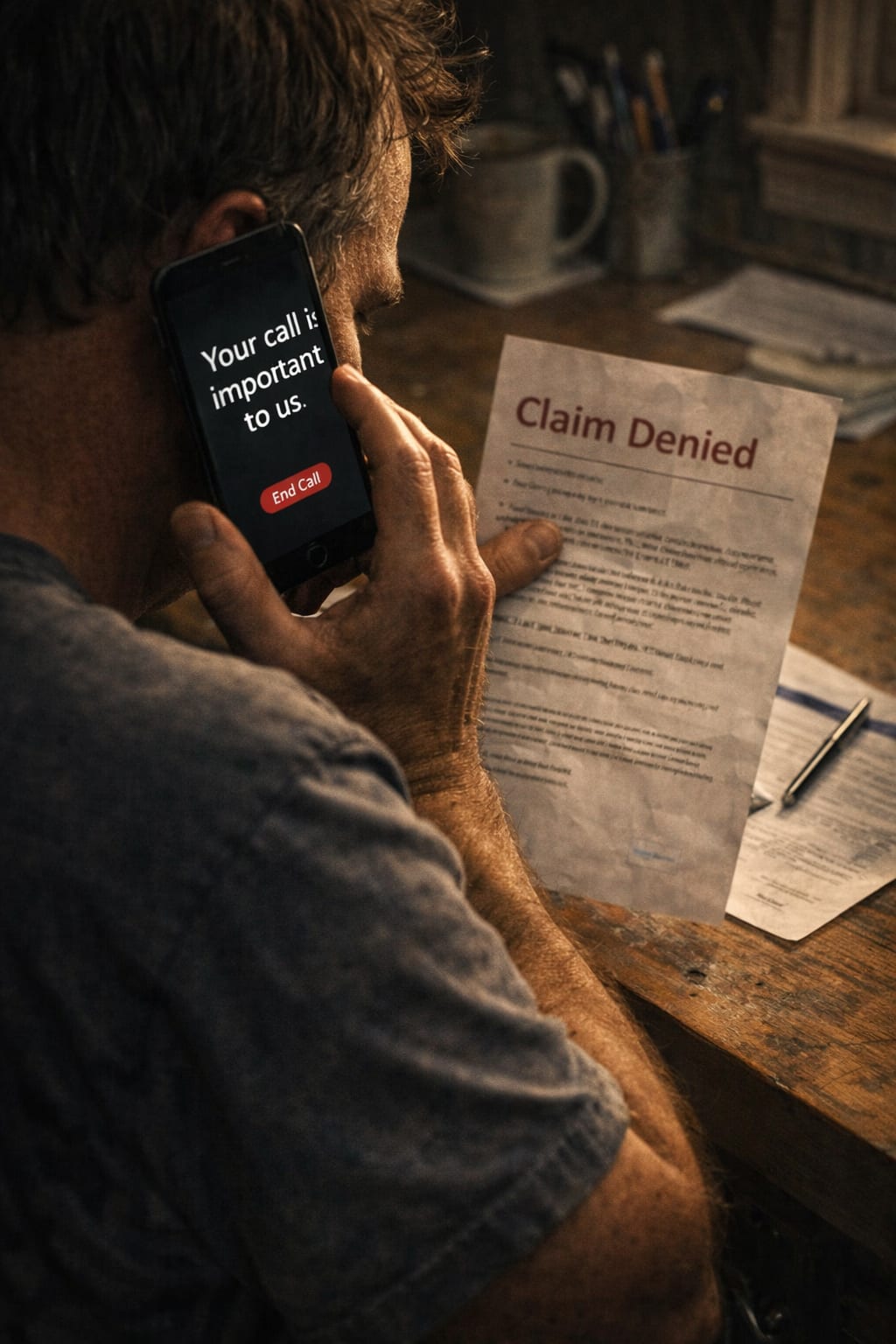
You don't see it until you hit it.
That's the thing about modern systems. They look like open doors. They look like pathways. The website is clean, the buttons are bright, the language is welcoming. Apply Now. Get Started. Join Us. It feels like invitation.
But there is a wall. It is invisible, made of code and criteria, and it stands right in the middle of the doorway. You don't know it's there until you walk forward at full speed and bounce off.
I found mine last month. I was looking for an apartment.
Nothing fancy. A one-bedroom in a city that has become too expensive for people like me. I found a place that fit the budget. It was small, the carpet was worn, the kitchen smelled faintly of old grease, but it had light. It had a window that faced east. I could imagine having coffee there.
I filled out the application on my phone while sitting in my car outside the building. The interface was smooth. Swipe to upload ID. Snap a photo of my pay stub. Type in my social security number. Green checkmarks appeared next to each field. Verified. Verified. Verified.
It felt good. It felt like progress. The system was accepting me. I was moving forward.
I hit submit. The screen spun for a moment, a little loading circle dancing in the center. Then, the message appeared.
Application Denied.
That was it. No explanation. No reason. Just a red banner and a button that said Close.
I sat in the car for a long time. The engine was off. The silence of the parking lot pressed against the windows. I looked at the phone. I refreshed the page. Maybe it was a glitch. Maybe I had clicked the wrong button.
Application Denied.
I called the leasing office. The number was on the listing. A woman answered. She sounded busy.
"I just submitted an application," I said. "It was denied immediately. I was wondering why?"
"Oh," she said. I could hear papers shuffling on her end. "That's automated. We use a third-party screening service. I don't see the details."
"Can you find out? Maybe there was a mistake."
"If there was a mistake, you can dispute it with the screening company. Their number is in the email you just received."
"I didn't receive an email."
"Check your spam."
I checked. Nothing.
"I don't have anything," I said. My voice was getting tight. "I just want to know what I did wrong. My credit is fine. My income is fine."
"I can't help you with that," she said. "I just manage the property. The system decides."
She hung up.
I sat there holding the phone. The leasing agent wasn't rude. She wasn't evil. She was just another person standing on the other side of the wall. She couldn't see me any more than the algorithm could. To her, I was a status update. Denied. To the algorithm, I was a risk score. To myself, I was a person who needed a place to live.
The misalignment was absolute.
We talk about transparency in systems. We talk about user experience. But this is the reality of the user experience for millions of people. It is a black box. You put your life in—your history, your money, your identity—and the box swallows it. Sometimes it gives you a key. Sometimes it gives you nothing.
And you are not allowed to ask why.
I went home. I opened my laptop. I tried to find the screening company. Their website was even sleeker than the rental application. Empowering Landlords. Secure Decisions. Fast Results.
There was a link for Consumer Dispute. I clicked it. It asked for my reference number. I didn't have one. I clicked Contact Us. It gave me a mailing address. A physical address for a digital problem.
I laughed. Actually laughed. Out loud in my empty apartment.
Who mails a dispute letter anymore? By the time the letter arrives, the apartment will be rented. By the time they review it, I will have moved on. The system is designed to be fast for the payer (the landlord) and slow for the user (the tenant). It is designed to protect the asset, not the human.
This is the friction. It isn't a crash. The website didn't go down. The server didn't fail. The system worked exactly as intended. It screened me out.
But what does it mean for a system to work if it excludes the people it is supposed to serve?
I thought about the data. What flag did I trip? Did I live at my current address too short a time? Did I have a late payment from six years ago? Did my name match someone else's in a database? I had no way of knowing. I was being judged by a ghost.
There is a specific kind of shame that comes with this. When a human rejects you, you can see it in their eyes. You can argue. You can plead. You can understand the reason. When a system rejects you, the shame turns inward. What is wrong with me? What did I do? Am I broken?
The system makes you feel like the error code.
I remembered a friend who told me about a job application she submitted. She got the rejection email three minutes after hitting send. Three minutes. No human could have read her resume in three minutes. It was the keyword filter. She didn't have the exact phrase "project management" in her summary, even though she had managed projects for ten years.
She didn't get an interview. She didn't get an explanation. She just got the wall.
We are building a world where the walls are getting higher and harder to see. We hide behind terms of service. We hide behind algorithms. We hide behind "company policy." It makes life cleaner for the institutions. They don't have to look people in the eye. They don't have to say no. The system says no.
But someone built the system. Someone wrote the code that decided I wasn't worthy of that apartment. Someone set the credit score threshold. Someone decided that a mailing address was the only way to dispute a digital error.
They are somewhere in an office, probably thinking they are making things efficient. They are probably proud of the software. It saves time. It reduces risk.
But whose time? And whose risk?
It saves the landlord's time. It reduces the landlord's risk. It costs me my evening. It costs me my peace. It costs me the feeling of safety.
I didn't get the apartment. I found another one two weeks later. It was more expensive. The window faced west, so the afternoon sun made the room unbearable in the summer. But the application was processed by a person. I met the landlord in the lobby. He looked at my pay stub. He looked at me. He nodded.
"Okay," he said. "You seem good."
That was the whole interview. "You seem good."
It wasn't efficient. It was risky for him. He was trusting his gut. But it was human.
I signed the lease. I got the keys. I moved in.
But I still think about the wall. I think about the people who don't find a workaround. The people who don't have a friend with a spare room. The people who don't have a landlord who trusts his gut.
The system is still there. It's running in the background of every application, every loan, every job search. It is waiting for the next person to walk into the door.
It promises order. It promises fairness. Because the code doesn't have biases, right? The code is neutral.
But the code is written by people. And the people who write the code are not thinking about the person sitting in the car, staring at a red banner. They are thinking about scalability. They are thinking about liability.
So the wall remains. Invisible. Solid.
I unpacked my boxes yesterday. I put the coffee mug on the windowsill. The light came in. It was warm.
I looked at my phone. A notification popped up. Update Available.
I swiped it away.
For a moment, I just stood there. I listened to the silence of the new apartment. The hum of the refrigerator. The traffic outside.
I am inside now. I am safe. But I know how easy it was to be outside. I know how thin the barrier is between being accepted and being rejected.
And I know that the system doesn't care which side I'm on. It only cares that the wall stands.
We walk into these systems every day. We trust them with our futures. We assume that if we follow the rules, if we fill out the forms, if we check the boxes, we will get through.
But sometimes, you just hit the wall. And when you do, there is no one on the other side to let you in. There is only the silence of the machine, humming along, doing its job, keeping you out.
I hope you never hit it. But if you do, know that it's not you. It's the design.
The wall isn't there to keep you safe. It's there to keep them comfortable.
And we are the ones left standing in the parking lot, wondering why the door won't open.
About the Creator
Edward Smith
Health,Relationship & make money coach.Subscibe to my Health Channel https://www.youtube.com/channel/UCkwTqTnKB1Zd2_M55Rxt_bw?sub_confirmation=1 and my Relationship https://www.youtube.com/channel/UCogePtFEB9_2zbhxktRg8JQ?sub_confirmation=1
Keep reading
More stories from Edward Smith and writers in Humans and other communities.
The Wall
You don't see it until you hit it. That's the thing about modern systems. They look like open doors. They look like pathways. The website is clean, the buttons are bright, the language is welcoming. Apply Now. Get Started. Join Us. It feels like invitation.
By Edward Smithabout 5 hours ago in Humans
Training the Brain in Spite of A.I.
While A.I. is being shoved down our throats, it's more important than ever to keep our minds sharp the old fashioned way. Letting a machine think for you might be tempting at first. How many times have you heard, "Work smarter, not harder," in reference to letting A.I. handle a report at work. Sounds innocent enough. But don't get carried away because let's remember that machine learning has its flaws.
By Leslie Writes7 days ago in Humans


Comments
There are no comments for this story
Be the first to respond and start the conversation.