
Happiness is ... a papercut
Surrealism and creativity
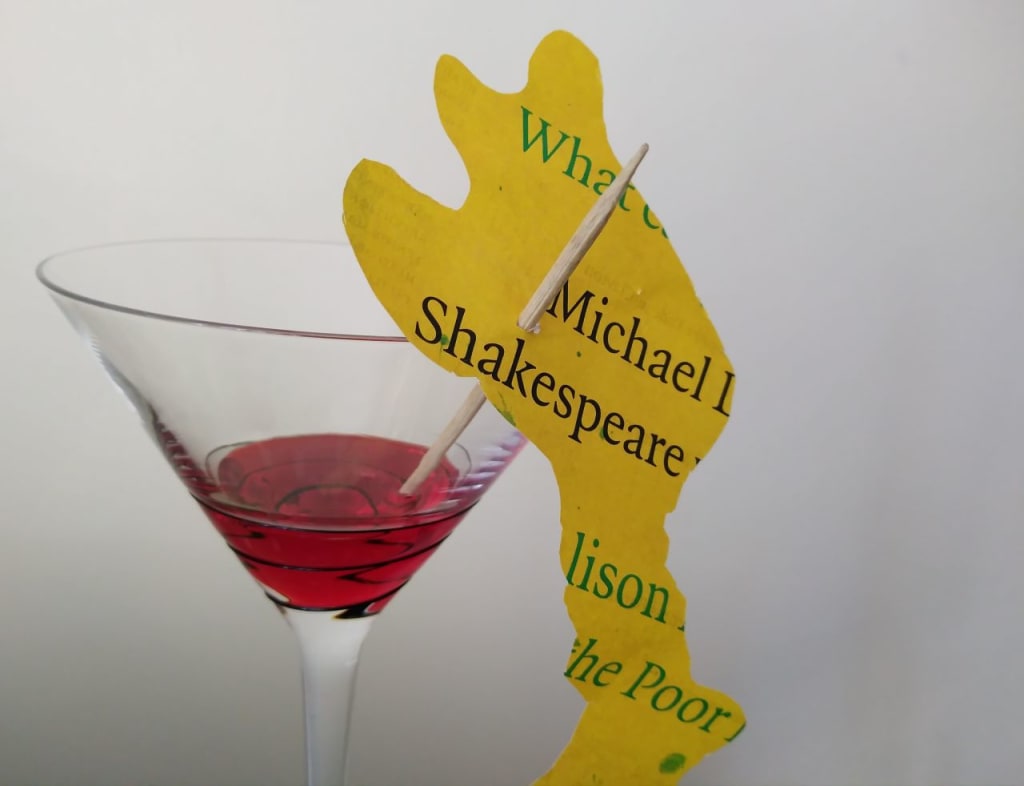
If I spoke to you of powerful cocktails, you might believe my happiness lies in a glass of a well-mixed alcoholic beverage. But you would be wrong. Well, maybe not totally wrong, I love the art and science involved in the making of a perfect Tequila Sunrise or a Blue Daiquiri, but that isn't the kind of cocktail I'm referring to here. What I'm talking about is the potent blend of dread and despair that used to face me in the form of the blank page, and how I chanced upon the sheer, surreal, creative joy of paper cutting.
I'm not sure I could tell you the exact moment I discovered paper cutting as an endorphin-inducing creative aid - it was the result of a process over time rather than a eureka moment - but I can tell you about my first meeting with a surrealist. It was in a coffee house in a seaside town on the south coast of England.
I had gone to the coffee house to write, to work on a troublesome poem to be precise. There were workmen digging up the road outside my apartment and the noise was unbearable, so I had relocated to the coffee house hoping my concentration would improve and that words would start to flow onto the still stark page. I found a seat away from the other customers, not wanting their babble to interrupt my train of thought, but after half an hour of chewing a metaphorical pencil I was still no further forward. It was then that a group of four glamorous, arty-looking people came into the coffee house and sat at the table next to mine.
The four - a man and three women - were distractingly vivacious, and once their coffee had been ordered, they sat in intense conversation centred around their creative practice. They name-dropped artists and writers, theories and manifestoes, and argued vociferously, arms waving in the air. As they became louder and more passionate, all hopes of crafting the poem I had hoped to complete went out of the window as I became more and more mesmerised by the nearby party. In fact, so enrapt was I listening to their ideas that I was startled when, suddenly, the man in the group turned to me, smiled and asked:
'Do you believe in the power of serendipity?'
I was completely thrown and more than a little embarrassed that my eavesdropping might perhaps have been so obvious, but there was no hint of reproach in his voice. I replied that I'd had positive experiences of happenstance and he held out his hand for me to shake, explaining that he was a surrealist painter, and invited me to his studio to see some of his work. Though I feared for a moment this may have been a modern take on 'come up and see my etchings', I agreed, and so began my introduction to a world where amongst many other techniques, paper cutting was a 'thing'.
Eric (that was his name) not only showed me his vast array of paintings and some wonderfully weird sculptures, but also allowed me an insight into some of his techniques. One of these involved plaster of Paris and broken found objects, and looked like blanched works by Salvador Dali. Eric talked of dreams and fantasies and a number of substances that had freed his imagination from the constraints of the conscious mind. And that is when I first heard of Tristan Tzara, the early 20th century Romanian/French avant-garde poet, essayist and performance artist. Tzara was one of the founders of the anti-establishment Dadaist movement, and would go on to align himself with Andre Breton and the Surrealists.
Like many people, I had my formative experiences of poetry in the school classroom, mainly through the highly structured sonnets and ballads of the Romantics. Hours were spent counting syllables and stresses, of writing a b a b c d c d in the margins next to verse lines. For me, studying poetry fast became a miserable chore. But after I left school, the lure of capturing the essence of a universal experience in such a brief form increasingly entranced me, and as I became more confident I began to study and gravitate towards free verse. But cutting up newspaper as a way of creating poetry or art? Definitely nowhere on my radar.
As I worked at my craft. I read a great deal: theories on poetics, guide-books on rhythm, and the work of poets from Armantrout to Zephaniah. I joined workshops and attended readings. But I would have to confess that despite improving my craft and having the odd poem published, there was no real joy for me in the creative process. Instead, I found that with each success I became more and more anxious, nervous of writing something in the wrong way, of saying the wrong thing. Somewhere along my creative journey I had amassed a basement store of poetry dos and don'ts. And they were crippling me.
I increasingly found that the periods of time between sheer inspiration to write, or the desire to sit down and hew a poem from the coal face of the English language were growing longer and longer. That old cliche about the blank page had become a gruesome reality. Then after one particularly frustrating attempt to order my thoughts onto paper, in sheer rage I ripped up the page and threw it into the air in disgust. And it was as the multitude of pieces fluttered their way down to the floor, the name of Tristan Tzara popped into to my head. I stared hard at the scattered word salad on the carpet. I shuffled them around with my foot. I made neologisms. I discovered the serendipity of apposition. I played and I played.
And I had so much fun.
Since that moment, I have refined my fierce Dadaist paper cutting, with its silly serendipity and resultant creative bucket of chaos, into something gloriously special. I determined from the start that freedom of imagination, the tapping into the creativity that lurks beneath our more dominant cognitive functions, would always be the 'goal' in itself, and not the finished work.
Sometimes the cutting provides a beginning. Sometimes an ending. Sometimes questions. And sometimes answers. But the pleasure is always in the process, in the joy of discovery, and it is a gift I never want to lose; unlike Tristan Tzara who, perhaps with his tongue firmly in his cheek, wrote instructions on how to write a Dadaist poem:
Take a newspaper.
Take some scissors.
Choose from this paper an article of the length you want to make your poem.
Cut out the article.
Next carefully cut out each of the words that makes up this article and put them all in a bag.
Shake gently.
Next take out each cutting one after the other.
Copy conscientiously in the order in which they left the bag.
The poem will resemble you.
And there you are – an infinitely original author of charming sensibility, even though unappreciated by the vulgar herd.
This makes me laugh, but nonetheless, I love the simplicity of it. Take a newspaper and some scissors and anything can happen.
Over the years I have turned to many different newspapers and magazines, and I have owned many sets of scissors: dressmaking, craft, kitchen, even pinking shears. But the pair I love most for my forays into creative paper cutting are a pair I discovered by chance in a charity shop. Well-loved, I would say, judging by how the pattern had been worn off the finger rings, but with plenty of life still in them. And also, I believe, a little magic.
I recently took my scissors to a glossy magazine page that featured recipes for different types of bread. I snipped away, words falling like graffitied confetti until I had a small heap, which I spread over the table with my hands. Then I closed my eyes and picked words at random. They presented themselves like this:
dough rise us slice snow sift yeast lift butter bread smell fed soup share morsel fare
At first I was puzzled. How did snow get into a recipe? And us? It was only after I noticed the difference in paper colour that I realized some of the words were on the reverse of the recipe. A travel feature on skiing.
And then I noticed the metre and rhythm:
dough rise/us slice/snow sift/yeast lift/butter bread/smell fed/soup share/morsel fare
This was far less surreal than many other outcomes I'd had in the past - sardine Harleys posing tame sunsets, for instance, or freckled flops crop powered dahlias - but both of these groups of randomly selected words produced wonderful images in my mind and became the nub of some fairly decent poetry. And once I am immersed in my paper cutting, hours can pass and the worries of the world are put on hold.
So, there you are. Hemingway had his Mojito. Fitzgerald his Gin Rickey. And Edna St Vincent Millay was partial to a cool glass of Between the Sheets.
And me? I have my scissors.
Author's note: There is no known cocktail called a Scissors. I plan to invent one. Through paper cutting.
About the Creator
Elaine Ruth White
Hi. I'm a writer who believes that nothing is wasted! My words have become poems, plays, short stories and novels. My favourite themes are mental health, art and scuba diving. You can follow me on www.words-like-music, Goodreads and Amazon.
Keep reading
More stories from Elaine Ruth White and writers in Humans and other communities.
Resilient Creature
Mid-August, but Edinburgh is cold tonight. If I had half a wit, I would cling to my layers, seek the warmth of a wee bar, the cosy hum of revellers. If I’d an ounce of the common, I would merge into the midst of the well-pashed and pissheads, soak up their energy, blend in, merge, disappear. Instead, I stand in the street beyond the elliptical glow of a streetlamp, the chill stone pavement sucking heat from my bare feet.
By Elaine Ruth White5 years ago in Humans
The Angry Man in Your House
"If you grow up with an angry man in your house, there will always be an angry man in your house" This statement has caused plenty of controversy online, people say its a statement that blames victims while also undermining those who break traumatic cycles to form health relationships... but if I'm honest now that I'm in my 30s it makes more sense to me than ever, and I'd argue that its not just about fathers and uncles.
By S. A. Crawford4 days ago in Humans
The Silent Struggle: Understanding the "Non-Proactive" Heart of a Woman
In the world of emotions, everyone eventually encounters a period of agonizing hesitation—especially when "holding on" becomes the dominant theme of the heart. For many women, affection is a delicate and deep-rooted tapestry. Even when a relationship reaches its breaking point, truly letting go is rarely a clean break.
By Elena Vance 4 days ago in Humans


Comments
There are no comments for this story
Be the first to respond and start the conversation.