
After the Applause
The Sound That Leaves When the Crowd Does

The applause arrived like weather.
It rolled in waves beneath the stage lights, warm and thunderous, striking the body before the mind could name it. From the lip of the stage, the crowd was a single living organism—breathing, rising, dissolving into brightness. Hands clapped. Feet struck the floor. Someone shouted her name.
Mara bowed.
The spotlight flattened her into something clean and deliberate: a silhouette made of grace. Her smile held its place with professional steadiness. She felt the heat of the lamps along her collarbone where glitter clung to her skin, stubborn and radiant.
This was the public self—composed of posture and timing, breath measured in beats, silence engineered for effect. On stage she was intention. She was proof of talent. She was necessary.
The curtain fell.
The applause did not end; it receded.
There is a moment performers rarely speak about—the exact second when the sound begins to thin. It doesn’t stop. It drains. Like water pulled through a grate. The roar becomes scattered clapping. Then pockets of it. Then only the hum of people collecting coats.
Applause fades faster than doubt.
Backstage, the air changed. Cooler. Real. Someone hugged her. Another voice said, “You were incredible.” A bouquet pressed into her hands. A photograph. A signature. Her name said again and again, as if repetition might secure it to her bones.
But praise is frictionless. It slides off the surface.
Mara slipped into the dressing room and shut the door.
In the mirror, the stage still clung to her face—winged liner sharp as armor, red mouth deliberate and bright. She touched her reflection lightly, as if expecting the glass to ripple.
Who are you without the light?
The question hovered, uninvited.
She removed the earrings first. Then the lashes. Each small act peeled something away. The woman in the mirror softened. Less defined. Less certain.
In the corridor, laughter echoed and then drifted toward the exit. The building exhaled. Eventually there would be only the cleaning crew and the echo of footsteps across empty aisles.
She changed into a gray sweatshirt and jeans. Folded the costume carefully. Packed the glittered skin back into a garment bag.
When she stepped outside, night received her without recognition.
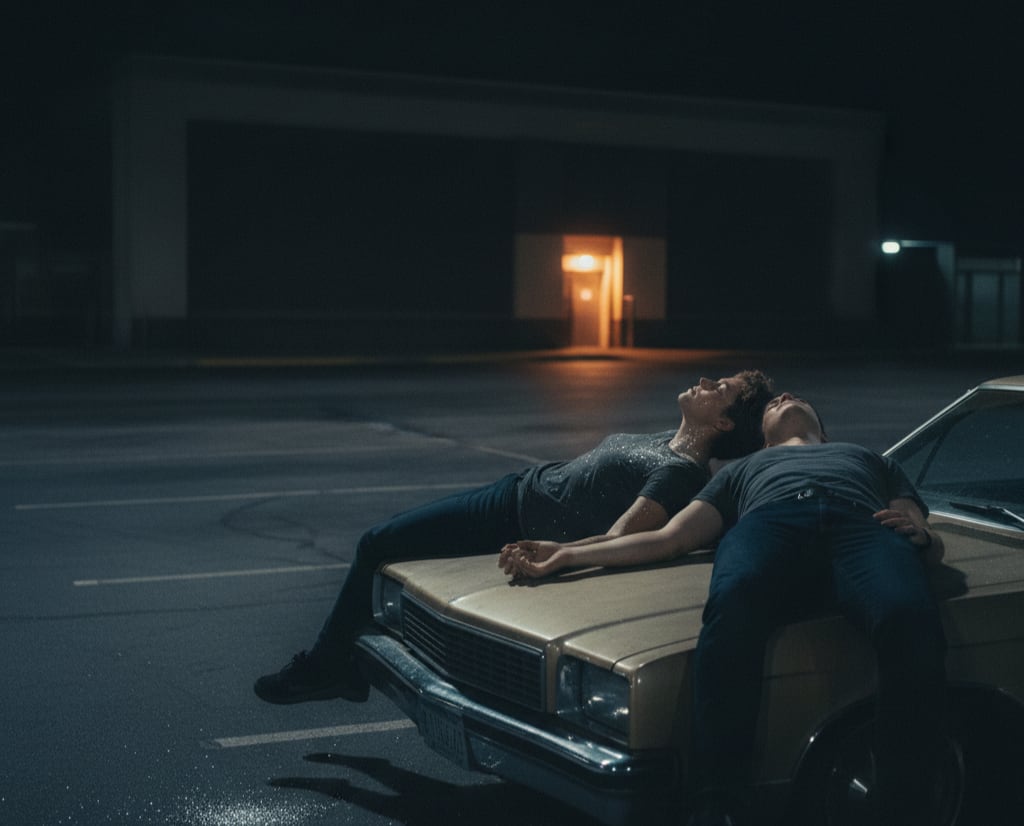
The parking lot was wide and underlit. Sodium lamps hummed above rows of cooling cars. The asphalt still held the memory of heat from the day. A thin haze lingered—stage fog escaping into open air, dissolving without applause.
This was the in-between.
Not adored. Not anonymous. Just a body moving through dim space.
She paused beside her car but did not unlock it. Instead, she leaned back against the cool metal and looked at the building. From the outside it was brick and shadow. No glow. No thunder.
Was that all it was? A room that borrowed her voice for a while?
Her phone buzzed. Messages stacked in digital confetti:
You were electric.
I cried.
When’s the next show?
Each one affirmed the version of her that existed under lights. The version shaped by expectation. The version who knew exactly how long to hold a pause before a final note.
Mara typed no replies.
Across the lot, a man loaded equipment into a van. He moved with the practical rhythm of someone whose work required no applause. Case. Door. Latch. Repeat.
She envied him.
On stage, identity is amplified. Every gesture magnified. Every flaw disguised by distance. In the parking lot, nothing is magnified. Nothing disguised. The body is simply a body. The mind returns to its unscored silence.
She unlocked the car and slid inside.
For a moment she did not start the engine. She rested her forehead against the steering wheel and listened to the echo in her chest. The show replayed in fragments—high note, laughter, the swell before the encore. She searched the memory for the feeling she had when she first stepped into performance years ago.
Back then, she did not want applause.
She wanted translation.
She had been young, uncertain how to inhabit herself. On stage, emotion could be structured. Pain given melody. Joy measured into counts. Performance had been a language for what she could not otherwise articulate.
Somewhere along the way, the language became product.
The applause became proof.
And proof became hunger.
The engine turned over. The radio remained off.
Home was a small apartment on the third floor of a narrow building. No marquee. No crowd. Just a hallway that smelled faintly of detergent and old wood.
Inside, the quiet was immediate and unapologetic.
She dropped her keys in the bowl by the door and stood still.
No one here knew her stage name.
The mirror in the bathroom reflected a nearly bare face. A faint shimmer of glitter still traced her collarbone. She washed it away. The sink caught the residue—silver flecks circling the drain.
In the bedroom, she sat at the edge of the bed and let her shoulders collapse forward. The absence of expectation was both relief and threat. Without an audience, there was no script. No applause to measure the worth of a moment.
She closed her eyes.
Who are you without them?
The answer did not arrive as a revelation. It arrived as a quieter question:
Who were you before you needed them?
She reached for the notebook on her nightstand. It was not the leather-bound journal she posted about online. This one was cheap. Bent at the corners. Private.
She began to write—not lyrics, not lines for the next performance. Just fragments.
I am tired of being excellent.
I miss being curious.
I want to make something no one hears.
The words were uneven, unspectacular. They would not earn a standing ovation. They did not need one.
In the quiet room, she felt something unfamiliar: not emptiness, exactly, but space. Space where doubt had once echoed loudly. Space where sound had to justify itself.
Applause fades faster than doubt.
But silence, she realized, lingers longer than both.
Mara set the notebook aside and lay back against the pillows. The room held her without demand. No spotlight. No choreography. Just breath.
Tomorrow she would return to the stage. The public self would rise, deliberate and luminous.
But tonight, in the small unlit space between performances, she let herself exist without being witnessed.
Not as a performer.
Not as proof.
Just as a woman, unamplified, listening to the steady rhythm of a life that did not need applause to continue.


Comments (2)
I love your use of imagery; it really painted the scene in my mind
Great job 👏