
The Last Car
Tales from the Darkside Season 2, Episode 19 (1986)

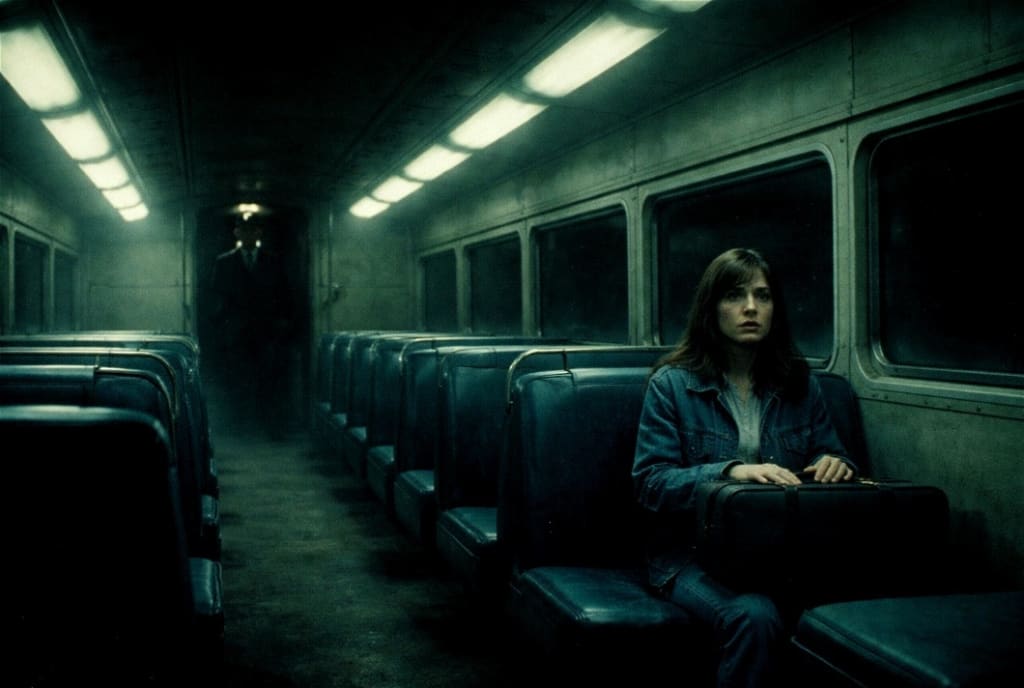
One of the weirdest television episodes to ever air, "The Last Car," Season 2, Episode 19 of "Tales from the Darkside," has all the earmarks of an absurdist, surrealist dream. It's the sort of short film that David Lynch might have admired, something that could have been transposed onto the template for his "Twin Peaks" without skipping much of a beat. Like every dream (in this case, an interminable nightmare), it must be interpreted, picked apart, and digested for meaning and symbolism. What is this metaphor saying to the viewer?
A woman, Stacy (Begonya Plaza), is in a seemingly abandoned train station, a dark and ugly waystation of dreams, standing on the platform holding her luggage. Embarking on "the last car," she enters a strange, stifling environment lit by fluorescents, where there are three people: an old woman, Mrs. Crane (Mary Carver), knitting; a man with a box of sandwiches; and a little boy whose strange costume keeps changing—he is alternately a cowboy, soldier, football star, and spaceman. These roles of a child at play seem to suggest, at least subconsciously, a progression or growth in development. Worn, however, on the back of a child, they subtly mock the idea.
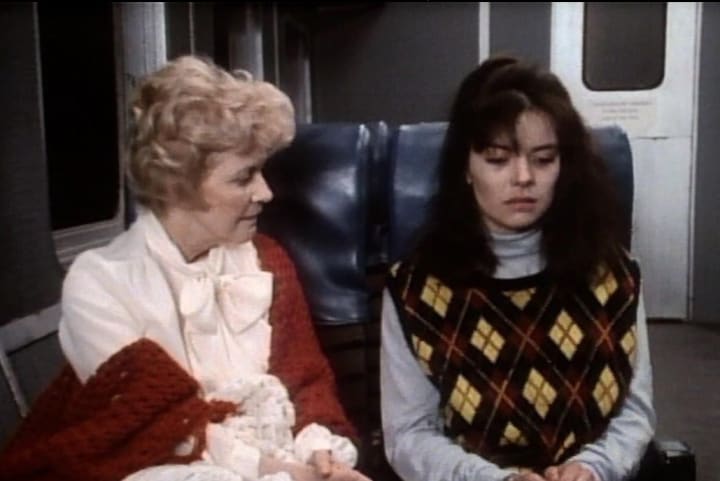
The old woman begs the young woman to sit beside her. She begins to speak obliquely of "tunnels"; i.e., the egress into darkness, the fast, silvery thought-form of the train representing the liminal space wherein we are neither here nor there, but in a state of in-between becoming. A train could conceivably be coupled with additional cars into infinity, much like our thoughts, feelings, and ideas progressing forever on a conveyance that emerges, centipede-like, from the buried darkness of our personal "tunnels."
Here, there is apparently no time. She is on "The Last Car," and that, as Mrs. Crane notes, is significant. At one point she comments to Stacy:
Mrs. Crane: What a strange bracelet. What on earth do those little numbers mean?
Stacy: [puzzled] It's a watch.
Things have ceased in this no-place void of The Last Car. The little boy (Scotter Stevens), the male energy or childhood grasp toward self-realization, changes form while at play, first appearing as a cowboy—a maverick or outlaw—then a soldier, one whose job is quite literally to do or die, kill or be killed. Next he becomes a football hero, playing for the adulation of vast crowds, a heroic gridiron gladiator and object of social admiration. Finally, he is a spaceman, complete with ray gun, an explorer of strange new worlds, hinting quite literally at the alien.
One could read these costume changes as representative of past, present, and future timelines. Or perhaps assign the suits of Tarot to each: the cup, the mercurial fluid of the past represented by the cowboy; the sword, clearly the soldier; the wand, the staff of the football player; and lastly the pentacle, which in Tarot often represents material existence or currency, here suggesting a literal "man among the stars" in the boy’s spaceman costume.
The boy suggests the playfulness of youth, trying on hats and filling out roles. He exists between two polarities—the two elder figures: the old woman and the old man with the sandwiches. Is Stacy seeing a message written large? One concerning age, sexual roles, childhood trauma, and the grasp toward self-realization? The unbridled youth and masculinity uncertain of itself, constantly reorganizing its sense of identity and self-worth?
Mrs. Crane is Mother, or Grandmother—a stern figure of traditional womanhood or matriarchal power—yet here she seems threatening. The Sandwich Man (Louis Guss) is literally killed when the boy shoots him with a toy gun. The act feels Oedipal: kill the father, and the attentions of Mother Crane become the boy’s alone.
Can a woman be afflicted by this complex? Stacy seems to be reading something within the dream environment, some symbolic text the viewer detects only on a near-subliminal level.
Tales From the Darkside Opening Credits and Theme Song
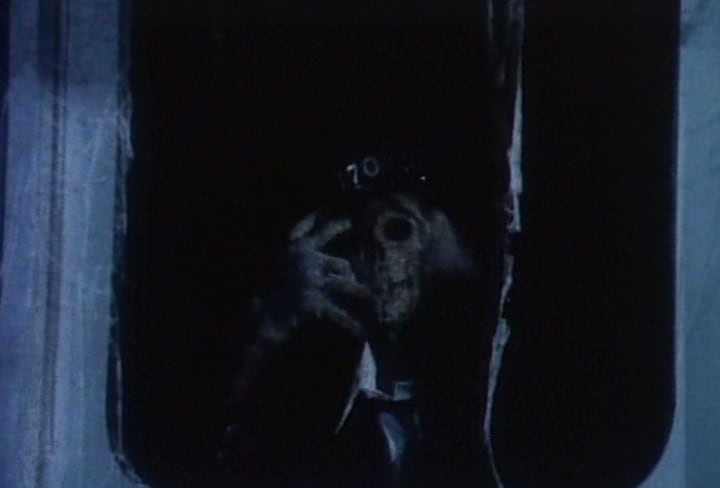
There are sudden shifts of horror suggesting that everyone here may already be dead. The Conductor (Bert Williams) emerges as a symbolic guide, clearly not contemporary. His hat bears the number "170," an unknown factor on The Last Car, which reduces numerologically to eight—the number of infinity.
Stacy is offered a sandwich. In the myth of Persephone, Hades ensures her return to the Underworld each year by offering her pomegranate seeds. If one accepts food from the land of the dead, escape becomes impossible; one remains bound to that realm.
She requests hummus and is given a cup from which she recoils. We never see why.
The episode ends in deep ambiguity concerning the nature of life, time, and dreams, offering viewers a page of coded imagery that must be parsed and decoded into some usable framework of subtextual meaning.
Few other television programs can rival this episode for sheer puzzling ambiguity. "Tales from the Darkside" stands as a glittering diadem in the heavens of eighties syndicated genre television, and this episode remains one of its strangest, brightest jewels.
Author's website:
Articles archive:
Read my book: Cult Films and Midnight Movies "From High Art to Low Trash" Vol 1 By Tom Baker
Ebook
Read my book: Silent Scream! Nosferatu, The Cabinet of Dr. Caligari, Metropolis, and Edison's Frankenstein--Four Novels. By C. Augustine
Ebook
Read my book: Theater of the Worm: Essays on Poe, Lovecraft, Bierce, and the Machinery of Dread Paperback – by Tom Baker (Author)
About the Creator
Tom Baker
Author of Haunted Indianapolis, Indiana Ghost Folklore, Midwest Maniacs, Midwest UFOs and Beyond, Scary Urban Legends, 50 Famous Fables and Folk Tales, and Notorious Crimes of the Upper Midwest.: http://tombakerbooks.weebly.com
Killing him slowly
There’s an intruder in my house again. He stumbles through the door, wet carrier bags in hand. He’s bought me offerings. I show my appreciation, letting him caress my beautiful body. He wants to touch me. I rub myself against his legs. He sighs, dropping the bags. He can’t resist touching me. Running his hand slowly down my spine, I arch my back towards his caress, let out a low purr. It’s what we both need.
By N J Delmasabout a month ago in Horror
The Bell That Rang After Midnight
In the coastal village of Greymoor, the sea never slept. Waves whispered against black rocks, and wind threaded through crooked chimneys like a breath searching for a mouth. Tourists came in summer for the views and left before autumn taught the cliffs their true language. The villagers stayed, wrapped in wool and habit, and obeyed one old rule: when the church bell rang after midnight, nobody opened a door.
By Iazaz hussain3 days ago in Horror


Comments
There are no comments for this story
Be the first to respond and start the conversation.