
The Leucistic Rock Pigeon
It endured psychological as well as physical pain.

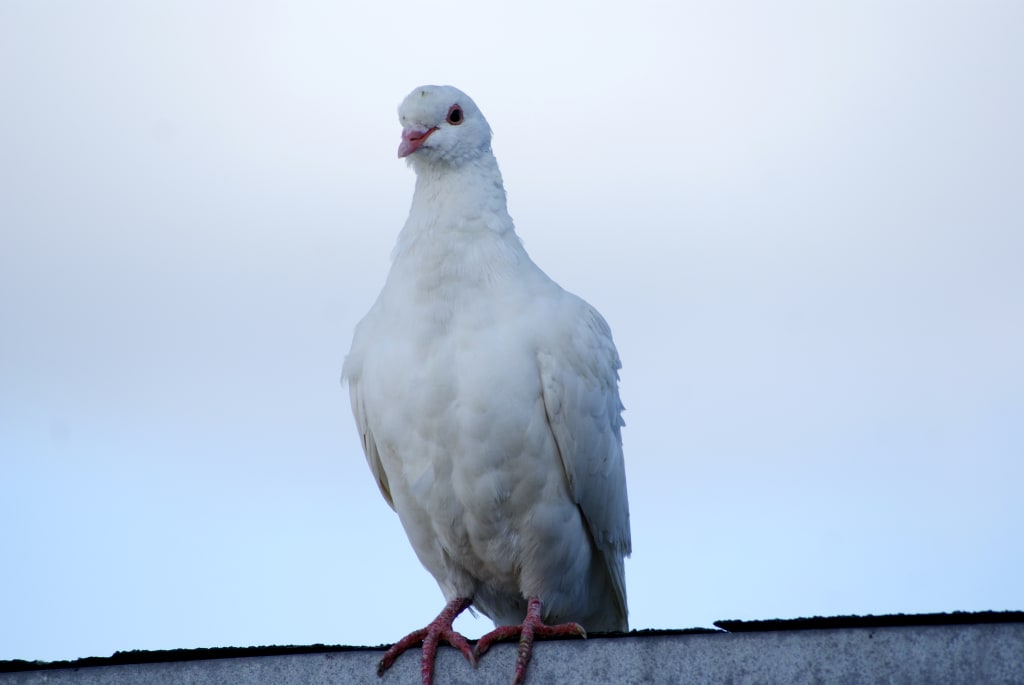
It was summer. I was visiting India and staying at my parents’ rural home.
Every day, around midday, a leucistic rock pigeon would arrive to take a sip of water from the tubs placed under the ixora bush in the courtyard.
Its feathers were snow-white, and its eyes, beak, and feet had a pinkish hue.
I recognized that it had leucism—a genetic condition in animals and birds, where pigments are either missing or reduced. I had seen several cases before, so I wasn’t surprised.
But if you search for leucistic birds and animals online, you’ll see how widespread this condition is—it affects species across different animal classes.
This genetically-deviant bird was part of a group of rock pigeons that gathered on a neighbor’s terrace.
I don’t know where the rest of the flock drank from, but this one always came alone to my parents’ house. I suspected it was lonely—perhaps due to its different appearance.
Maybe it had been segregated by the group, or perhaps it felt like it didn’t belong. It likely couldn’t survive completely on its own, so it lingered at the fringe of the flock’s community.
Birds are known to exhibit complex social behavior, but I hadn’t realized that they, too, could suffer from issues of identity or belonging.
I felt a quiet sorrow for the bird. It’s not easy being the odd one out. Rejection hurts—whether you're a bird or a human. We are all wired to live in connection, not isolation.
Beyond the emotional aspect, the bird also faced physical challenges. With no melanin to shield its skin, it was prone to sunburn, especially in the harsh Indian summer.
One day, after quenching its thirst, it flew up to the clay-tiled roof and rested in the shade. Its pure white plumage stood out sharply against the gray-orange background of the tiles. It was beautiful—but achingly vulnerable.
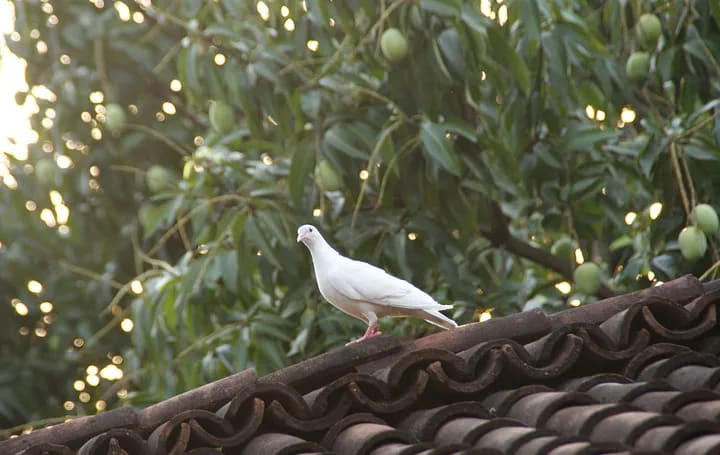
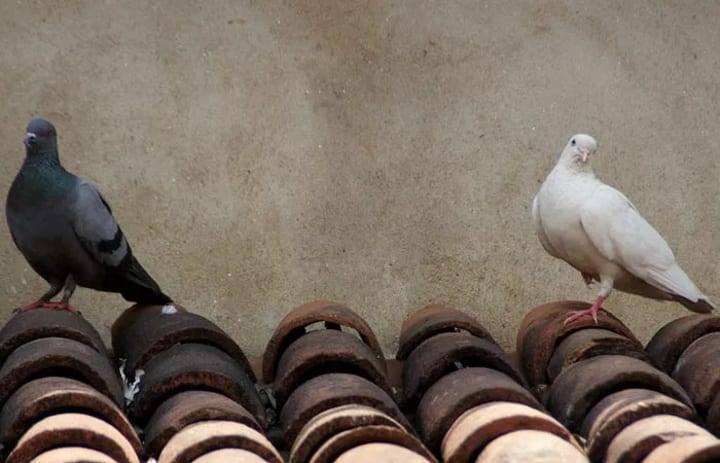
What moved me even more was that the leucistic pigeon wasn’t alone. It had a companion.
Another rock pigeon—this one with a regular slate-gray plumage—but with a curved, deformed beak.
It was unexpected. Two birds, each with a physical peculiarity, keeping each other company.
We often say, “Birds of a feather flock together.” Here, their feathers weren’t quite the same, by color,—but perhaps they had bonded over their shared deformities.
I took pictures. I wanted to remember this moment—this quiet, unusual friendship.
We don’t choose the physical characteristics we are born with. But life demands that we navigate the world with what we’ve got.
For some, that path is easy. For others, it’s unusually tough. Being treated as a pariah can be demoralizing and stressful.
The leucistic pigeon endured psychological as well as physical pain, day after day.
Its emotional and physical security was constantly at stake.
Isn’t it the same with humans too? We feel insecure and rejected if we’re not included. We long to be accepted, to belong, to be seen as we are.
So, dear readers, practice inclusion. Embrace diversity. Be kind to those who seem different.
Because,
"The tax on being different is massive." — Vivienne Ming
"The shame of being different is very painful for a lot of people." — Min Jin Lee
Once I saw a leucistic cobra too in a zoo. Recently, a leucistic deer was spotted and photographed in a blooming almond orchard in California.
Have you ever seen a leucistic creature in real life?
I hope this story has been informative—and maybe even a little moving.
About the Creator
Seema Patel
Hi, I am Seema. I have been writing on the internet for 15 years. I have contributed to PubMed, Blogger, Medium, LinkedIn, Substack, and Amazon KDP.
I write about nature, health, parenting, creativity, gardening, and psychology.
Keep reading
More stories from Seema Patel and writers in FYI and other communities.
A Failed Artist, A Disillusioned Poet, An Underpaid Game Show Host
I took my son and niece to Gori, a small town in Georgia where Joseph Stalin was born. They talked me into visiting the Stalin's Museum, the largest in the post-Soviet space. I had resisted going there because I just can't stand the monster and know enough about him, or so I thought.
By Lana V Lynx29 days ago in FYI
Top Luxury Travel Tours for Private, Invite-Only Experiences Around the World
Luxury travel is no longer defined solely by five-star hotels or first-class flights. Over the past few years, the definition has quietly shifted. In conversations with frequent travelers, travel planners, and industry insiders, one theme comes up again and again: true luxury is about access, not excess.
By All 4 Season5 days ago in FYI
A Letter to the Firestarter
Dear Firestarter, We can all see you, we've been watching you since you began. In case you didn't know we were here before you and we will be here after. We witnessed your rise, your setbacks, your guilt and your lies. We witnessed you start the fire.
By Donny Foley5 days ago in Poets



Comments (1)
This is a beautifully written and emotionally resonant piece.