
Flames on the frontier _when border burn and peace stand at the crossroads
inside the February 20226 Afghanistan - Pakistan escalation: security fears,sovereignty, and the human cost of rising conflict

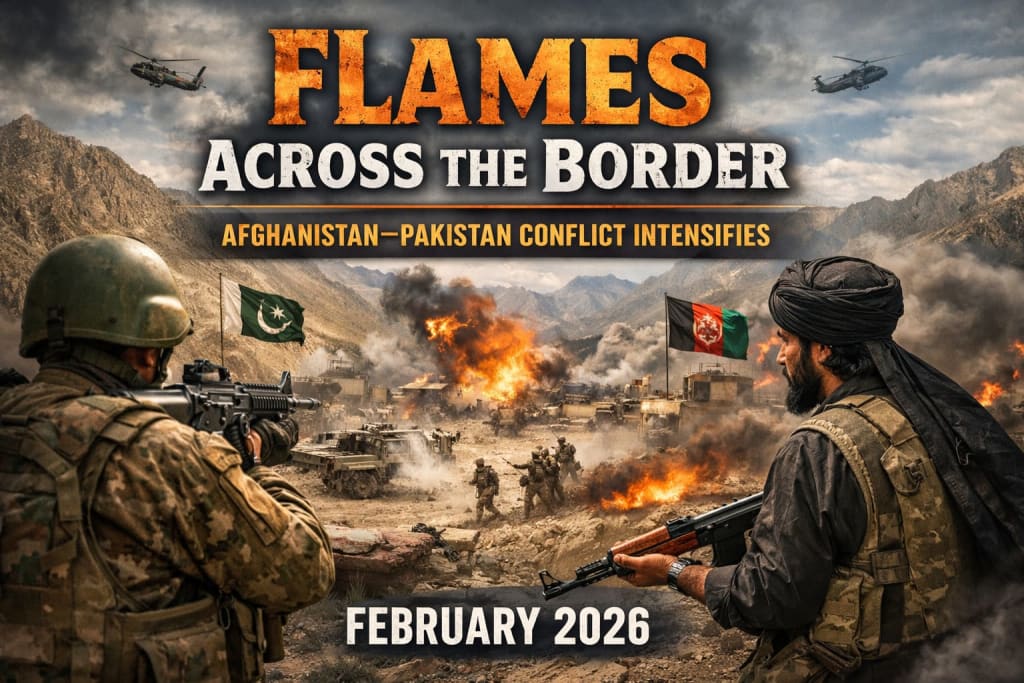
In global politics, some borders are not merely lines drawn on a map; they carry layers of history, culture, memories, and pain. The border between Afghanistan and Pakistan is one such frontier, shaped by decades of mistrust, shared traditions, conflict, and cooperation. The clashes that intensified in February 2026 have once again brought this sensitive region into the spotlight of international attention.
The latest escalation began after a series of deadly militant attacks inside Pakistan. Authorities in Islamabad claimed that the attackers had used Afghan territory as a safe haven to plan and organize assaults. Viewing these incidents as a direct threat to national security, Pakistan launched cross-border air operations. According to Pakistani officials, the strikes were aimed specifically at militant hideouts believed to be responsible for the violence.
Afghanistan’s current leadership, however, strongly condemned the strikes, calling them a violation of national sovereignty. Afghan authorities argued that civilians were also affected by the bombardment, increasing anger among local communities already exhausted by decades of conflict. In response, reports emerged of heavy exchanges of fire between Afghan forces and Pakistani security personnel along several border areas, further raising fears of a wider confrontation.
This conflict is not only a military dispute between two neighboring states; it is rapidly becoming a humanitarian concern. Families living near the border face uncertainty and fear as tensions rise. Trade routes have been repeatedly disrupted, border crossings frequently closed, and daily life for ordinary citizens has become increasingly difficult. For many residents, survival now depends on navigating instability that they did not create.
The roots of this tension are far from new. Historical disagreements over border recognition, the long-standing refugee crisis, and accusations regarding the presence of militant groups have repeatedly strained relations between the two countries. Over the past decades, moments of crisis have often been followed by diplomatic dialogue, yet lasting trust has remained difficult to achieve.
The international community has expressed growing concern over the situation. Several countries and global organizations have urged restraint and called on both governments to return to negotiations. Analysts warn that continued escalation could extend beyond regional boundaries, affecting economic stability and security across South Asia and potentially influencing global geopolitical dynamics.
For Pakistan, the primary challenge remains internal security. Rising incidents of violence have increased public pressure on authorities to act decisively against militant threats. Afghanistan, on the other hand, faces the equally complex task of protecting its sovereignty while seeking recognition and stability on the international stage. Each country is responding according to its own priorities, yet every decision carries consequences for millions of civilians living on both sides of the border.
History repeatedly teaches that wars are often easier to begin than to end. The sound of weapons may demonstrate strength in the short term, but lasting peace is rarely achieved through force alone. Dialogue, cooperation, and mutual understanding remain the only sustainable foundations for stability. The people of Afghanistan and Pakistan share centuries of cultural, religious, and familial connections, making permanent hostility neither practical nor beneficial.
Today, wisdom demands careful strategy rather than emotional reactions. Border security concerns can only be resolved through cooperation, intelligence sharing, and consistent political engagement. If conflict continues to escalate, the greatest cost will not be paid solely by soldiers or governments, but by ordinary citizens striving to live normal lives.
Perhaps the time has come for this region to choose conversation over confront.
About the Creator
hamad khan
I write stories that touch hearts and heal minds.
Through simple words, I share real-life lessons, emotions, and moments of reflection.
Join me on a journey of healing, hope, and self-discovery.
Keep reading
More stories from hamad khan and writers in FYI and other communities.
The Silent Love of the Forest
Deep between green mountains lay a vast and peaceful forest where life moved in harmony with nature. Every morning, golden sunlight slipped gently through the leaves, painting patterns upon the soft earth. Birds filled the air with melodies, and a clear river flowed through the forest like a silver ribbon, carrying stories of time itself.
By hamad khana day ago in Fiction
Daylight Saving Time Turns 60 and Arrives Earlier This Year
It's time to Spring Forward Daylight Saving Time is when we Spring Forward and turn clocks up one hour. It was once the last Sunday in March, but it has been coming earlier. This year, we lose an hour of sleep on March 8, and 2026 marks the 60th anniversary of this annual change that gives more daylight in the evenings.
By Cheryl E Preston4 days ago in FYI
Winterthorne
Winterthorne stood alone at the edge of the park. The beautiful snow that had surrounded him was all trampled now, from the feet of all of the children who had built him. He missed the sparkly clean snow blanket, but he was happy that so many children had come out to make him.
By Laura DePace7 days ago in Fiction



Comments
There are no comments for this story
Be the first to respond and start the conversation.