
End-to-End Development with Angular + .NET Microservices Boilerplate: From Frontend to Backend
Step-by-step guide to building production-ready Angular applications with .NET microservices architecture
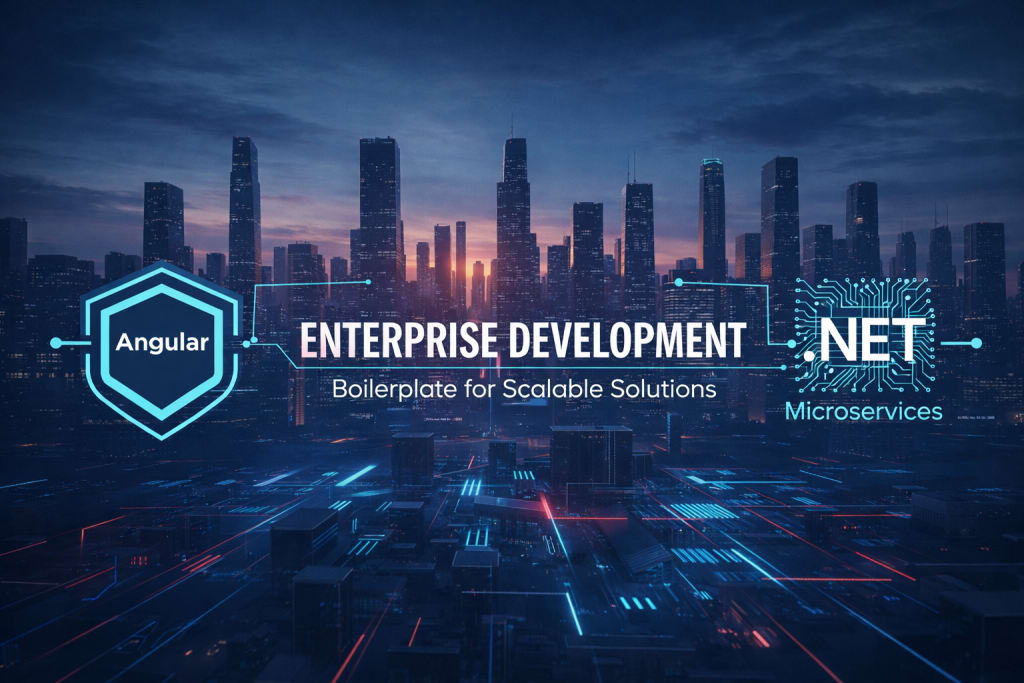
Modern enterprise applications demand scalability, security, and faster time to market. Relying on ad-hoc setups for frontend and backend development often leads to inconsistencies, technical debt, and delayed releases. An Angular + .NET microservices boilerplate solves this challenge by providing a production-ready, end-to-end architecture that unifies frontend and backend development under a single, proven foundation.
This article explores how using an Angular frontend with a .NET microservices backend boilerplate streamlines development, improves maintainability, and accelerates delivery from concept to production.
Why Choose an End-to-End Angular + .NET Architecture?
Enterprise systems today must handle high traffic, frequent feature updates, and evolving business requirements. Microservices architecture offers the flexibility to scale services independently, while Angular provides a robust and structured frontend framework.
However, implementing this architecture from scratch can be complex. An Angular + .NET microservices development removes this complexity by pre-configuring architectural patterns, communication standards, and security mechanisms, allowing teams to focus on building features instead of infrastructure.
Angular Frontend: Scalable and Maintainable UI Development
Angular is widely used for enterprise frontend development due to its opinionated structure and strong tooling. In a boilerplate-based setup, the Angular frontend is designed to scale as the application grows.
Key Angular frontend benefits include:
- Modular, feature-based architecture
- Reusable components and shared services
- Type safety with TypeScript
- Built-in routing and dependency injection
The boilerplate typically includes predefined folder structures, environment-specific configurations, and API service layers. This ensures consistency across projects and improves long-term maintainability.
.NET Microservices Backend: Enterprise-Grade Performance
On the backend, .NET is a preferred platform for building microservices due to its performance, security, and mature ecosystem. A .NET microservices boilerplate enforces best practices such as clean architecture, domain-driven design (DDD), and separation of concerns.
Common backend features include:
- Independently deployable microservices
- RESTful APIs or gRPC communication
- Centralized logging, monitoring, and health checks
- Configuration management and service discovery
This standardized approach ensures that each microservice follows consistent patterns, making the system easier to scale and maintain.
Seamless Frontend and Backend Integration
One of the strongest advantages of an Angular + .NET microservices boilerplate is seamless frontend-backend integration. API contracts are clearly defined, often using OpenAPI/Swagger, enabling frontend and backend teams to work in parallel.
Integration benefits include:
- Consistent API response formats
- Environment-based API endpoint management
- Reduced integration bugs
- Faster feature delivery
This alignment improves collaboration and reduces friction across teams.
Built-In Security and Authentication
Security is critical for enterprise applications. A production-ready boilerplate includes security best practices across both frontend and backend layers.
Typical security features include:
- JWT or OAuth 2.0 authentication
- Role-based access control (RBAC)
- Secure API gateways
- Input validation and centralized error handling
By standardizing security mechanisms, the boilerplate reduces the risk of vulnerabilities caused by inconsistent implementations.
DevOps and Production Readiness
An Angular + .NET microservices boilerplate goes beyond development; it prepares applications for production environments.
DevOps-friendly features often include:
- Docker-based containerization
- CI/CD pipeline templates
- Environment-specific configurations
- Cloud-ready deployment support
These capabilities ensure smoother deployments and faster release cycles.
Faster Development and Team Productivity
Consistency is essential for large teams. An end-to-end boilerplate acts as a shared reference architecture, enabling faster onboarding and reducing technical debt. Developers spend less time on setup and more time delivering business value.
From Frontend to Backend: A Smarter Way to Build
A scalable Angular .NET microservices starter kit provides a powerful, scalable foundation for building modern enterprise applications. By combining a structured Angular frontend with a robust .NET microservices backend, teams can deliver secure, maintainable, and production-ready solutions faster.
For organizations aiming to streamline development and future-proof their architecture, an end-to-end boilerplate is not just a convenience; it’s a strategic advantage.
About the Creator
Keep reading
More stories from Jakob Stanely and writers in FYI and other communities.
The Ultimate Starter Kit for Building Scalable, Secure Enterprise Microservices
As enterprises demand faster release cycles, greater resilience, and modular evolution of systems, microservices provide a powerful architectural foundation. By breaking software into independently deployable components aligned to business capabilities, organizations gain flexibility, improved fault isolation, and the ability to scale services individually based on usage. However, succeeding with microservices requires more than coding smaller applications — it requires the right architectural discipline, tooling, security posture, and operational maturity.
By Jakob Stanely3 months ago in FYI
Search warrants in QLD: what police can (and can’t) do at your place
Getting police at the door is a proper adrenaline moment. Doesn’t matter if you’ve done nothing wrong. The heart still goes. The brain still blanks. And suddenly every sentence sounds either too defensive… or too chatty… or weirdly angry.
By Dan Toombs6 days ago in FYI



Comments
There are no comments for this story
Be the first to respond and start the conversation.