
Andrew May No Longer Be A Prince But He Could Still Be King
As unlikely as his ascension may be, Andrew remains eighth in line to the throne with questions abound as to why


Andrew Mountbatten-Windsor, the man formerly known as Prince Andrew The Duke of York, has certainly been at the center of much controversy in recent years. From his association with convicted sex-trafficker Jeffrey Epstein to allegations of his own misconduct, the former Duke is once again in hot water.
Under investigation for misconduct while in public office, Andrew is alleged to have leaked confidential files to Epstein during his time as the UK's trade envoy. Arrested on the morning of his 66th birthday, Andrew has become the first senior British Royal in almost 400 years to be arrested. Released under investigation, he is neither convicted nor exonerated but remains under close scrutiny.
This has been the latest in what has been a humiliating and very public fall from grace. Since Epstein's death in 2019 and the revelation of his ties to Andrew, the former Prince has been removed from his role as a working royal, evicted from his grace and favour residence and has been stripped off all his royal titles.
Despite having lost his privileges, his home and now wrestling with potentially losing his freedom, Andrew retains one very significant right. He is still eighth in line to the throne. Despite the mass backlash and what appears to be his ex-communication from within the Royal family itself, Andrew's place on the line of succession remains intact. As pressure mounts to address this, the question for now is why this remains so.
How Close Is Andrew To The Throne?
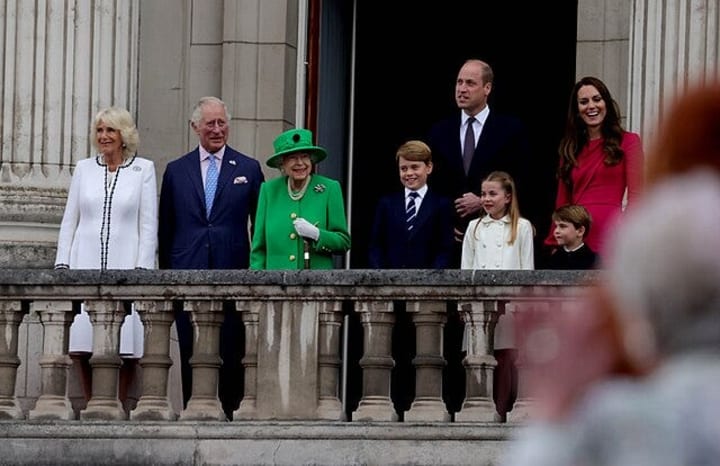
At the time of his birth in 1960, the then-Prince Andrew was second in line to the throne. He was behind only his elder brother, the now-King Charles III. Andrew's mother, the late Queen Elizabeth II was the sitting monarch when he was born.
On his wedding day in 1986, Andrew was given the title of Duke of York by the Queen. Typically given to the second son of the reigning monarch, the Dukedom had, over the course of history, produced a number of Kings. In total, six Dukes of York (including Andrew's own grandfather King George VI) unexpectedly ascended the throne, usually in cases where their elder brothers either predeceased them before becoming monarch or if they did not have a suitable heir.
As the years have gone on however, Andrew's place on the line of succession has gradually fallen. This is due to the birth of Charles' two children, Princes William and Harry and the subsequent births of their own children. William has three children Prince George, Princess Charlotte and Prince Louis while Harry has two children, Prince Archie and Princess Lilibet.
This would mean that for Andrew to ever become King, he must not only outlive his brother but also his two nephews and their five children while hoping that no others are born in the meantime.
Why Exactly Hasn't Andrew Been Removed?
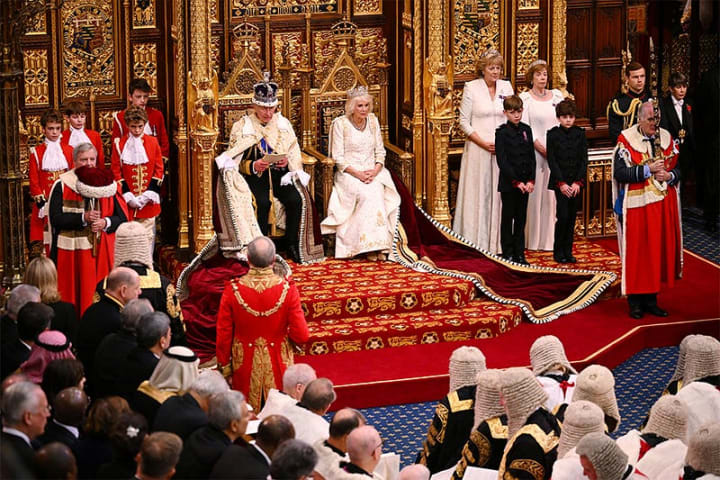
To put it briefly, the reason Andrew remains in the line of succession is simply because there is no straightforward method to remove him. As the UK is a Constitutional Monarchy, neither the government nor the Royal Family have the discretion to have Andrew taken off the line of succession overnight.
Instead, legislation must be passed in order for such an action to take place. This means that Parliament must convene and agree to pass an Act which must first come into force by the Monarch's royal assent. As this is an act that deals with the succession of the monarchy, it must also be approved by every other Commonwealth nation that recognises King Charles III as its Head of State. These include countries like Canada, Australia and New Zealand.
It should be noted that this approval is not merely some kind of blanket statement of agreement but an effort on the parts of each of these countries to amend their individual laws to accommodate such a change.
It is certainly a tedious process but not one that is unheard of. In fact, it has only been around 12 years since the last Parliamentary Act relating to succession has been passed. In 2013, the Succession to the Crown Act was passed and has been the leading statute on succession related issues.
This Act allowed for any female born after 28 October 2011 to take precedence over a younger male in the line of succession. This means that going forward an elder sister will remain closer in line to the throne than her younger brothers. The Act also included a clause that restored the succession rights of individuals who married Catholics.
Thus, it goes to show that the line of succession is less a popularity contest where people can be arbitrarily removed or pushed forward due to the climate of the day and more a strict, rigid legal document that requires careful procedures for even the slightest of changes. However, as recent history has shown, enacting such changes is a very real possibility.
Should Efforts Still Be Made To Remove Andrew?

From a practical standpoint, the chances of Andrew ever being King are essentially zero. He is already 66 years old and still remains behind 7 much younger, healthier individuals. This is without yet counting the births of any more people who will widen this gap further still.
Due to the circumstances of his birth, the longer Andrew lives, the further down the line of succession he will be pushed. As the brother of a sitting monarch he will continue to be overtaken by any future grandchildren or great-grandchildren of King Charles III. Add on to this the well-documented efforts by the Monarchy to maintain a direct line of succession and Andrew's claim to the throne is all but symbolic.
It begs the question as to why it would be necessary to remove him at all. Why bother to enact laws that require such complex and tedious processes to prevent a man from inheriting a throne that he already has virtually no claim to?
As it stands now, Andrew's status does not affect the authorities powers to investigate or even prosecute him. On top of that, the Royal Family's own decision to distance themselves from him and support the investigation have shown that they have no interest in protecting him. Thus to some, any effort to remove his claim to the throne can be seen as being superficial optics at best and ineffective at worst.
However, there are also those of the view that removing Andrew from the line of succession, even symbolically, is an endeavour that is worth the effort. It will formalise both the Royal Family and the Government's stance against the controversial ex-Royal and can serve as a safeguard against any future indiscretions later down the line. With countries like Australia already expressing support for Andrew's removal, it is as good a time as ever to see to it that he never has any claim to the throne whatsoever.
Thus as it stands now, Andrew Mountbatten-Windsor remains eighth in line to the throne. Not by any of his own merits but simply because hereditary institutions are designed to not collapse even when personal reputations do. While any decision to remove him may not happen overnight, it is not an impossibility. Until then, the ball is in the court of the authorities, the government and the Monarchy to act. Hopefully, it shall be in the interest of the people and justice as a whole.
About the Creator
Isa Nan
Written accounts of life, death and everything in between
What Makes Aerospace Manufacturing Different from Other Industries?
Manufacturing exists across countless industries, from automotive production to consumer electronics. However, aerospace manufacturing stands apart because of the extreme demands placed on both products and processes. In aviation, there is no margin for error. Every component must perform flawlessly under stress, pressure, vibration, and temperature variation.
By Beckett Dowhan5 days ago in FYI
When Amazon Says You’re a Disappointment
Yesterday, for the first Wednesday in months, I didn’t publish a piece on Vocal. Believe me, I wanted to. I had it all written up and ready to go. I was going to share the news that I had officially become a published author.
By Sandy Gillman5 days ago in Writers



Comments
There are no comments for this story
Be the first to respond and start the conversation.