
Why Most AI Systems Fail at State Management?
Understanding why memory, context tracking, and workflow continuity remain some of the hardest problems in modern AI system design

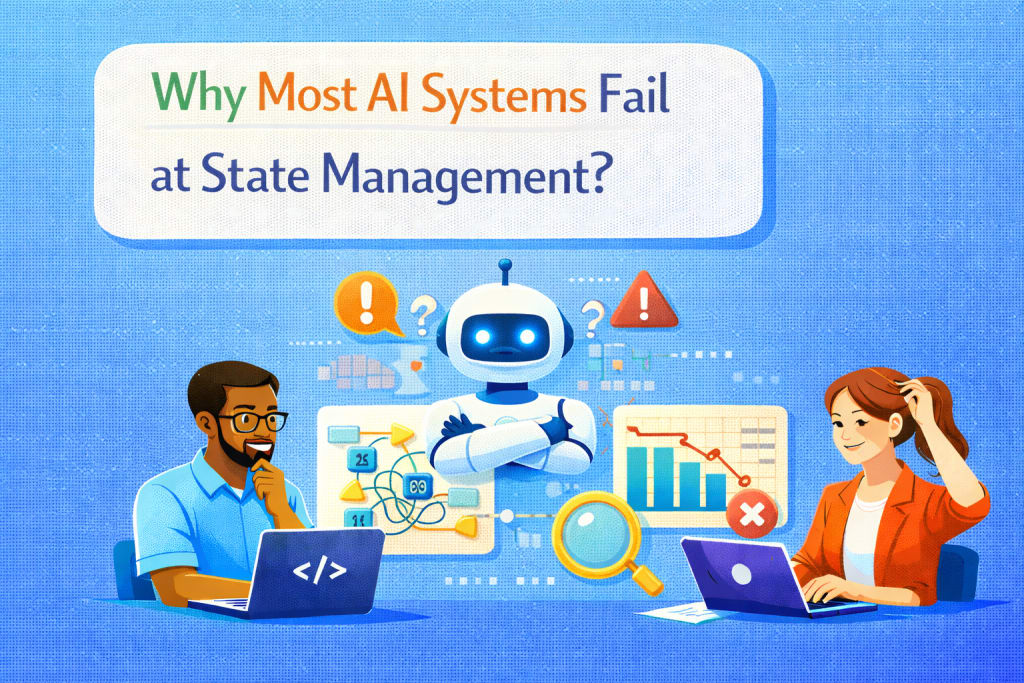
AI systems powered by large language models often appear intelligent during isolated interactions, yet struggle when conversations or workflows extend across multiple steps. One of the main reasons is state management — the ability to track, update, and maintain context over time. While traditional software engineering has long relied on well-defined state models, AI-driven applications introduce new challenges because behavior is probabilistic rather than deterministic.
Many teams focus heavily on prompts, model selection, or retrieval strategies, only to discover later that poor state handling leads to inconsistent responses, repeated questions, or loss of important context. Understanding why this happens is essential for building reliable AI-powered systems.
Why state management matters in AI applications
State management determines how an application remembers information between interactions. In traditional systems, state may include:
- user session data
- workflow progress
- transaction status
In AI systems, state expands to include:
- conversation history
- user preferences
- retrieved knowledge context
- task progression across multiple steps
Without structured state handling, AI interactions may feel disconnected or unreliable.
The difference between stateless models and stateful applications
Large language models themselves are fundamentally stateless. Each request is processed independently unless previous context is explicitly provided.
This means developers must design systems that:
- store relevant context externally
- decide what information to include in each prompt
- manage memory limitations and token constraints
Treating AI models as stateful without proper architecture leads to unpredictable behavior.
Common mistakes teams make with AI state
Many failures stem from misunderstanding how context works.
1. Relying entirely on conversation history
Sending entire chat histories into prompts quickly becomes inefficient and expensive. It can also introduce irrelevant information that confuses model responses.
Effective systems summarize or structure history rather than passing everything verbatim.
2. Mixing short-term and long-term memory
AI applications often require multiple types of memory:
- short-term conversational context
- long-term user data or preferences
- external knowledge retrieved dynamically
Combining these without clear separation makes debugging difficult and can degrade output quality.
3. Ignoring workflow state
AI-driven apps frequently support multi-step tasks such as onboarding flows, form completion, or guided processes.
Without tracking workflow progress explicitly, the AI may:
- repeat instructions
- skip necessary steps
- lose track of user goals
Developers should manage workflow state independently from conversational context.
Retrieval pipelines and state coordination
Modern AI systems often use retrieval pipelines to provide contextual information. While retrieval improves accuracy, it introduces another layer of state complexity.
Developers must manage:
- which documents were previously used
- how context evolves over time
- avoiding repeated or redundant retrieval
Without coordination, retrieval systems may produce inconsistent or conflicting context.
Memory architecture patterns that work better
Successful AI systems treat state as a structured architectural layer rather than an afterthought.
Common patterns include:
- Session state storage: track user interactions during active sessions.
- Summarized memory: periodically compress conversation history.
- Vector-based long-term memory: store embeddings for relevant knowledge retrieval.
- Workflow engines: maintain structured task progression independent of AI responses.
Separating responsibilities reduces complexity and improves reliability.
Observability challenges related to state
Debugging AI state issues can be difficult because problems often appear as subtle behavior changes rather than system errors.
Developers should monitor:
- prompt content and context changes
- state transitions across interactions
- user correction patterns indicating confusion
Tracking these signals helps identify where state management breaks down.
Implications for mobile app development
As AI becomes integrated into mobile experiences, managing state across devices introduces additional challenges. Apps must maintain continuity between sessions, synchronize context efficiently, and handle intermittent connectivity.
Teams working within mobile app development Denver environments often prioritize scalable state architectures to support conversational interfaces, personalized workflows, and intelligent automation without overwhelming mobile performance constraints.
Practical takeaways
- Treat AI models as stateless and manage state externally.
- Separate conversational memory from workflow state.
- Summarize context rather than passing entire histories.
- Monitor how state changes affect output consistency.
- Design retrieval pipelines that align with state architecture.
Final thoughts
State management remains one of the most overlooked challenges in AI system design. While models continue improving, reliable applications depend on structured approaches to tracking context, workflow progress, and memory over time.
Developers who approach state as a first-class architectural concern — rather than a patch added later — build systems that feel coherent, reliable, and capable of handling real-world interactions beyond single prompts.
About the Creator
Keep reading
More stories from Samantha Blake and writers in Futurism and other communities.
Entertainment and Streaming Trends in Mobile App Development Los Angeles
There was a time when streaming meant pressing play and watching quietly. That era is fading. Today, audiences expect interaction, personalization, and real-time engagement layered into entertainment experiences. The shift has transformed mobile apps from passive viewing platforms into digital stages where users comment, create, react, and influence outcomes as events unfold.
By Samantha Blake3 days ago in Futurism
Fish Farming Market Outlook: Rising Seafood Demand and Sustainable Aquaculture Growth Opportunities
According to IMARC Group's latest research publication, The global fish farming market size reached USD 322.3 Billion in 2024. Looking forward, IMARC Group expects the market to reach USD 470.3 Billion by 2033, exhibiting a growth rate (CAGR) of 4.25% during 2025-2033.
By James Whitman7 days ago in Futurism
Magnetic Sensors Market Outlook: Smart Electronics Demand and Growth Opportunities
According to IMARC Group's latest research publication, The global magnetic sensors market size reached USD 4.5 Billion in 2024. Looking forward, IMARC Group expects the market to reach USD 8.2 Billion by 2033, exhibiting a growth rate (CAGR) of 6.13% during 2025-2033.
By James Whitman8 days ago in Futurism




Comments
There are no comments for this story
Be the first to respond and start the conversation.