
What’s the Best Roadmap for Getting Into Marketing Analytics?
That’s a good question—but I think what you’re really asking is...

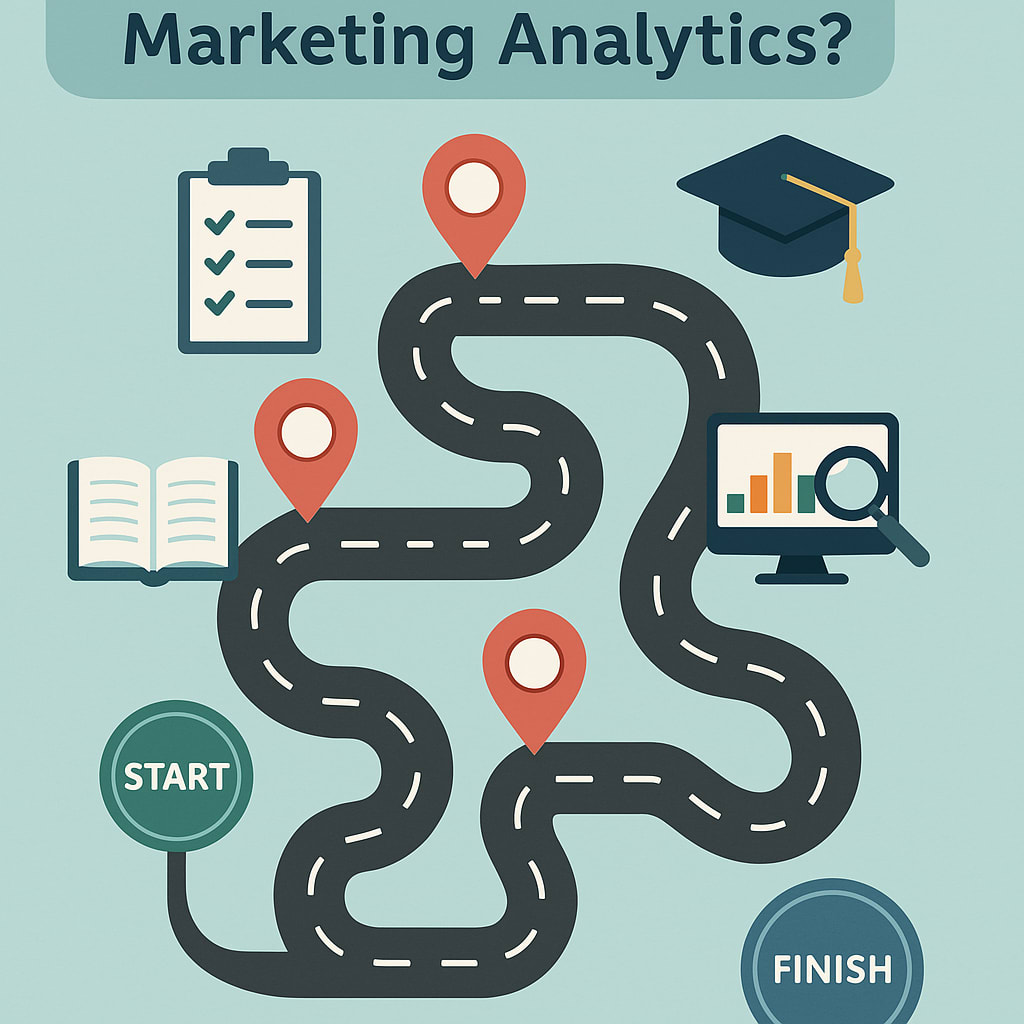
“What’s the clearest, most realistic way to break in when the path feels overwhelming, the job descriptions are unclear, and I’m not sure where to focus?”
Let’s walk through this together step by step.
Marketing analytics can feel overwhelming. There’s a flood of tools, jargon, and advice—but no clear starting point.
So if you're early in your career and trying to figure out where to start, what to learn, and how to stand out, this guide is for you.
Step 1: Learn to Think Like a Marketer (Not Just an Analyst)
Before the tools, learn the terrain. Marketing analytics is about uncovering insights that drive decisions.
Learn how the funnel works:
- Awareness: How people first hear about your product (ads, SEO, word of mouth)
- Acquisition: Getting them to visit or engage (clicks, traffic, signups)
- Activation: Helping them experience value quickly (first conversion or meaningful event)
- Retention: Keeping them engaged and coming back (repeat usage, reduced churn)
- Revenue: Turning engagement into sustainable income (subscriptions, LTV, upsells)
Understand these core metrics:
- CAC (Customer Acquisition Cost): How much it costs to acquire a customer
- LTV (Lifetime Value): How much value a customer brings over time
- CTR (Click-Through Rate): % of people clicking a link/ad
- CVR (Conversion Rate): % of users who take a desired action
- Bounce Rate: % who leave after viewing only one page
- Churn Rate: % of users who leave over time
- ROAS (Return on Ad Spend): Revenue generated per dollar spent on ads
- Revenue per Session: Earnings per website visit
Resources:
- HubSpot Academy (Free) – Intro to Digital Marketing
- Reforge blog (Advanced, strategic insights)
- CXL Blog – In-depth breakdowns of metrics, experimentation, CRO
Step 2: Build Your “Analytics Stack” Skillset
You don’t need to know everything. You need the right tools:
Essential Tools (Minimum Viable Stack):
- SQL: Foundational for querying large datasets and joining tables across platforms
- Excel/Google Sheets: Still critical for quick data exploration, pivot tables, and modeling
- Google Analytics 4 (GA4): To understand website behavior and conversion patterns
- Looker Studio / Power BI: For turning insights into shareable, visual dashboards
Optional (for growth or certain roles):
- Mixpanel or Amplitude: Powerful for product-led and event-based user flows
- Google Tag Manager (GTM): Learn tagging and event tracking implementation basics
Pro Tip: Don’t aim to master everything. Learn each tool through a project—e.g., “Track user drop-offs in signup funnel with GA4 + Looker.”
Step 3: Choose One Domain to Go Deep In
Marketing analytics is a wide ocean. You don’t need to swim across all of it—just dive deep in one bay.
Four Strong Focus Areas:
- Acquisition Analytics: Understand channel performance (paid search, SEO, social, etc.) and ROAS
- Retention & Lifecycle: Master cohort analysis, user behavior over time, churn prediction
- Conversion Optimization & Experimentation: Learn test design, CRO principles, statistical validity, and lift analysis
- Attribution Modeling: Evaluate how touchpoints contribute to conversions (first-touch, last-touch, linear, data-driven)
Choose based on curiosity and traction—what problems excite you? What’s in demand in the job market?
Step 4: Learn to Communicate Insights
A dashboard is not a story. A chart is not an answer.
To stand out:
- Frame the question: “What decision does this analysis support?”
- Simplify the narrative: Focus on “why this matters” to business
- Use clear visuals: Avoid clutter, emphasize clarity
- Tell a story: What’s happening, why, and what action should be taken
Practice summarizing insights in 2–3 sentences:
“Users from paid search convert 3x higher than organic, but bounce faster. We should explore retargeting or optimizing landing pages for organic.”
This skill alone sets you apart from 90% of other candidates.
Step 5: Build a Portfolio That Shows Business Thinking
Hiring managers don’t just want tech skills. They want applied thinking.
Ideas for portfolio pieces:
- Funnel analysis + business recommendations
- Real (or simulated) campaign performance breakdown
- A/B test strategy doc with results interpretation
- Looker Studio dashboard with annotations and insights
Use public datasets (Kaggle, Google Merchandise Store), your own blog/project, or side gigs.
Step 6: Signal Your Knowledge Publicly
Make your learning visible:
- Add project links to your LinkedIn and resume
- Share bite-sized learnings (“What I learned building my first GA4 funnel report”)
- Complete certifications: GA4, SQL, Google Data Analytics (Coursera), HubSpot Analytics
- Bonus: Publish one LinkedIn post per week = instant credibility compounding
Step 7: Get Closer to Real People (10x Growth Hack)
- Follow practitioners on LinkedIn and ask thoughtful questions
- Book ADPList calls with analytics leaders
- Attend online meetups, workshops, or community events (many are free)
You’ll grow faster through conversation than consumption.
Final Word
You don’t need a fancy degree or 10 years of experience. You need:
- Curiosity
- Direction
- A repeatable plan
Start where you are. Go deep in one thing. Build, share, refine.
Tools help you get answers. Insight helps you get hired.
If this was helpful, subscribe to Experimentation Career for weekly guides, job-winning frameworks, and honest takes from someone inside the industry.
Let’s figure it out—together.
Talk soon,
Atticus
👉 Like this? Subscribe for career tips.
🤝 Connect on LinkedIn to swap ideas.
About the Creator
Experimentation Career
Helping students & early career pros land $100K+ roles in analytics, marketing, and experimentation. Hiring manager at NRG (Fortune 500, $28B+ revenue).
Keep reading
More stories from Experimentation Career and writers in Futurism and other communities.
Electronic Data Capture (EDC) Systems Market Outlook: Clinical Trial Digitization and Growth Opportunities
According to IMARC Group's latest research publication, The global electronic data capture (EDC) systems market size reached USD 1.4 Billion in 2024. Looking forward, IMARC Group expects the market to reach USD 3.3 Billion by 2033, exhibiting a growth rate (CAGR) of 9.7% during 2025-2033.
By James Whitmanabout 8 hours ago in Futurism
Australia Frozen Potato Products Market: Consumption Trends, Retail Expansion & Product Innovation
According to IMARC Group, the Australia frozen potato products market reached a value of USD 1,147.6 Million in 2025 and is projected to grow to USD 1,771.2 Million by 2034, exhibiting a compound annual growth rate (CAGR) of 4.79% during 2026–2034. This steady expansion reflects evolving consumer eating habits, strong demand from quick-service restaurants (QSRs) and continuous improvements in cold chain infrastructure. Frozen potato products—ranging from fries and wedges to hash browns and specialty formats—have become staple items across both foodservice and retail channels. As convenience, consistency and extended shelf life become increasingly important, frozen potato products are playing a strategic role in Australia’s modern food ecosystem across Australia.
By Shrestha Royabout 11 hours ago in Futurism




Comments
There are no comments for this story
Be the first to respond and start the conversation.