
🟢💧 The Liquid Green Drop That Froze: The Epic Rise and Fall of Sony Ericsson 📉
The Divorce: Lessons in Tech Humility 💔

If you grew up in the first decade of the 21st century, you likely remember the iconic liquid-green logo—a glowing orb of energy—and 그 short, ascending ringtone that echoed through school hallways and office corridors. 📱 Sony Ericsson wasn't just a phone manufacturer; it was a status symbol, a lifestyle accessory, and proof that technology could have a soul. But how did the duo that defined modern mobile entertainment vanish almost overnight? 🕵️♂️
A Marriage of Convenience (and Absolute Necessity) 🤝
The story begins in 2001. The Swedish giant Ericsson 🇸🇪, a titan of telecommunications infrastructure, was in deep trouble. While their phones were mechanically solid and technically advanced, they looked like grey bricks designed by someone who harbored a personal grudge against color. To make matters worse, a devastating fire at a key Philips microchip factory in New Mexico had crippled their production lines. 🔥
On the other side of the world was Sony 🇯🇵—the masters of design, the creators of the Walkman, and the kings of the PlayStation. Sony desperately wanted to conquer the mobile market but lacked the patents and the technical networking backbone that Ericsson possessed. The merger seemed like a stroke of genius: the Swedes would provide the "brain" and signal stability, while the Japanese would bring the "heart," the style, and the marketing magic. Thus, the Sony Ericsson joint venture was born. ✨
The Walkman and Cyber-shot Era: When the Phone Became the Universe 🎶📸
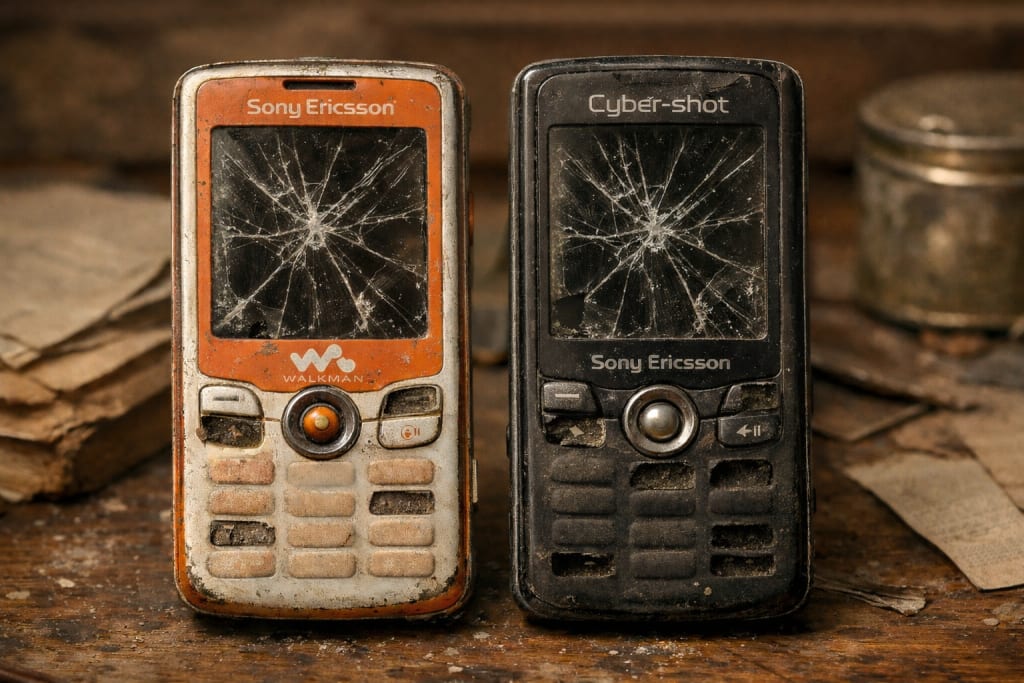
The early years were promising, but the true explosion happened when Sony allowed the venture to tap into its most powerful sub-brands. In 2005, the W800i hit the shelves—the first phone to bear the Walkman logo. It was a total revolution. 🍊 Sony Ericsson understood before anyone else that a phone wasn't just for calling; it was a pocket-sized entertainment hub. People ditched their MP3 players in droves because this bright orange phone offered everything in one sleek package.
Shortly after, they struck again with the Cyber-shot line. Models like the K750i and the legendary K800i (famously used by James Bond in Casino Royale 0️⃣0️⃣7️⃣) featured real xenon flashes and physical lens sliders. It transformed the device from a "phone with a camera" into a professional-grade compact camera that just happened to make calls. Sony Ericsson dominated the lifestyle market. They were cool, they were cutting-edge, and it seemed like they were invincible. 🚀
"Who Would Buy a Glass Trap?" – The Fatal Mockery 🔨😂
In 2007, Steve Jobs walked onto a stage in San Francisco and pulled the iPhone out of his pocket. While the rest of the world held its breath, inside the design offices of Sony Ericsson in Lund and Tokyo... there was laughter. 😒
The company’s leadership committed a strategic blunder that is now taught in business schools as a classic case of corporate hubris. Sony Ericsson’s executives openly mocked the concept of a large, buttonless touchscreen. Their logic felt "ironclad" at the time: "Nobody wants a phone without a keyboard! A touchscreen is just a fragile toy—a 'glass trap' that will shatter into a thousand pieces the very first time someone drops it on a sidewalk." 📱💥
They were so convinced they were right that instead of pivoting to develop a touch interface, they doubled down on perfecting their signature physical joysticks. The irony is staggering: those legendary joysticks ended up failing on almost every model after six months of use due to dust and wear, while the "fragile" touchscreens became the gold standard the entire world craved. The company believed their superior optics and physical buttons would save them. They were tragically wrong. 📉
The Beginning of the End: Bureaucratic Paralysis ⏳🏛️
By the time the company realized the iPhone wasn't a toy and that Android was about to flood the market, it was already too late. Sony Ericsson became trapped in its own complex, dual-headed structure. They had two headquarters, two management styles, and two vastly different philosophies on technology. 🌍
The Swedes wanted to focus on open systems and technical functionality; the Japanese were obsessed with aesthetics and Sony’s proprietary, "walled garden" ecosystems. Decisions that took Samsung or Apple a week to finalize would languish for months in committees and consultations at Sony Ericsson. When they finally released their first "smart" devices, like the Xperia X1, they were clunky, ran on the already-dying Windows Mobile system, and—true to their stubborn roots—featured a massive physical slide-out keyboard that the world was moving away from. ⌨️🚫
Later attempts, like the Xperia X10, suffered from software lag and delayed updates. The company that used to set the trends had become a perpetual runner-up, desperately trying to close the gap with Samsung, which had adopted Google’s Android faster and more efficiently. 🏃♂️💨
The Divorce and the Legacy: A Lesson in Humility 💔🎓
In 2011, the marriage officially ended. Sony bought out Ericsson’s stake for over a billion euros, scrubbing the Swedish name from the logo. From that point on, the phones became simply "Sony Mobile" products. 🔚
Why did Sony Ericsson fall? It wasn't a lack of technology—they had some of the best camera sensors and display panels on Earth. It was a lack of humility in the face of changing user needs. Their fear of "shattering glass" and their obsession with plastic buttons blinded them to the fact that users would rather replace a screen than be stuck in the past. 🕸️
Today, the Sony Ericsson brand is a nostalgic memory for a generation that remembers beaming ringtones via infrared ports and playing Bluetooth Terror on the bus. It serves as a haunting lesson for any tech giant: in this industry, success is never permanent, and mocking the competition is usually the first step toward irrelevance. 🕯️📜
About the Creator
Piotr Nowak
Pole in Italy ✈️ | AI | Crypto | Online Earning | Book writer | Every read supports my work on Vocal
Keep reading
More stories from Piotr Nowak and writers in Futurism and other communities.
Freelancing: Between “404: Reality Not Found” and Building Your Own Kingdom 🏗️
When I published my debut novella, "404: Reality Not Found", I didn’t expect the title to become such a perfect metaphor for my professional life 💻. In the world of freelancing, the reality promised by glossy magazines—the one with a laptop on the beach and a constant smile—is often, well, "not found." Instead of ocean blue, we more often see the blue light of a monitor at 3 AM 🌙. Working for yourself is a fascinating journey, but it’s worth talking about it without the filters, showing both the highs and the lows of this profession.
By Piotr Nowak16 days ago in Futurism
Australia Ready Mix Concrete Market: Infrastructure Demand, Sustainability & Tech Adoption
According to IMARC Group, the Australia ready mix concrete market reached USD 53,481.3 Million in 2025 and is projected to grow to USD 121,276.9 Million by 2034, exhibiting a compound annual growth rate (CAGR) of 9.24% during 2026–2034. The strong expansion reflects rapid infrastructure modernization, urban development, and large-scale construction activity across Australia. Ready mix concrete (RMC), known for its quality consistency and efficiency in large projects, is increasingly preferred over site-mixed alternatives. Government investments in transportation networks, renewable energy facilities, and residential housing are significantly strengthening Australia ready mix concrete market share, while sustainability initiatives and production technology upgrades are reshaping industry standards.
By Shrestha Roy4 days ago in Futurism
The Fintech Revolution: Stablecoins and the Future of Remittances
The global financial landscape is rapidly evolving as financial technology continues to reshape how people and businesses manage money. One of the most significant innovations driving this change is the rise of stablecoins. These blockchain-based digital assets are designed to maintain a stable value, usually pegged to traditional currencies like the US dollar. As the demand for faster and more affordable cross-border transactions grows, Stablecoin Remittance Platform Services are emerging as a powerful solution for the future of global payments.
By Celine Dion2 days ago in Futurism



Comments
There are no comments for this story
Be the first to respond and start the conversation.