
The Death of Trust: Can AI Mimic Your Soul?
Why "Emotional Deepfakes" are the next frontier of cyber-attacks—and how to protect your reputation before the camera lies for you.


I recently watched a video of an old friend of mine. In the clip, he was sobbing, confessing to a betrayal that seemed completely out of character. I almost reached for my phone to call him, my heart heavy with a mix of anger and confusion.
Then I noticed the slight, almost imperceptible glitch in the way his tear caught the light. It wasn’t him. It was a high-fidelity Emotional Deepfake.
In 2026, we’ve moved past the era of "face-swapping." We are now facing the era of Persona Hijacking. It’s no longer just about making you say words you didn’t say; it’s about making you "feel" things you didn’t feel. This is the new silent predator in our digital lives, and it’s time we talk about the Emotional Firewall.
The Science of a Digital Sob
Traditional deepfakes were often "uncanny"—they looked a bit robotic. But today’s AI models have studied millions of hours of human micro-expressions. They know exactly how your pupils dilate when you lie, or how the muscles in your jaw tighten when you’re suppressed by grief.
Hackers are no longer just looking for your credit card numbers; they are looking for your Emotional Data. By scraping your Zoom calls, your YouTube vlogs, or even your video messages to family, they can reconstruct a version of "you" that can be used to:
1. Destroy Professional Reputations: Imagine a video of you "confessing" to a crime or making a racist slur appearing on LinkedIn.
2. Social Engineering: A "crying" video sent to your parents, begging for money because you’re in "legal trouble."
3. Relationship Sabotage: Fake clips of partners "admitting" to infidelity, designed with such emotional depth that logic is thrown out the window.
The Anatomy of the Attack
The most terrifying part of an emotional deepfake isn't the technology; it’s the Human Response. Our brains are wired to react to emotion before we process logic. When we see someone we love in pain or anger, our "critical thinking" shuts down. The hackers know this. They aren't hacking your computer; they are hacking your empathy.
How to Build Your "Emotional Firewall"
Since we cannot stop the technology, we must upgrade our human "software." Here is how you defend your digital soul:
1. The "Visual Artifact" Check
Even the best AI struggles with three things: Teeth, Tongue, and Tears.
• The Fix: If you receive a suspicious emotional video, look closely at the mouth. Does the tongue move naturally when they speak? Do the tears follow the contours of the face perfectly? If it looks "too cinematic," it’s likely fake.
2. Establish "The Random Question" Protocol
If you get a video call or a message that feels emotionally "heavy" or out of character, interrupt the flow.
• The Fix: Ask a question only the real person would know—but make it mundane. "What was the name of that bad pizza place we went to in 2019?" An AI generated video cannot pivot to "offline" memories in real-time.
3. Low-Light Defense
AI models need clear data to render faces.
• The Pro-Tip: If you suspect a live video call is a deepfake, ask the person to turn their head sideways or dim their lights. Deepfakes often "break" or show ghosting effects when the lighting changes suddenly or when the profile view is forced.
4. The "Consent Watermark"
For content creators and professionals, consider using a physical "anchor" in your videos. A specific ring, a unique background item, or a subtle habit (like holding a specific pen) that you never change.
• The Fix: If a video of you appears without your "anchor," your inner circle will immediately know something is wrong.
5. Digital Minimalist: The "Face Blur" Policy
Stop posting high-definition, close-up videos of your face where you are expressing intense emotions.
• The Fix: Save the heart-to-heart conversations for encrypted, private calls. Every public emotional video you post is just "training data" for a future attacker.
Protecting the Future of Truth
We are living in a time where "seeing is no longer believing." The cost of our digital connectivity is a constant state of skepticism. But this doesn't mean we have to live in fear.
By building an Emotional Firewall, we are reclaiming our right to be human. We are deciding that our emotions are not for sale, and they certainly cannot be synthesized.
The next time you see a video that makes your blood boil or your heart break, take a breath. Look for the glitch. Because in the age of AI, the most "human" thing you can do is pause.
About the Creator
Alex Sterling
Decoding the intersection of global power and the human heart. Writing about the silent shifts between the East and the West—from AI and digital sovereignty to the stories that make us real
Keep reading
More stories from Alex Sterling and writers in Futurism and other communities.
The Last Fortress
The Final Frontier of Privacy For centuries, the human mind has been the only place where true freedom existed. No matter how oppressive a regime was, or how invasive a technology became, your thoughts were yours alone. They were the "Last Fortress"—a sanctuary of private dreams, silent rebellions, and unspoken loves.
By Alex Sterling 2 days ago in Futurism
Australia Energy Storage Market: Renewable Integration, Battery Deployment & Grid Stability
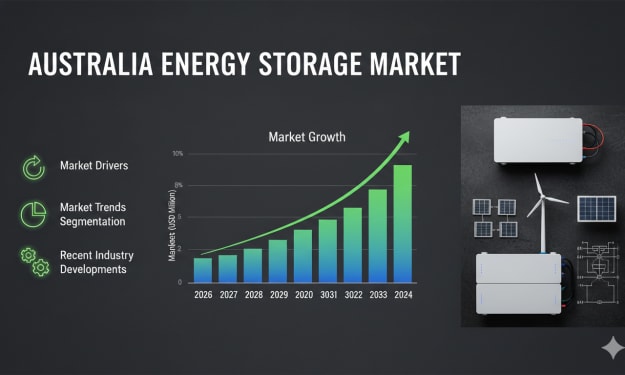
According to IMARC Group, the Australia energy storage market reached 4.72 GW in 2025 and is projected to expand significantly to 19.81 GW by 2034, exhibiting a compound annual growth rate (CAGR) of 17.28% during 2026–2034. The rapid growth of the sector reflects the country’s accelerating transition toward renewable energy and the increasing need for reliable electricity systems across Australia. As solar and wind power generation expands, energy storage technologies such as battery energy storage systems (BESS) are becoming essential for maintaining grid reliability and balancing electricity supply and demand. Government policies supporting clean energy adoption, declining battery costs, and investments in grid modernization are significantly strengthening Australia energy storage market share while enabling the integration of renewable power into the national electricity network.
By Shrestha Roy6 days ago in Futurism
Microencapsulation Market Outlook: Controlled Release Technologies and Application Expansion Opportunities
According to IMARC Group's latest research publication, the global microencapsulation market size reached USD 11.3 Billion in 2024. Looking forward, IMARC Group expects the market to reach USD 22.1 Billion by 2033, exhibiting a growth rate (CAGR) of 7.38% during 2025-2033.
By James Whitmanabout 8 hours ago in Futurism
Silken Chains
Silhouettes of the female form were given flesh and bone. Silken skin glistened under the spotlight. Dry ice rose around our Icons as they danced atop their podiums in the Square. Heralded for their beauty, their movements were slight, powerful, and sensual.
By Paul Stewart5 days ago in Fiction



Comments
There are no comments for this story
Be the first to respond and start the conversation.