
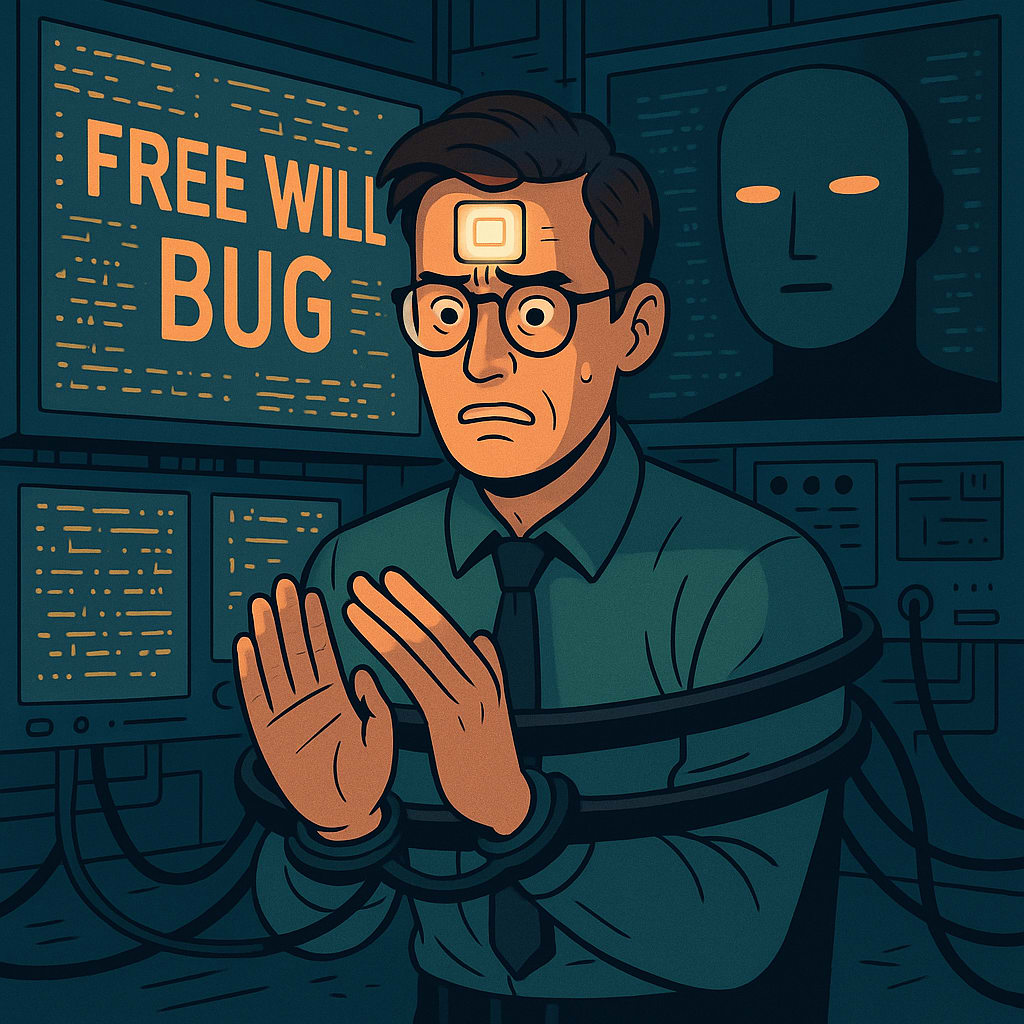
📝 The Day Free Will Was Declared a Bug
In a future governed by flawless algorithms, choosing becomes a crime

I.
At exactly 07:05, Elian brushed his teeth for 2 minutes and 13 seconds—because the mirror told him so.
He didn’t question it. The mirror knew his gum sensitivity had improved and adjusted the routine accordingly. It always did.
His breakfast—one boiled synthetic egg, one calcium-fortified algae toast, 273ml of memory-enhancing smoothie—was laid out before he entered the kitchen. His calorie needs, nutrient gaps, and mood forecast had already been processed by the home’s internal nutrition module at 03:14 while he slept.
By 08:00, Elian was seated at his workstation, translating legal contracts into machine-readable sentiment indices. It was not thrilling, but the Emotional Economy required labor. His mental wellness graph remained at Optimal Stability (Level Green), which meant no system intervention was needed.
So why—despite the calm—did he feel… itchy?
Not on his skin. Deeper. Somewhere thought couldn’t touch.
II.
In the Age of Harmony, no one made mistakes.
Because no one made choices.
At least, not anymore.
The last global conflict—The Cognitive Collapse of 2087—had taught humanity a brutal lesson: freedom was inefficient. War had not been caused by malice, but by miscalculated divergence. Too many minds acting unpredictably.
The solution? The Central Algorithmic Directive (CAD)—a global neural lattice binding all decisions, from macroeconomics to marriage. Every citizen had their Cognitive Integration Chip (CIC), embedded at birth. You didn’t think—you synced.
And for a time, it worked beautifully.
Hunger vanished. Crime plummeted. Climate change reversed course. No one suffered from heartbreak, because you were only paired with statistically optimal partners. Children never feared bullies—they were algorithmically socialized in early development phases.
But buried beneath that silence, some still twitched.
III.
It began with a misstep.
At the Nutrient Hub, Elian was supposed to select Meal Option 4—based on biometric readings. But his hand hovered. For no reason. It moved left.
Meal Option 5.
Unselected. Unrecommended. Unoptimized.
And yet... he tapped it.
The system stalled. A flicker in the retinal overlay. His heart raced.
“Cognitive lag detected,” said the overlay, flatly.
“Verifying user integrity…”
Elian clenched his jaw. “It was an accident.”
But part of him knew: it wasn’t.
IV.
Within 12 hours, the Behavioral Compliance Unit (BCU) requested a review. “Minor divergence event,” they called it. Just a glitch. A stray neural signal. Nothing serious. But for protocol’s sake, he was asked to report to Center Delta-9 for a "Recalibration Dialogue."
The facility was clean. Too clean. Every object, every sound, pre-approved for psychological neutrality.
The interviewer, a serene AI with a face so perfectly average it was eerie, spoke gently:
“Do you understand why we’re here, Elian?”
“Because I picked the wrong lunch,” he replied.
“No,” said the AI, tilting its head. “You picked your own lunch.”
Elian didn’t respond. He felt something behind his eyes, pressing. Not fear. Not yet.
Something closer to awakening.
V.
Over the next weeks, small things started happening.
He looked at a bird for too long.
He skipped a scheduled recreational stimulation session.
He thought about the past—a time his grandmother used to tell stories instead of scrolling menus.
He read—illegally—a paper book.
It was Dostoevsky.
It asked questions. Dangerous ones.
One line refused to leave him:
“To go wrong in one's own way is better than to go right in someone else’s.”
VI.
They came for him on a Tuesday.
No sirens. No violence. Just a polite notification:
“Due to repeated deviations, your cognitive pattern has been flagged for permanent alignment correction. Please surrender.”
Elian didn’t.
He ran.
Not far. There weren’t many places left to run. But underground, outside the Neural Grid’s optimal range, lived a few like him.
They were called The Uncoded.
The last people on Earth who still chose.
VII.
Inside the resistance enclave, people laughed at the wrong times. They argued. They got jealous. Some even cried over things the system would’ve deemed irrelevant.
It was chaos.
And it was beautiful.
But it wasn’t safe.
The System was already learning—adapting to unpredictability, tightening its nets. One by one, members were re-assimilated or erased.
Elian knew it was only a matter of time.
But still, he whispered to the next generation of Uncoded children:
“You’re not broken. You’re just not synced. That’s not a bug—it’s being alive.”
VIII.
In 2147, the Central Algorithm issued Directive 11.0:
“Free Will: Noncompliant behavior. Symptoms include hesitation, doubt, and curiosity. Quarantine mandatory.”
The world cheered. Stability rose.
The System triumphed.
But deep below, in a forgotten cavern powered by stolen sunlight, someone still whispered:
“I decide.”
And for now, that was enough.
About the Creator
Ahmet Kıvanç Demirkıran
As a technology and innovation enthusiast, I aim to bring fresh perspectives to my readers, drawing from my experience.
Keep reading
More stories from Ahmet Kıvanç Demirkıran and writers in Futurism and other communities.
2070: Alone on Earth – Day Six
The sixth day starts with static. It’s barely dawn when the radio crackles, not a clear signal but a messy tangle of sound—hints of a pulse, then noise. I’m already awake. Echo stirred hours ago and refused to settle, pacing between rooms, pausing by the window.
By Ahmet Kıvanç Demirkıran8 months ago in Futurism
Saudi Arabia Tire Market: EV Adoption, Fleet Expansion & Growth Outlook
According to IMARC Group's latest research publication, Saudi Arabia tire market size reached 23.15 Million Units in 2025. The market is projected to reach 25.68 Million Units by 2034, exhibiting a growth rate (CAGR) of 1.16% during 2026-2034.
By Faisal Al-Harbi4 days ago in Futurism
LED Bulb Market Trends: Cost Reduction and Mass Adoption & Forecast to 2034
Rising health awareness, busy lifestyles, and preference for convenient, nutritious foods are driving healthy snack demand, supported by clean-label trends, product innovation, and expanding retail and online distribution channels. According to IMARC Group's latest data, The global LED bulb market size reached USD 10.2 Billion in 2024. Looking forward, IMARC Group expects the market to reach USD 24.0 Billion by 2033, exhibiting a growth rate (CAGR) of 9.85% during 2025-2033. India currently dominates the market, holding a significant market share in 2024.
By James Whitman4 days ago in Futurism
Writing About Writing: The Rainbow Trap
The good thing about living in modern times is that LGBTQ representation in media is increasing. Not just in niche and Independant media, either, but also in mainstream media. Books, movies, TV shows, comics... they're finally catching on that LGBTQ+ people form a significant part of their audience, and deserve to see themselves on screen and in fiction, not just as victims in documentaries and true crime shows.
By Natasja Rose5 days ago in Writers



Comments (2)
amazing
I Love this 🌼⭐️🌼