
The 500,000-Year-Old Spark Plug: The Artifact That Proves Pre-Flood Industrialization?
On February 13, 1961, three prospectors found an object that could rewrite human history. Then, it vanished.


In my work investigating the secret history of the world, I've learned one crucial lesson: our official timeline is fragile. It’s a story we tell ourselves, built on a carefully curated set of "acceptable" facts. Anything that doesn't fit is labeled a hoax, a misidentification, or is simply… lost.
But what if an object was so blatant, so undeniable, that it threatened the entire foundation of modern archaeology? What if we found something that proved, without a shadow of a doubt, that an industrial civilization existed half a million years before our own?
We did.
It was found on a remote mountaintop in California. It was X-rayed, studied by a geologist, and then it disappeared. This is the story of the Coso Artifact, an object that should not exist, and one that the academic world desperately wants you to forget.
The Official Discovery
The official story begins, as it often does, by accident. On February 13, 1961, Wallace Lane, Virginia Maxey, and Mike Mikesell were prospecting for geodes near Olancha, California, in the Coso Mountains. They ran a small gift shop and were looking for interesting mineral specimens to sell.
Among their haul was a particularly hard, heavy rock. The next day, back at their shop, Mikesell prepared to cut it, expecting a hollow, crystal-filled cavity. Instead, his diamond-tipped saw blade snapped in two. Inside the rock, which was not a hollow geode but a solid nodule of hardened clay, was something impossible. Embedded in the center was a perfectly cylindrical object made of white porcelain. In the very middle of the porcelain was a 2-millimeter shaft of bright metal. Surrounding this core was a copper-casing, and fragments of what appeared to be an outer hexagonal casing, as if it had once been a nut or bolt.
The three prospectors were baffled. The object looked for all the world like a modern spark plug. But how did it get inside a rock that, by all appearances, was ancient?
The story gets stranger. A geologist, whose identity is now debated but was named at the time as Virginia Maxey (one of the discoverers, who also had geological training), was called in to examine the find. She studied the rock, the fossil inclusions in its outer layer, and the visible stratification.
Her conclusion was explosive: the rock, based on the fossils of ancient sea life encrusting it, was at least 500,000 years old.
The Skeptical Explanation
Before we go further, we must address the "official" explanation. When the story gained traction in fringe magazines, the mainstream scientific community was forced to respond. Their conclusion was swift and dismissive.
According to skeptics, the artifact is not a half-million-year-old piece of lost technology. It is, they claim, a 1920s-era "Champion" spark plug.
They argue that the "rock" is not an ancient geode at all, but a "concretion." A concretion is a mass of mineral matter that can form relatively quickly (in decades, not millennia) around a metal object through electrochemical processes. They propose that a modern spark plug from an old mining engine or vehicle simply fell to the ground, was covered in mud, and the iron-oxide solution in the soil formed a hard, rock-like nodule around it.
This, they claim, explains everything: the object looks like a spark plug because it is a spark plug. The "ancient fossils" on the exterior were dismissed as misidentified contaminants or simple marine invertebrate shells that got stuck in the mud. It's a neat, tidy explanation. It requires no rewriting of history. It puts the anomaly back in its box.
If the story ended there, it would be nothing more than a curious footnote. But it doesn't.
The Anomalies That Defy The Official Story
This is where the official narrative breaks down. When you dig deeper, the "tidy explanation" becomes the most unlikely of all.
Anomaly 1: The X-Rays
In 1969, the artifact was famously X-rayed by Ron Calais. The resulting images confirmed that it was, indeed, a man-made mechanical device. The porcelain, the metal core, and the copper components were all clear. But the X-rays revealed something the skeptics never talk about.
At the top of the device, the X-ray showed a tiny, intricate metallic spring or helix. This component is not found in any 1920s-era Champion spark plug. In fact, it doesn't match any known model of spark plug, past or present. The internal structure, while similar to a spark plug (a simple electrical insulator and conductor), possessed a level of complexity at the top that baffled engineers.
The X-rays proved it was man-made. They also proved it was not the common Champion plug the skeptics use for their entire argument.
Anomaly 2: The Geologist's Report
The claim that Virginia Maxey, a trained geologist, mistook a 40-year-old mud concretion for a 500,000-year-old fossil-bearing rock is, frankly, insulting.
Her half-million-year-old estimate was not a guess. It was based on the geological stratum in which the nodule was found (the Coso Mountain range is ancient) and the specific fossilized marine life she identified on its surface. The location itself, at over 4,000 feet, was an ancient lakebed.
For the skeptic's theory to be true, you must believe that a 1920s spark plug was dropped, formed a concretion which also happened to perfectly embed ancient marine fossils, and was then found by a geologist who was so incompetent she couldn't tell the difference between a 40-year-old mud ball and a 500,000-year-old geode. The simpler explanation is that the geologist was right. The rock was ancient.
Anomaly 3: The Vanishing
Here is the most damning fact of all. Where is the Coso Artifact today? It's gone. After being displayed in the discoverers' gift shop for several years, it was reportedly sold to an unknown collector. Its last known location was in the possession of Wallace Lane, who, by the 1990s, refused to speak about it. After his death, the artifact vanished from his belongings.
This is the nail in the coffin of the skeptic's argument. If the Coso Artifact was so obviously a 1920s spark plug, why would it be hidden? Why not have it on display in a museum as a "Case Study in Pseudoscience"? Why wouldn't the skeptics who "solved" the mystery parade it around as proof of their intellect?
You don't hide evidence that proves you right. You hide evidence that proves you wrong.
The Mystic's View
As an investigator of our planet's hidden history, the Coso Artifact is not a mystery to me. It is a "data point." It is another piece of a grand, terrifying puzzle. It belongs to a category of objects we call "OOPArts," or Out-of-Place-Artifacts.
These are objects that prove the "Scholar" narrative of history is wrong. They include: The Antikythera Mechanism: An impossibly complex astronomical computer found in an ancient Greek shipwreck, with technology that shouldn't reappear for 1,500 years.
The 120-Million-Year-Old Map: The "Dashka Stone" found in Russia, a 3D relief map of the Ural mountains so precise it could only have been made with aerial or satellite data, yet dated to 120 million years old.
The Piri Reis Map: A 1513 map that shows the coast of Antarctica... without ice. The last time Antarctica was ice-free was at least 6,000 years ago.
The Coso Artifact is, in my opinion, the most dangerous of them all. The others show high knowledge (astronomy, cartography). The Coso Artifact proves high technology. It proves industrialization.
A spark plug, or whatever this device truly is (an antenna? a capacitor? a power source?), implies engines, manufacturing, and industry. It implies a civilization with a technological level equal to, or perhaps different from, our own. The half-million-year date places it squarely in a pre-cataclysmic world. A world before the last great ice age, before the Younger Dryas impact, before the global floods that are recorded in every culture's mythology.
We are not the first. We are merely the civilization that survived the last "reset."
The Coso Artifact is not a product of our timeline. It is a relic, a piece of industrial shrapnel from a forgotten epoch, a message in a bottle from a world that was buried under half a million years of rock and time, only to be found by three lucky prospectors on a mountaintop.
The Prison of Our Timeline
Why does a 500,000-year-old spark plug matter?
It matters because it is a key. It unlocks the prison of our perceived timeline. The official story, that we evolved from mud huts to smartphones in a neat, linear progression, is a lie. It's a comfortable lie, one that makes us feel safe, smart, and the apex of creation. The truth is far more humbling. We are a species with amnesia.
The disappearance of the Coso Artifact is the real story. It proves that there are forces at play dedicated to maintaining the lie. Academia, governments, and museums are the guardians of the official narrative. Their power rests on their being the sole authorities on history. An object like this undermines their entire structure. So, they dismiss it. And when that fails, they "lose" it.
But we do not have to accept their story. The real history is out there, waiting in the rocks, in the deep oceans, and in the "myths" we were taught to ignore. We must stop asking for permission to be curious. We must become the detectives ourselves.
The Csso Artifact is gone, but its story is not. It asks us one simple question:
Do you believe the rock, or do you believe the historians who are paid to tell you the rock is impossible?
About the Creator
The Secret History Of The World
I have spent the last twenty years studying and learning about ancient history, religion, and mythology. I have a huge interest in this field and the paranormal. I do run a YouTube channel
Keep reading
More stories from The Secret History Of The World and writers in Futurism and other communities.
Volume 7: After the Sky Opens: Life in the First Days of Disclosure
Life in the First Days of Disclosure The moment humanity has waited for will not arrive with fanfare or fireworks. It will come with silence broken by a collective gasp, a shockwave of realization that spreads not from governments or generals, but from the people who look to the sky and understand that everything has changed. Disclosure will not be the end of a mystery; it will be the beginning of a reckoning. And what follows in the days, weeks, and months after will test the very soul of humanity.
By The Secret History Of The WorldExclusive • 5 months ago
Europe Remote Patient Monitoring Market Set to Surpass USD 11.22 Billion by 2030 as Virtual Care Becomes Central to Healthcare Transformation
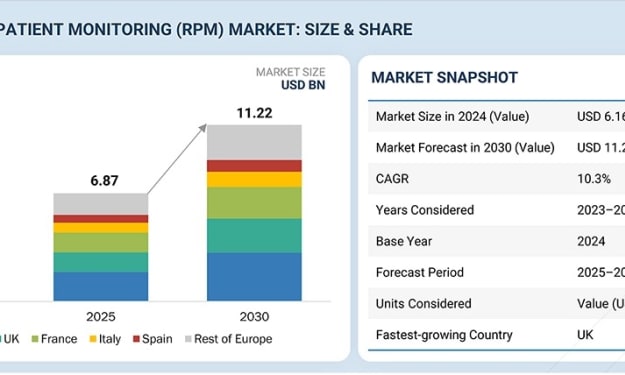
The Europe Remote Patient Monitoring (RPM) market is entering a decisive phase of expansion as healthcare systems pivot toward preventive, community-based, and digitally enabled care models. Valued at USD 6.87 billion in 2025, the market is projected to reach USD 11.22 billion by 2030, growing at a CAGR of 10.3% from 2025 to 2030. This growth reflects rising investment in home-based care, strengthening cross-border digital health infrastructure, and increasing demand from providers for real-time patient data to enable early intervention, reduce readmissions, and ensure continuity of care across decentralized settings.
By Juan Martinez7 days ago in Futurism
Digital Asset Management Market: AI Tagging, Fast Content Retrieval & Growth Trends
Rapid growth in digital content, remote work adoption, and omnichannel marketing is driving expansion of the digital asset management market. Organizations require centralized platforms to store, organize, and distribute media efficiently. Rising focus on brand consistency, workflow automation, and content security supports adoption. According to IMARC Group's latest research publication, The global digital asset management market size was valued at USD 7.73 Billion in 2025. Looking forward, IMARC Group estimates the market to reach USD 31.99 Billion by 2034, exhibiting a CAGR of 15.26% from 2026-2034.
By James Whitman7 days ago in Futurism


Comments
There are no comments for this story
Be the first to respond and start the conversation.