

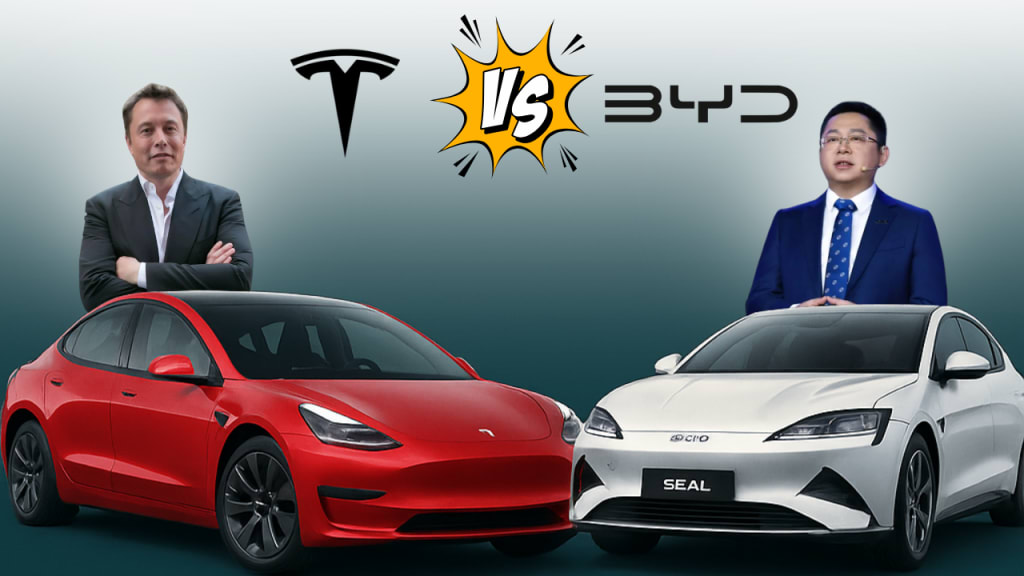
In the high-voltage world of electric vehicles (EVs), two titans are currently sparring for global dominance: Tesla and BYD (Build Your Dreams). On one side is Elon Musk’s iconic brand, a pioneer that revolutionized the EV landscape with sleek, tech-savvy cars and futuristic visions. On the other is BYD, the Chinese powerhouse backed by Warren Buffett, carving out a massive slice of the market with affordability, innovation, and scale. This isn’t just a corporate competition—it's a clash of philosophies, strategies, and ambitions.
Market Showdown: BYD Surges Ahead
Tesla may have ignited the modern EV movement, but BYD has come roaring into the spotlight. In Q1 2025, BYD recorded over one million NEV sales (including plug-in hybrids), with fully electric vehicles hitting 416,388 units. Even more striking, BYD outpaced Tesla in Europe for the first time in April 2025, boasting a stunning 359% year-on-year increase in registrations.
In contrast, Tesla’s sales growth appears more modest. While it still leads in BEV (battery electric vehicle) dominance, Tesla saw just 6% growth in the UK, while BYD exploded with 625% in the same period. These numbers are a clear sign that the global EV crown is no longer Tesla’s alone—it’s a heated race, and BYD is in pole position in many markets.
Price Wars: Premium vs. Practical
One of the key battlegrounds in this rivalry is pricing. Tesla has always positioned itself as a premium brand. Models like the Tesla Model 3 start at around $38,000, appealing to buyers looking for performance and luxury.
BYD, however, is flipping the script. Their entry-level cars—like the Seagull and Dolphin—start as low as $11,000 to $18,000 in China. That’s not just competitive—it’s disruptive. Even BYD’s higher-end vehicles, such as the Seal, remain well below Tesla’s pricing. This affordability, combined with improving tech and design, is helping BYD tap into a wider, budget-conscious customer base, especially in emerging markets.
Battery Brains: Blade vs. 4680
When it comes to the beating heart of EVs—the battery—both companies have taken different paths, each with its own advantages.
BYD’s Blade Battery uses LFP (Lithium Iron Phosphate) chemistry, known for being cheaper, safer, and longer-lasting. Blade batteries are also catching up in charging performance—some versions can gain 400 km of range in just five minutes.
Tesla’s advanced 4680 cells, on the other hand, are built on NMC/NCA (nickel-based) chemistry, offering higher energy density and therefore longer range. Tesla still holds a slight edge here—its Model 3 Long Range claims 358 miles (EPA estimated), compared to BYD’s Seal Extended Range at 342 miles (CLTC estimated). However, keep in mind that CLTC estimates tend to be more optimistic than the EPA’s conservative testing.
In terms of battery design, BYD aims for cost efficiency and space optimization, while Tesla emphasizes performance and energy density—another example of their diverging priorities.
Autonomy and Intelligence
Autonomous driving is another area where Tesla and BYD are pushing boundaries—but at different speeds.
Tesla leads with its Full Self-Driving (FSD) system, backed by its massive Dojo supercomputer. It’s aiming for Level 4 autonomy, though regulatory approvals remain a hurdle. Tesla’s approach is vision-based, heavily reliant on AI and real-world data.
BYD, meanwhile, is investing heavily in its own ADAS tech. Its systems—like DiPilot 300 and God’s Eye (launched in 2024)—use LiDAR, radar, and HD mapping. While BYD’s autonomy currently hovers around Level 2+ or near Level 3, the company is rapidly advancing. Their focus on combining sensor-based data and affordability is closing the gap faster than many expected.
Charging and Infrastructure: Tesla’s Stronghold
Tesla still dominates the charging infrastructure game with its globally recognized Supercharger network—fast, reliable, and everywhere. This is a major edge, particularly in Western markets where charger availability is often a concern.
BYD offers fast charging capabilities as well, but lacks an equivalent proprietary network outside China. However, partnerships and government support in countries like Thailand, Brazil, and even parts of Europe are helping expand its reach.
Interior and Experience
Tesla’s design is famously minimalist—a single central screen controls nearly everything. While this gives a futuristic feel, it has drawn criticism for lack of tactile controls and occasional build quality issues.
BYD goes a different route. Their interiors are more conventional and comfort-focused, with high-quality materials, tactile buttons, and smart infotainment. In fact, BYD has won praise for delivering luxury touches in surprisingly affordable packages. The company’s attention to detail in build quality and passenger comfort is helping win over traditional car buyers.
Warranty Confidence
Warranty offerings can often signal how confident a brand is in its products. BYD offers a generous 6-year/93,750-mile standard warranty in markets like the UK, with 8-year/125,000-mile coverage for batteries. Tesla’s warranty is slightly less—4 years/60,000 miles on the vehicle and 8 years on the battery, varying by model.
Conclusion: A Battle of Philosophies
Tesla vs. BYD is no longer David vs. Goliath—it’s Goliath vs. Goliath. Tesla remains the poster child for EV innovation, but BYD is proving that mass adoption and affordability can be just as powerful as cutting-edge tech.
Tesla excels in range, autonomy, and ecosystem sophistication. But BYD wins in affordability, diversity, and sheer sales momentum—especially in the world's largest auto market: China.
As the EV race accelerates, one thing is clear: the real winners will be consumers, who now have more choices than ever. Whether you want a high-performance, high-tech experience or a practical, budget-friendly ride, the EV revolution is now truly a global phenomenon—and it’s just getting started.
Tesla vs BYD — Who’s Winning the EV Race? Enjoyed the read? Leave a comment, share your thoughts, and follow for more tech and EV insights!
About the Creator
Det. Marcus
I'm a reporter, detective, YouTuber, and article writer based in Florida with 7+ years of experience. Since 2017, I've been uncovering stories, creating engaging content, and delivering unique perspectives across multiple platforms.
Keep reading
More stories from Det. Marcus and writers in Futurism and other communities.
DeepSeek vs. American Economy
DeepSeek vs. American Economy: The Battle for AI Dominance The rapid advancement of artificial intelligence (AI) is reshaping global economies, and at the forefront of this battle is China’s DeepSeek AI and the American economy, which thrives on tech innovation. This competition highlights the strategic, economic, and technological struggles between the two global superpowers.
By Det. Marcusabout a year ago in Futurism
Plant-Based Food Market: Growth, Trends, and Future Outlook
Overview: Plant-Based Food Market The global plant-based food market is rapidly growing as consumer preferences shift toward healthier, sustainable, and ethical eating habits. From meat and dairy alternatives to ready-to-eat plant-based meals, this market includes products derived primarily from vegetables, legumes, grains, nuts, and seeds that replace or supplement traditional animal-based foods. Driven by rising health consciousness, environmental concerns, and widespread flexitarian adoption, plant-based foods are moving from niche specialty aisles into mainstream retail and foodservice channels worldwide.
By James Smith3 days ago in Futurism
Off the Book
It ended like every other stupid idea. Badly, and alone. I’m researching digital confession ethics, he said. A tech ethicist. He gestured at floating data I couldn’t see then pulled out a physical notebook. Actual paper, fountain pen. He held it up like he was showing me scripture.
By Nicky Frankly4 days ago in Fiction




Comments (2)
BYD's rise in the EV market is impressive. Their growth in Europe and lower prices are shaking things up. I wonder how Tesla will respond. Will they cut costs or double down on luxury? And how will BYD keep innovating to stay ahead? This battle's far from over.
Great article! The Tesla vs. BYD showdown highlights how innovation and affordability are reshaping the EV market. It’s fascinating to see how both companies excel in different areas, pushing the industry forward and giving consumers more choices than ever before. Excited to see how this rivalry evolves!