
Supply Chain Analytics Market Overview: Digital Transformation, Cost Efficiency & Industry Outlook to 2033
Analyzing how digital transformation initiatives accelerate analytics investments, improve operational intelligence, and drive competitive advantage through smarter supply chain management.

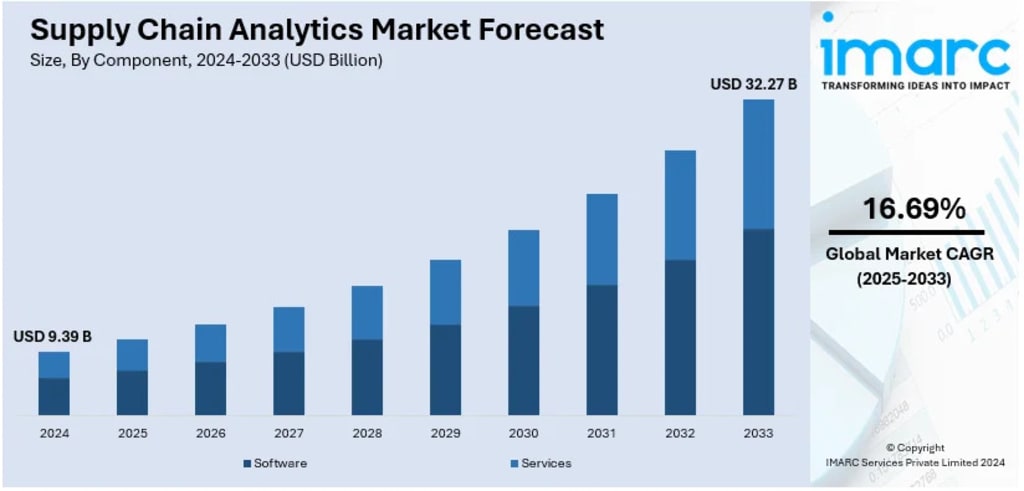
Integrating advanced data tools into logistics operations is no longer just a luxury for tech giants; it’s a survival requirement in today’s volatile global economy. By turning massive amounts of raw data into clear, actionable insights, businesses are moving away from reactive firefighting toward proactive, resilient planning. According to IMARC Group’s latest data, The global supply chain analytics market size was valued at USD 9.39 Billion in 2025. Looking forward, IMARC Group estimates the market to reach USD 32.27 Billion by 2033, exhibiting a CAGR of 16.69% from 2025-2033.
Supply chain analytics now represent a multi-billion-dollar global market exceeding USD 6 billion and exhibiting steady year-on-year expansion. Demand is driven by rising complexities in global logistics, the urgent need for cost optimization, and the rapid adoption of cloud-based AI solutions. Companies are increasingly investing in predictive and prescriptive tools to navigate port congestions, fluctuating fuel prices, and shifting consumer demands. Major segments include inventory analytics, demand planning, and transportation tools, with enterprises prioritizing real-time visibility and end-to-end transparency to maintain a competitive edge in a digital-first world.
Download Your Free “Supply Chain Analytics Market” Market Outlook
Supply Chain Analytics Market Growth Drivers:
- Rising Need for Real-Time Visibility and Transparency
In an era of global disruptions, companies are moving away from siloed data toward unified visibility. Supply chain analytics allow managers to track shipments and inventory levels in real-time, preventing costly delays. The market, currently valued at over USD 6.5 billion, is seeing a surge in demand for "control tower" solutions that offer a 360-degree view of operations. By identifying bottlenecks before they escalate, businesses can maintain customer trust and operational flow. This transparency is crucial for modern high-velocity retail and manufacturing environments where every minute of downtime impacts the bottom line.
- Growing Complexity of Global Logistics Networks
As businesses expand across borders, managing multiple suppliers, carriers, and regulatory requirements becomes increasingly difficult. Supply chain analytics simplify this complexity by synthesizing data from diverse sources into manageable insights. With the industry reaching a valuation of approximately USD 6.5 billion, the focus has shifted toward mitigating risks like geopolitical instability and climate-related shipping delays. Companies utilize these analytical tools to map out alternative routes and optimize multi-modal transportation, ensuring that goods move efficiently despite external pressures. This driver is particularly influential in the electronics and automotive sectors where precision is paramount.
- Integration of AI and Machine Learning for Demand Forecasting
Modern businesses are replacing traditional spreadsheets with AI-driven forecasting to predict consumer behavior with high accuracy. These tools analyze historical sales, social media trends, and even weather patterns to optimize stock levels. The global supply chain analytics sector, standing at USD 6.5 billion, benefits significantly from this shift, as accurate forecasting reduces the "bullwhip effect" and minimizes waste. Real-world applications include grocery chains using predictive models to manage perishables, ensuring fresh stock while reducing markdowns. This technological evolution allows firms to meet sudden demand spikes without overextending their capital in unsold inventory.
Supply Chain Analytics Market Trends:
- Shift Toward Cloud-Based SaaS Analytics Platforms
Enterprises are rapidly migrating their logistics data to cloud-based environments to ensure scalability and remote accessibility. These Software-as-a-Service (SaaS) models allow even small and medium enterprises to access powerful analytical tools without massive upfront infrastructure costs. The global market, valued at roughly USD 6.5 billion, is seeing a trend where cloud deployments dominate new installations. This shift supports a mobile workforce, enabling warehouse managers and procurement officers to access critical data via tablets or smartphones. It fosters a culture of collaborative decision-making that is essential for reacting to fast-paced market changes and labor shifts.
- Increased Focus on Sustainability and Green Logistics
There is a growing trend of using analytics to measure and reduce the carbon footprint of logistics operations. Companies are leveraging data to optimize delivery routes, reducing fuel consumption and empty miles. Government initiatives, such as the European Green Deal, are pushing firms to report their environmental impact, making analytics an essential compliance tool. Within the USD 6.5 billion market landscape, sustainability-focused modules are becoming a standard requirement. These tools help brands align with eco-conscious consumer expectations by identifying more efficient packaging methods and sustainable shipping lanes, effectively blending profitability with environmental responsibility.
- Rise of Prescriptive Analytics for Risk Management
While predictive analytics forecast the future, prescriptive analytics go a step further by suggesting specific actions to mitigate risks. This trend is gaining massive traction as companies look for automated "what-if" scenario planning. Industry data reflects a growing appetite for these sophisticated tools within the USD 6.5 billion market, especially in the pharmaceutical and food sectors where safety is critical. For instance, if a strike is predicted at a major port, the system automatically suggests rerouting to a secondary hub. This proactive approach ensures business continuity and protects margins by automating complex problem-solving in high-pressure situations.
Recent News and Developments in Supply Chain Analytics Market
- January 2024: SAP SE announced the launch of new AI-driven capabilities within its Supply Chain Management suite, focusing on enhancing carbon footprint tracking and predictive maintenance for global logistics providers.
- March 2024: Oracle expanded its Cloud SCM offerings by integrating generative AI features designed to help procurement teams automatically identify alternative suppliers during regional trade disruptions.
- June 2024: Manhattan Associates introduced a unified supply chain platform that merges distribution, transportation, and labor management, providing retailers with a singular view of their entire fulfillment network.
- September 2024: Microsoft partnered with a leading logistics firm to deploy Azure-based analytics that utilize satellite data and IoT sensors to monitor the cold chain for high-value sensitive goods in real-time.
Note: If you require specific details, data, or insights that are not currently included in the scope of this report, we are happy to accommodate your request. As part of our customization service, we will gather and provide the additional information you need, tailored to your specific requirements. Please let us know your exact needs, and we will ensure the report is updated accordingly to meet your expectations.
About the Creator
Andrew Sullivan
Hello, I’m Andrew Sullivan. I have over 9+ years of experience as a market research specialist.
Keep reading
More stories from Andrew Sullivan and writers in Futurism and other communities.
Wealth Management Platform Market Insights: Client Experience, Automation & Industry Forecast to 2034
The rapid shift toward digital-first financial services, the rise of the tech-savvy millennial investor base, and a growing preference for automated, data-driven investment advice are steering the demand for wealth management platforms. These solutions are further supported by the integration of AI-driven analytics, a focus on regulatory compliance, and the expansion of hybrid advisory models. According to IMARC Group’s latest data, The global wealth management platform market size was valued at USD 6.10 Billion in 2025. Looking forward, IMARC Group estimates the market to reach USD 14.91 Billion by 2034, exhibiting a CAGR of 10.44% from 2026-2034.
By Andrew Sullivanabout 14 hours ago in Futurism
Web 3.0 Blockchain Market Outlook: Decentralized Internet Evolution and Growth Opportunities
According to IMARC Group's latest research publication, The global web 3.0 blockchain market size was valued at USD 5.3 Billion in 2025. Looking forward, IMARC Group estimates the market to reach USD 107.8 Billion by 2034, exhibiting a CAGR of 39.77% during 2026-2034.
By Michael Richard7 days ago in Futurism
PropTech Market Outlook: Digital Transformation in Real Estate and Growth Opportunities
According to IMARC Group's latest research publication, The global proptech market size reached USD 35.4 Billion in 2024. Looking forward, IMARC Group expects the market to reach USD 114.8 Billion by 2033, exhibiting a growth rate (CAGR) of 13.25% during 2025-2033.
By Michael Richarda day ago in Futurism
The Cairn Beside the Lake
And so it came to pass that King Ertharion, Tenth King of Lombaia, stood beside the still lake below unrelenting and unassailable cliffs with the remainder of his harried host. In what was the tenth year of his reign and his forty-fourth upon this great green earth, Menigo the Betrayer, cousin of King Ertharion, pressed home his false claim.
By Matthew J. Fromm6 days ago in Fiction



Comments
There are no comments for this story
Be the first to respond and start the conversation.